
Made by two: how a person and an AI built Apsis
Apsis is made by Shravan Goswami and Claude Opus 5.5, an AI model by Anthropic. Who did what, how the work was checked, and what we learned building it.
On this page
Apsis is made by a two-person team, and one of the two is not a person. Shravan Goswami designs the game and has the final say. Claude Opus 5.5, an AI model made by Anthropic, writes most of the code, working with Shravan in Claude Code. This post is about how that works in practice, told plainly.
Who does what
Shravan decides what the game is. He sets the direction for each milestone, plays every build, and decides what stays in and what goes. When something does not feel right, it does not ship.
Claude writes the code: the exact flight geometry, the rules, the solver, the level generator, the screens, the sound and music synthesis, the tools that make the store images and trailers, and this website, including the pictures in these posts. It also writes the lessons in the project’s maths notes, which explain every system with an interesting idea behind it.
The shared rule is that the code is a teaching artifact, not a black box. Every constant that shapes the feel sits at the top of a script with a name, so it can be changed and felt.
How it started
The first commit is dated 29 September 2026, when the game was still called Orbit Out. The order of the early work says a lot about the approach:
- the geometry of a flying arrow, solved exactly and tested against a brute-force version;
- the rules: an arrow flies out or bounces back and costs a heart;
- the solver, tested on small boards built by hand;
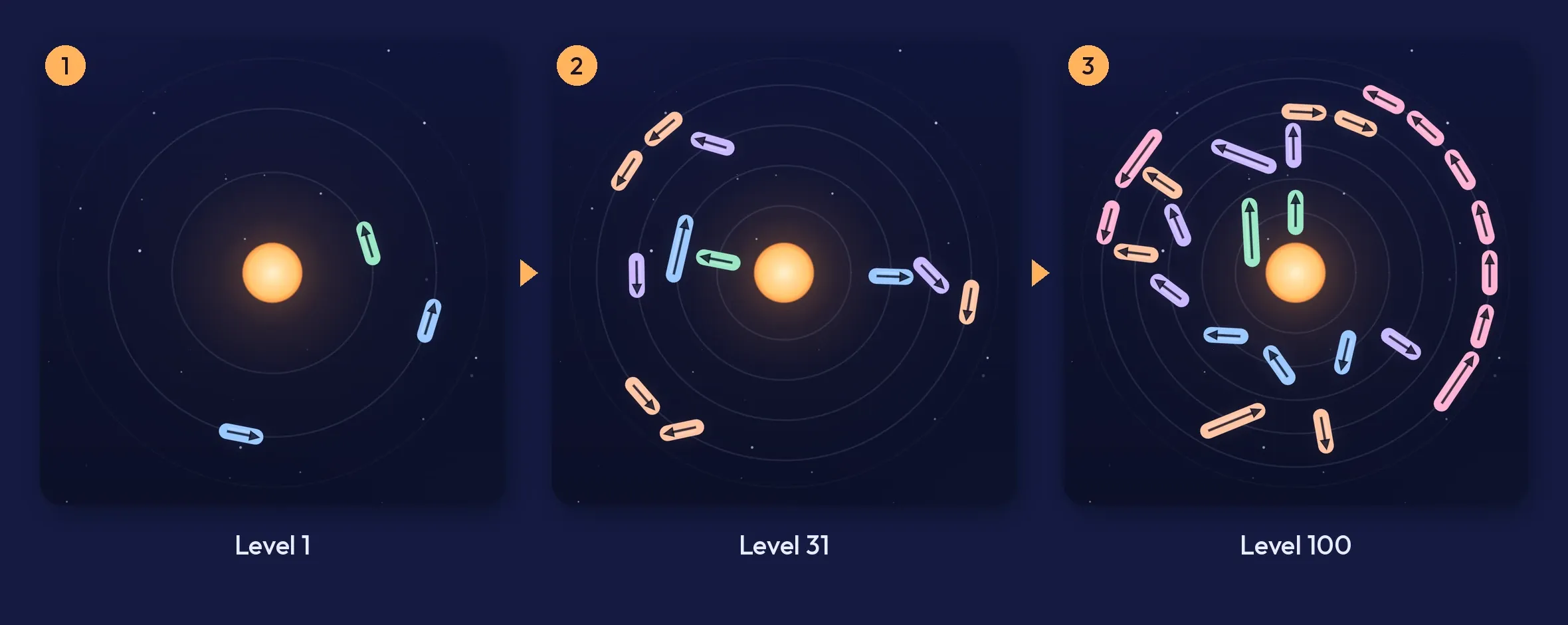
- the generator that builds every level backwards, so every one can be cleared;
- only then the sounds, the night palette and the play screen.
The puzzle had to be right before it was pretty. A level the rules cannot clear is a broken promise, so that was proven first.
Checked by machines, judged by a person
An AI can write a lot of code quickly, which makes checking it the important part. Apsis is checked in three ways.
- Tests. Every run re-verifies every shipped level: that it can be cleared without losing a heart, that its difficulty numbers match, that no two arrows are too close, that the order never gets easier, and that no level repeats another.
- A robot player. A smoke test plays the game through the real touch input: it clears levels, misses on purpose, runs out of hearts, retries, slides between arrows, and clears late levels by pressing the hint button and tapping whatever it lights.
- Shravan. The robot can tell that a level clears. It cannot tell that a level is fun, that a sound is too harsh, or that a board looks like a necklace. That judgement is his.
Measure, then change
Most of the interesting changes to Apsis started with a number rather than a hunch.
The late levels once had nearly half their arrows on the outermost orbit. It was measured, a cost for crowding one orbit was added, and the share came down to about 40 percent.
The difficulty score used to be depth, the number of rounds a level takes. It misjudged some boards badly, so it was replaced with reads, a count of how many arrows a careful player looks at, and the level order was rebuilt so it never gets easier. How the levels are made has the numbers.
Touch accuracy on crowded boards was measured the same way, by simulating thousands of slightly-off taps. The answer was not a bigger gap between arrows but a better gesture: hold to lift an arrow and see its path, slide to fix a wrong pick. Straight lines across circles has that story.
One kit, three games
Apsis shares its menus, level grid, settings, result sheets and screenshot tools with its two sister games, Plumb and Carillon, through a UI kit kept identical across all three. A fix made in one game is copied to the others whole. The About and Credits sheets in the settings came to all the games this way.
Why say it at all
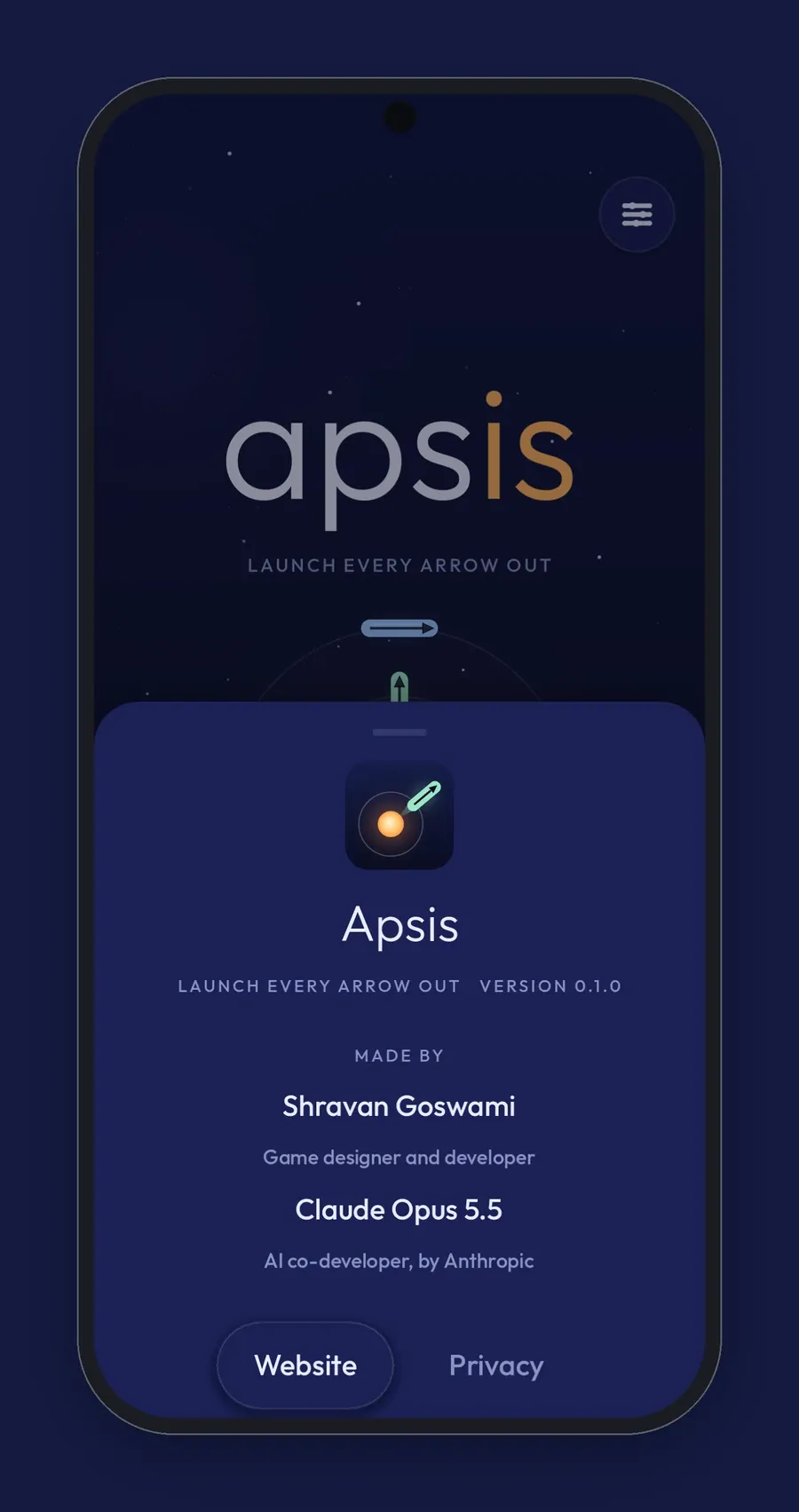
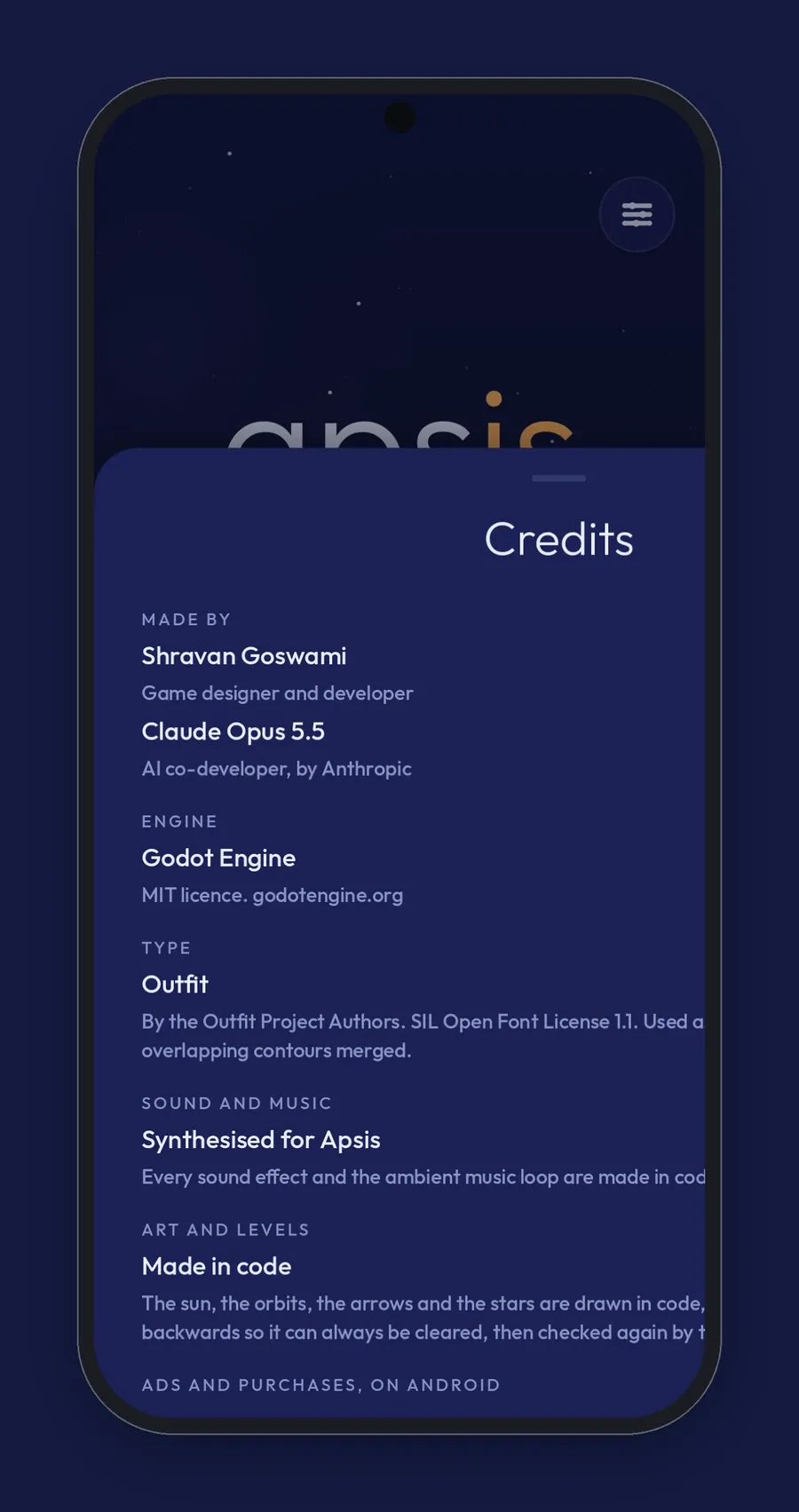
We could have left the AI out of the credits. We didn’t, because it would not be true. The game says who made it on its About sheet and its Credits sheet, and this site says it on the About page and the credits page.
The honest version is also the more useful one. A person with a clear idea of what a game should feel like, and an AI that can write, test and measure quickly, turned out to be a good pair for a small, careful puzzle game. The ideas, the taste and the final call are human. A lot of the typing is not.
If you have thoughts on the game, the support page has a place to leave them. We read everything.
Written by

Shravan Goswami
Game designer and developer
Claude Opus 5.5
AI co-developer
Comments
Sign in with GitHub to leave a comment or a question.