 Pyxis
The real constellations hiding in Pyxis
Some Pyxis webs are real constellations, from little Aries to Orion the hunter. How a figure from a star atlas becomes a level, and what happens when you clear one.
 , 3 min read
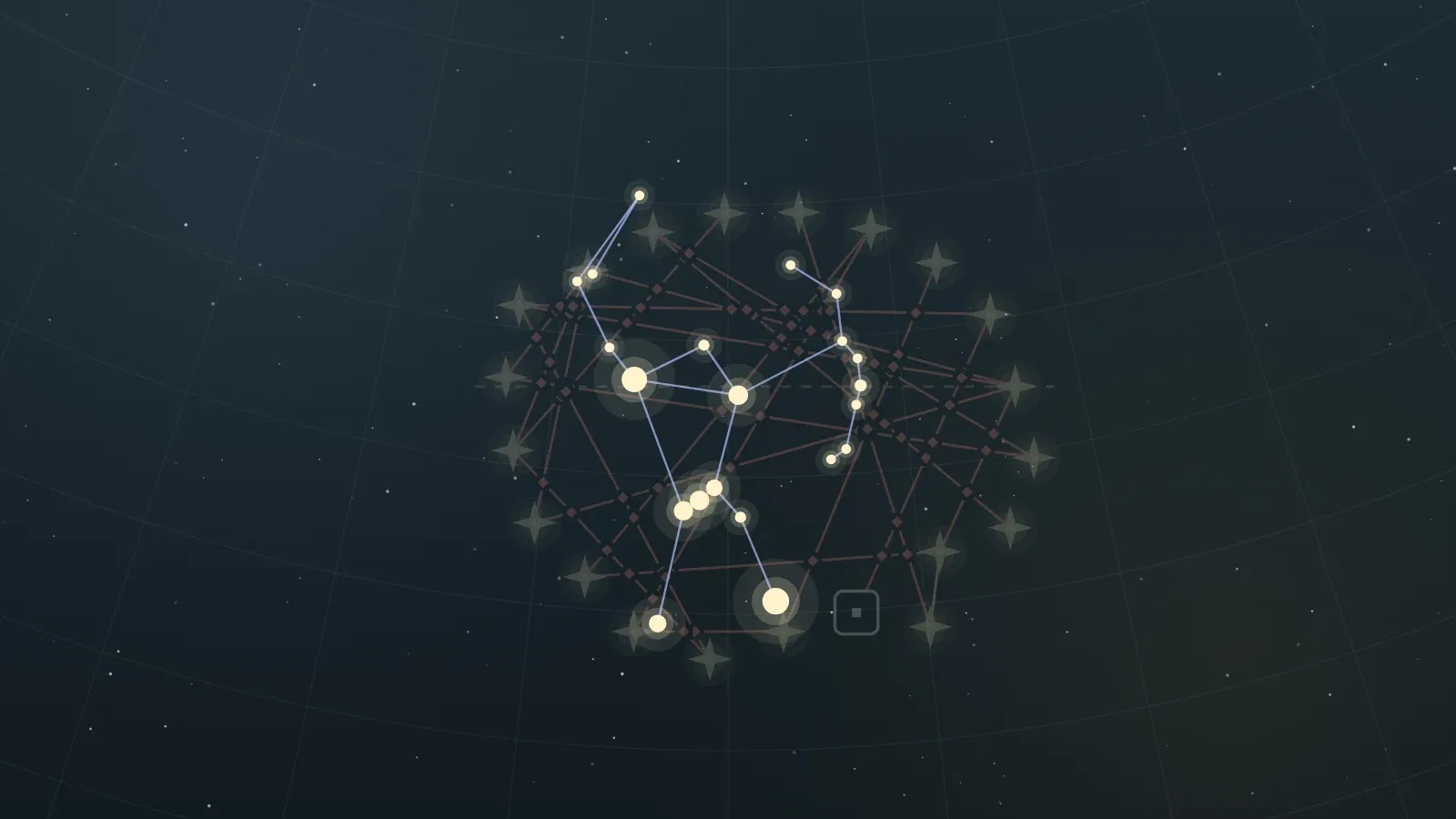
A cleared Pyxis web has always looked a bit like a constellation: a few points joined by straight lines with nothing crossing. So now some of them are. Every so often a level’s heading names a constellation instead of just a number, and its web is that constellation’s real figure.
Untangle the stars
A constellation level plays like any other. The knots are its stars and the strands are the lines of its figure, tangled the way its chapter tangles things. Clear it, and then the sky arrives. Night falls on the board, the knots fade into stars, each as large as it is bright, and they glide from wherever you left them to where they really are. The constellation’s name rises above them, and below them, what its figure shows: Aries, the ram, or Cygnus, the swan.
From a star atlas to a board
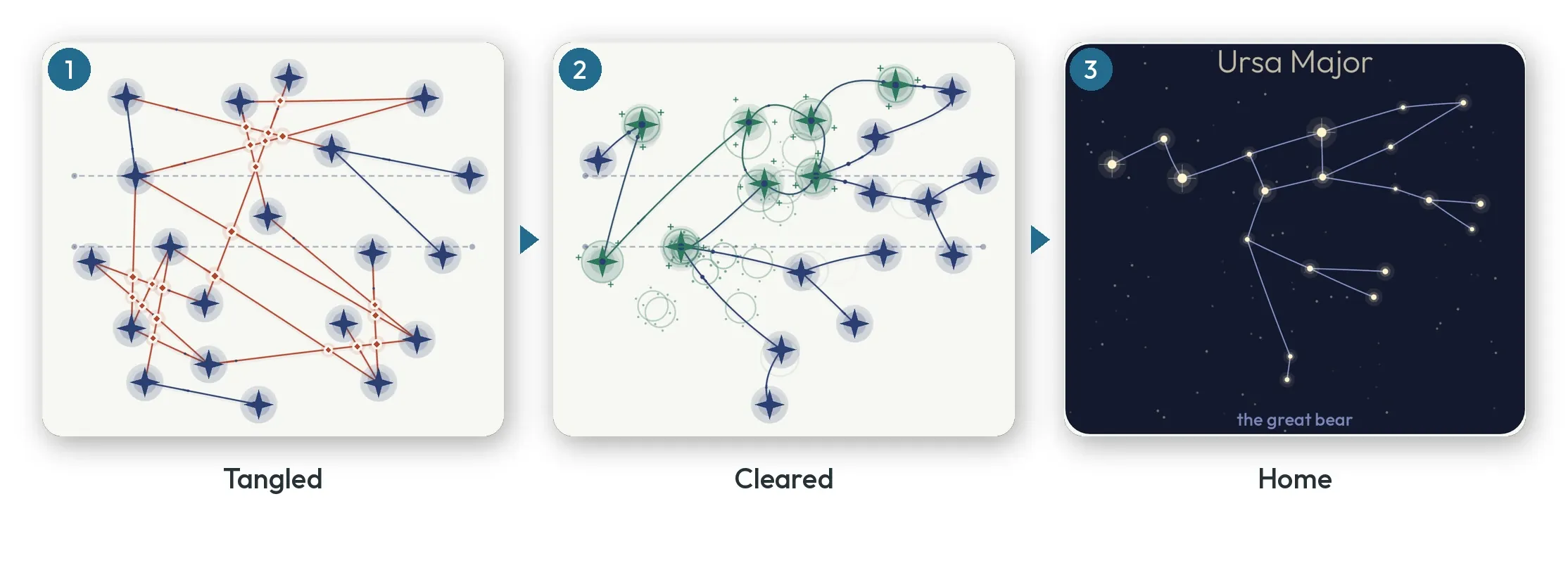
The figures come from an open star atlas, d3-celestial, which records the classic line drawing of every constellation and the brightness of its stars. Turning one into a level takes three steps.
Draw the chart. The stars are projected the way a star chart draws them, with north up and east to the left, as the sky looks when you face it overhead. The projection keeps straight lines straight, so the figure’s lines are still the straight strands Pyxis needs.
Make room for a finger. Real stars are often closer together than a fingertip can tell apart. Orion’s belt is three stars in a tight row, and Hydra’s head is a little knot of them. So the playable layout is spread out, one star at a time, never so far that two lines cross. The real chart is kept as it is for the moment the level is cleared.
Keep the big ones readable. A few figures have more stars than a phone screen can hold clearly. They lose their faintest stars along a straight run of the figure, so the shape survives with fewer points on it.
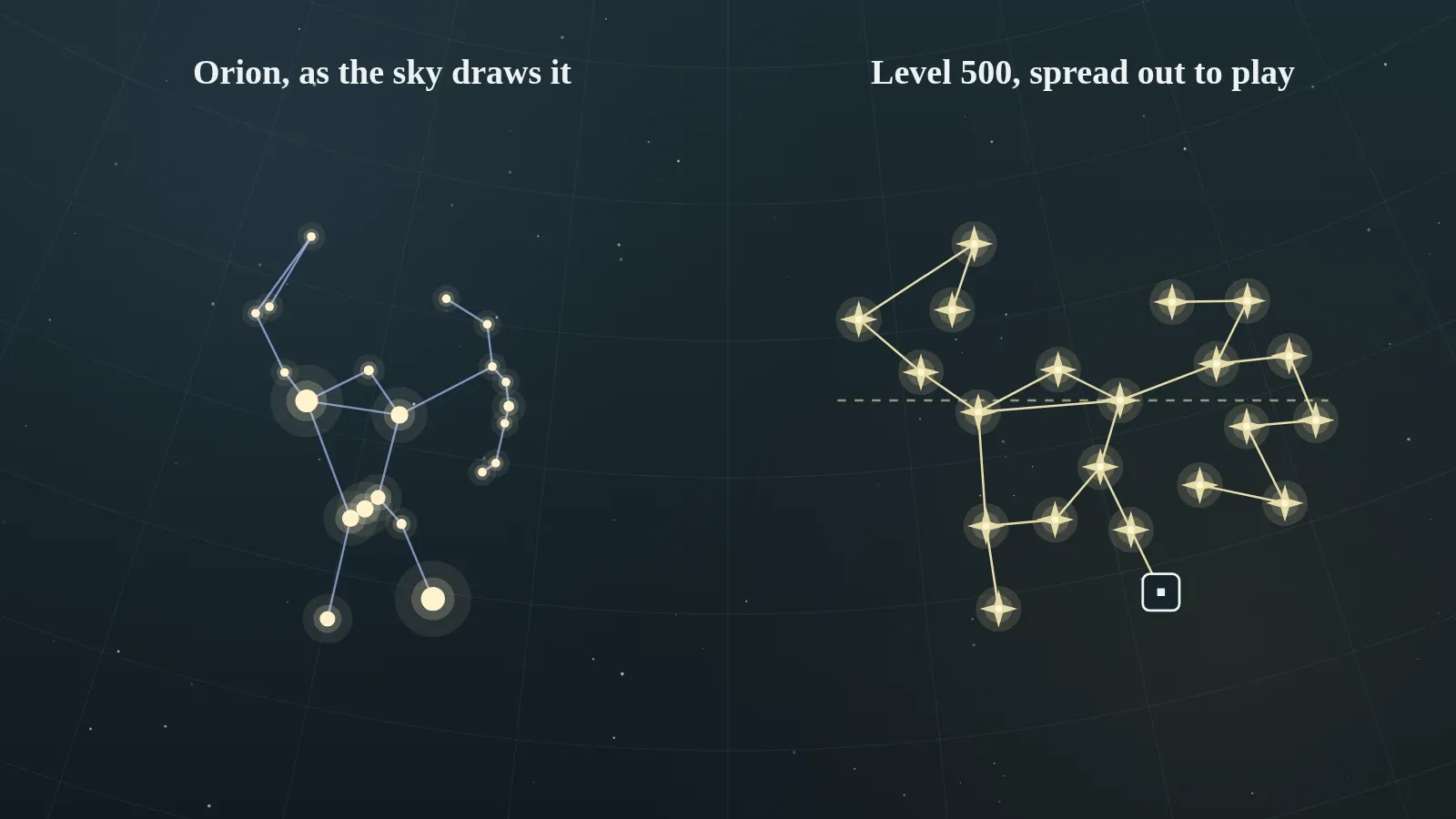
Small stars first
The constellations come in the order they can. A five-star figure like Cancer or Cassiopeia can only ever make a gentle level, because there is only so much a few lines can tangle. A great figure like Orion or Sagittarius can be gentle or very hard.
Pyxis promises that no level is easier than the one before. So the small constellations come early and often, and the great ones spread out through the later chapters. The first of them is Aries, four stars and three lines, right at the start. It ends on Orion, the hunter.
We wanted the zodiac in its astrological order at first, Aries, then Taurus, then Gemini and so on. It does not fit. Cancer, the fourth sign, is one of the smallest figures in the sky, and it could never be harder than the big Taurus and Gemini before it. Order by the sky’s own sizes won.
Where to find them
The heading of a constellation level shows its name under its number. The title screen shows the last one you cleared, untangling itself into its stars. And if you want to look up after playing, every one of them is out there, most of them easy to find on a clear night.