
Apsis beginner tips: seven habits that save hearts
Seven habits for Apsis: find the free arrows first, read the band and not the line, respect long arrows, and follow straight paths across curved orbits.
On this page
Apsis has one rule, and every arrow follows it: tap it and it flies straight the way it points, out of the system if nothing is in the way. The skill is all in reading the board. These seven habits are the ones that make the biggest difference, in roughly the order you will need them. If you are brand new, start with how to play.
1. Find the free arrows first
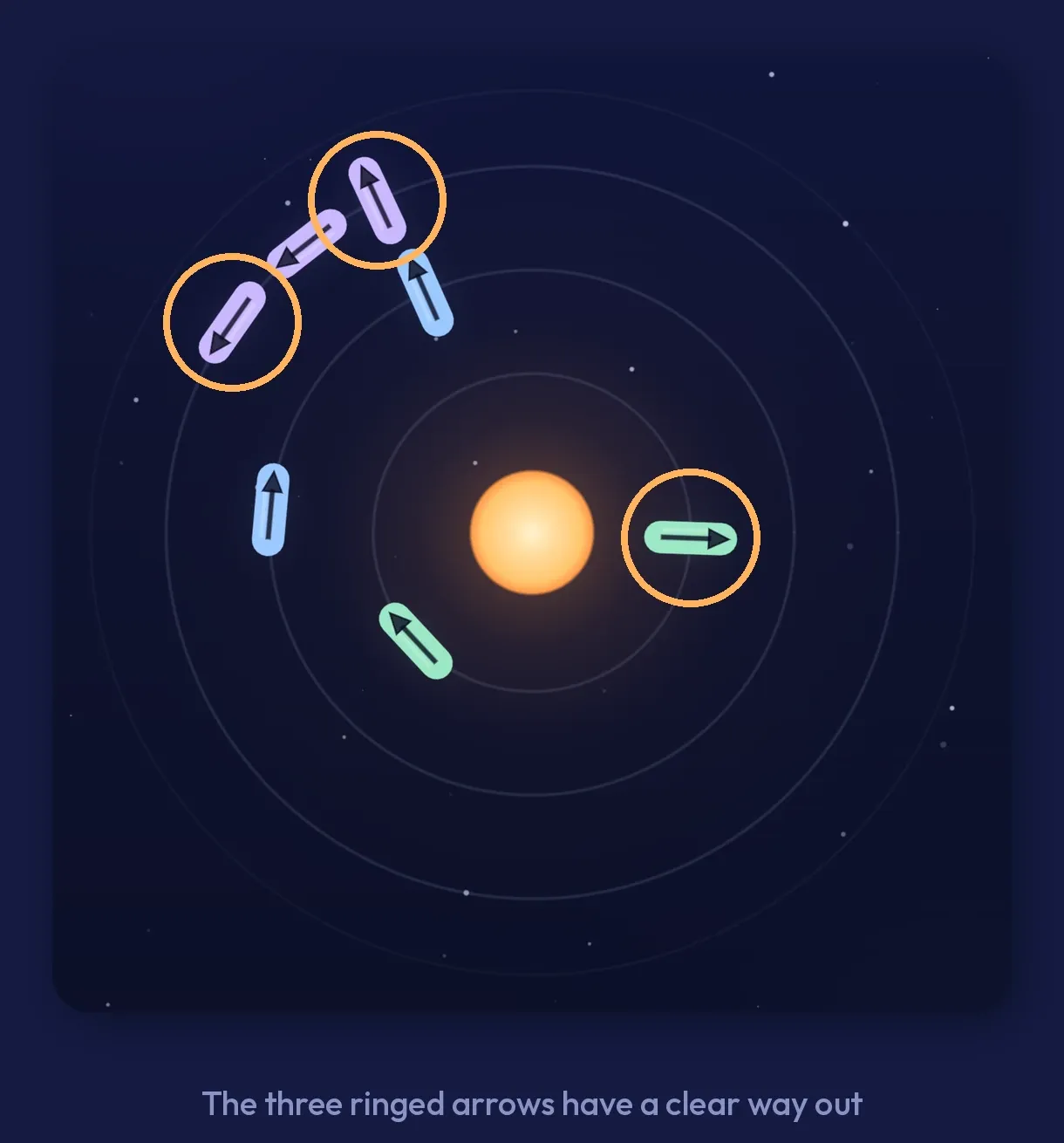
Before you tap anything, look along each arrow in the direction it points, all the way to the edge of the system. If nothing is in front of it, it is free, and it is a safe first move.
Most levels start with only two to four free arrows, however many there are on the board. Finding them is the whole first step, and the rest of the level unfolds from them.
2. Any free arrow will do
You might worry about launching the free arrows in the wrong order. You can’t. Taking an arrow away never puts anything in anyone’s way, so an arrow that is free now stays free until you launch it. The order among free arrows never matters.
So don’t hesitate between two free arrows. Launch either, then the other.
3. Read the band, not the line
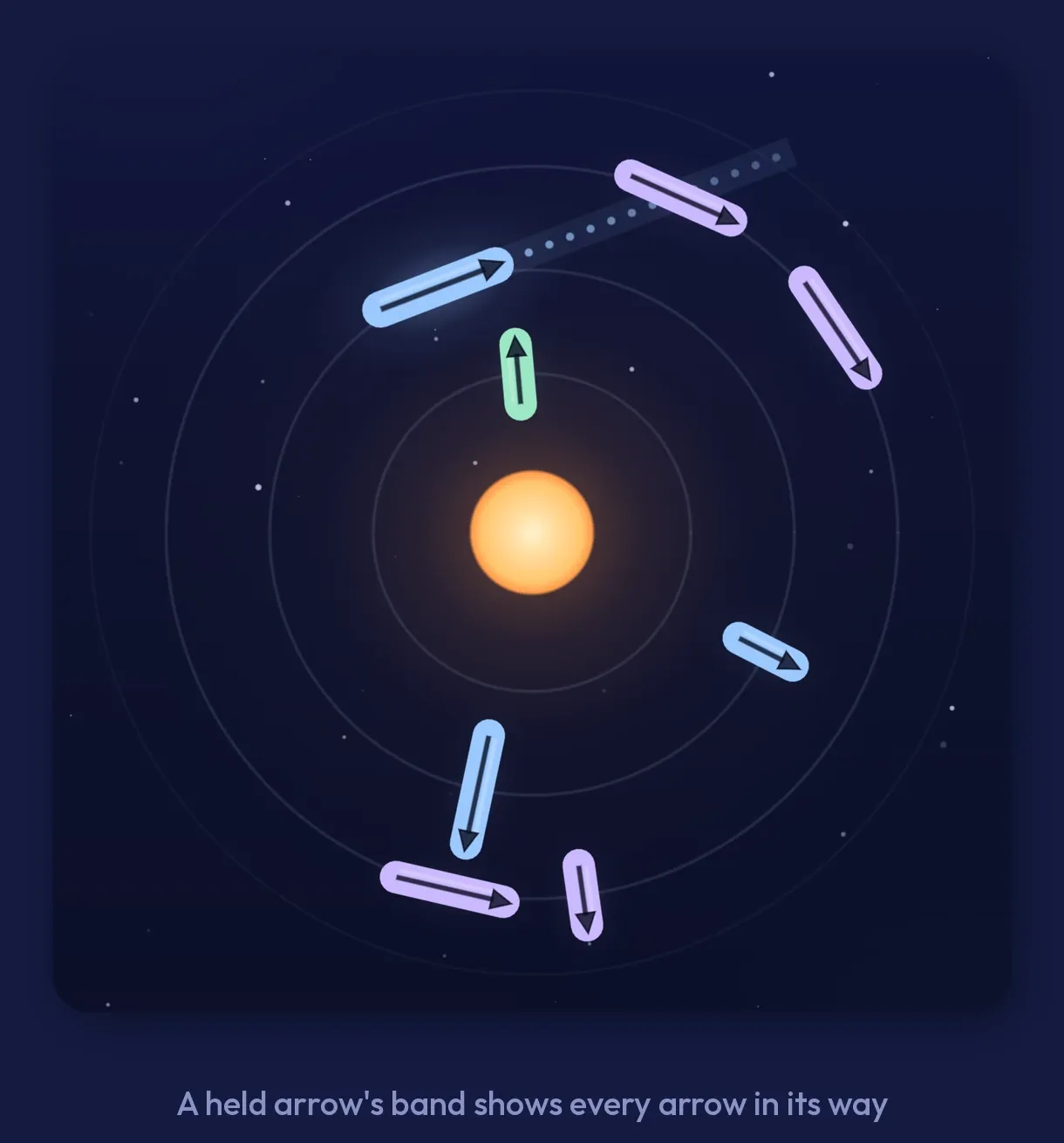
An arrow has width. Its path is not a thin line from its tip but a band as wide as the arrow itself, and it is blocked if any part of another arrow touches that band. The most common “but it was clear!” miss is an arrow whose centre line passes a neighbour while its edge clips the corner.
Hold your finger on an arrow to see the band drawn out to the rim. If another arrow overlaps it, even slightly, slide your finger off into open space and nothing happens.
4. Long arrows block more
From level 16 some arrows are long: 80 units instead of the usual 44. A long arrow sits in more paths than a short one, simply because it covers more of the board, so it is often the arrow everything else is waiting on. The game says so on its first level with them: “Long ones block more”.
When you look for what to launch next, check the long arrows early. Freeing one tends to free several others at once.
5. Look again after every launch
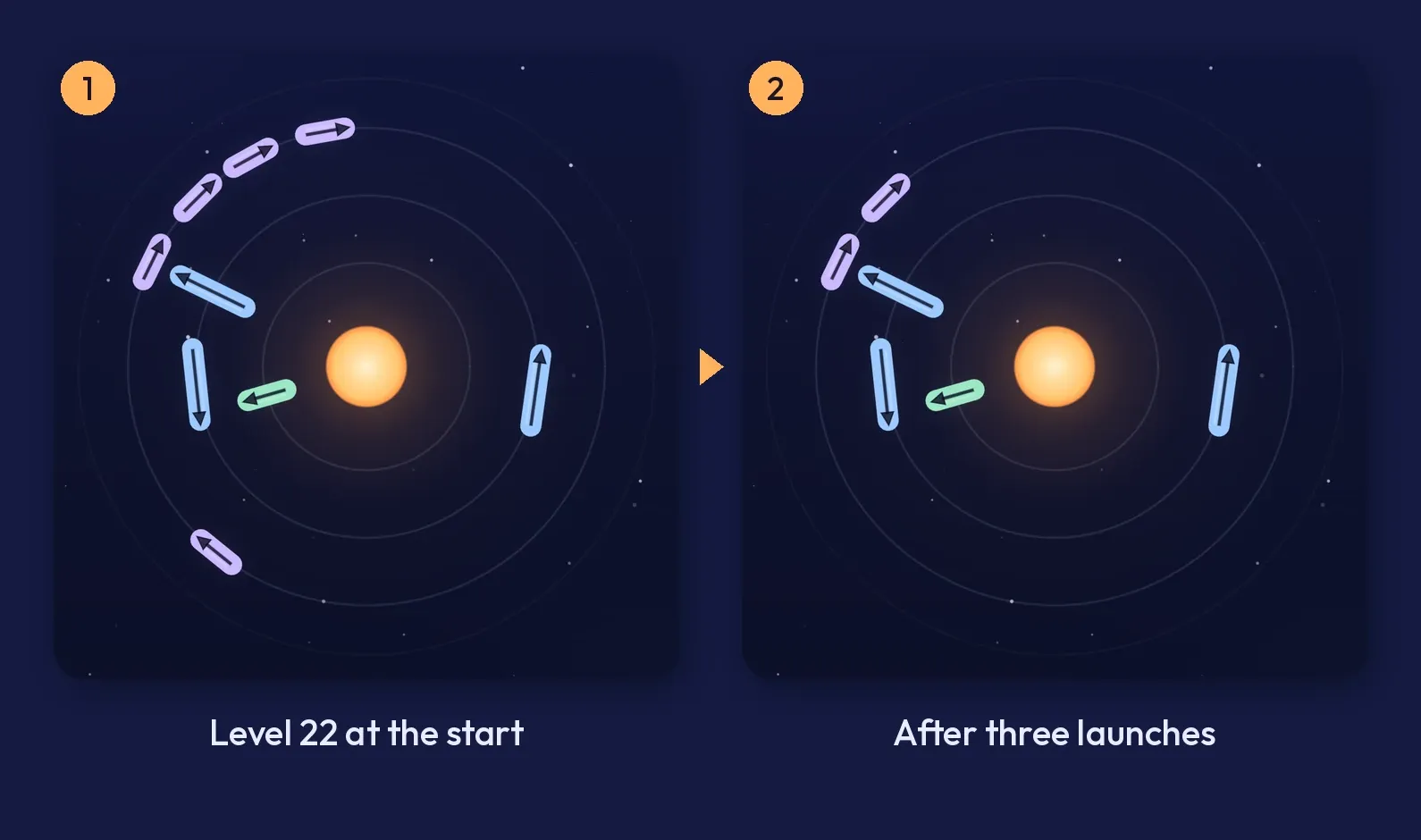
Every arrow that leaves opens a path for the arrows it was blocking. Your list of free arrows is different after each move, and usually longer.
A good rhythm is: launch, pause, scan. The scan takes a second, and it is where every clean run is won.
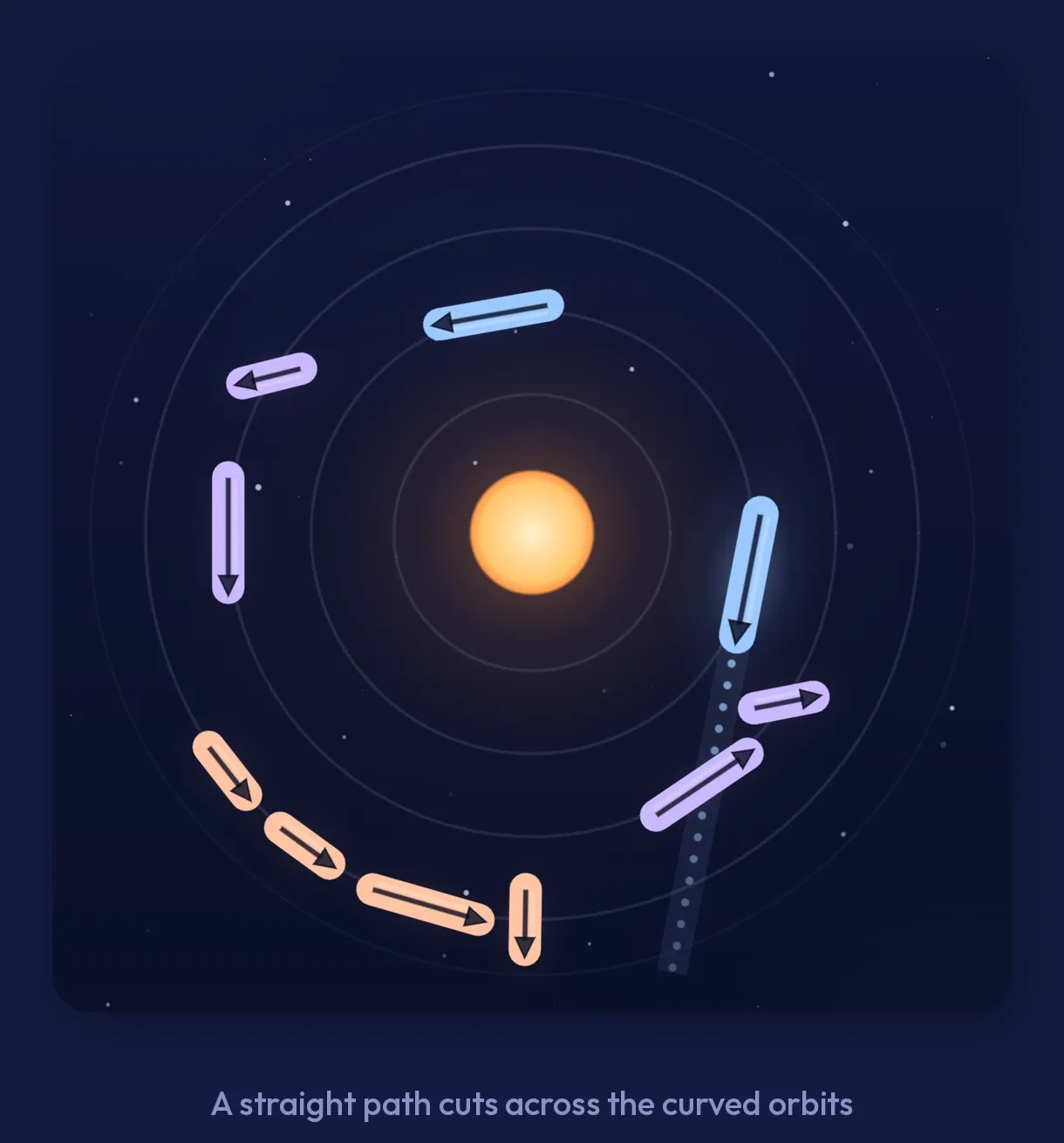
6. Follow straight paths across curved orbits
The orbits are only where arrows rest. A launched arrow never follows its orbit: it flies in a straight line, and that line cuts across the orbits at an angle.
Two cases catch people out:
- Arrows pointing along their orbit. A straight line that starts along a circle drifts off it slowly. For a good stretch it stays close to its own orbit, so the arrows just ahead of it on the same orbit are usually the first ones in its way.
- Diagonals. From level 31 some arrows point at 45 degrees, between straight out and along the orbit, and the game introduces them with “Some fly off at an angle”. Later levels add diagonals that point inward and pass close by the sun. The sun never blocks an arrow in a real level: no arrow is ever placed aimed across it. But those inward paths cross the inner orbits, and that is where their blockers are.
7. Let the hint teach you
The hint is not a crutch. It lights one arrow that is free right now and draws its way out, and it chooses the free arrow whose launch frees the most others. Following hints shows you how a strong player reads a board: start chains, not loose ends.
Use it when you are stuck, then look at why that arrow was the pick. There is more in how the hint works.
Bonus: slow down on dense boards
Late levels hold more than twenty arrows on five orbits, packed close. On a small phone a quick tap can land on the arrow next to the one you meant. If you hold instead of tapping, you see which arrow you caught, and sliding onto the right one fixes it before anything counts.
There is no timer, so taking two seconds over each move costs nothing. For how the stars are counted, see three stars and hearts.
Written by

Shravan Goswami
Game designer and developer
Claude Opus 5.5
AI co-developer
Comments
Sign in with GitHub to leave a comment or a question.