
Three stars in Apsis: how hearts and misses are scored
Why Apsis scores misses instead of moves, how three hearts become your stars, what a miss really costs, and a simple routine for clearing levels without one.
On this page
Most puzzle games score you on moves: solve it in fewer and you get more stars. Apsis can’t do that, and the reason says a lot about the game. This post explains how the stars work, what a miss costs, and how to clear a level without one.
Why moves can’t be the score
Every way of clearing an Apsis level taps every arrow exactly once. A level with twelve arrows takes twelve launches, whoever plays it and in whatever order. Counting moves would give every player the same score on every level.
It goes further than that. Whether an arrow is free depends only on which arrows are still on the board, and taking an arrow away only ever clears space. So an arrow that is free stays free, however many others leave first. There is no order to find and no way to paint yourself into a corner: if you only ever tap free arrows, you will clear the board.
That leaves exactly one kind of mistake: tapping an arrow that is not free. So that is what Apsis counts.
Hearts become stars
You start every level with three hearts, shown as a row under the level number.
- Tap an arrow whose path is blocked and it bounces back. The heart leaves the row at the moment of contact, not the moment of the tap, so you see what it hit before you see what it cost.
- Clear the level and the hearts you have left are your stars: three for no misses, two for one, one for two.
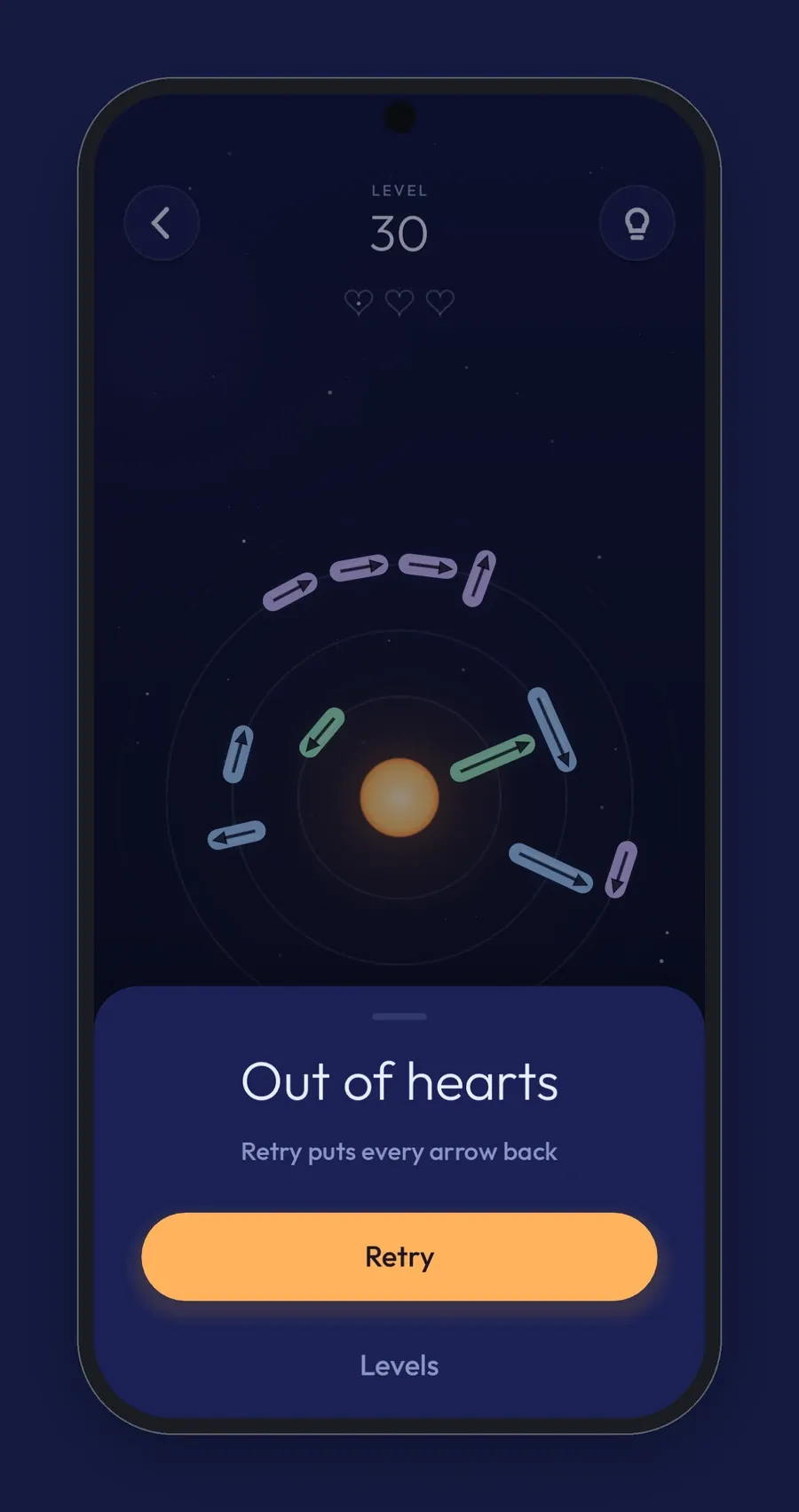
- Lose all three and the level is over. The sheet says “Out of hearts”, and Retry puts every arrow back with three fresh hearts.
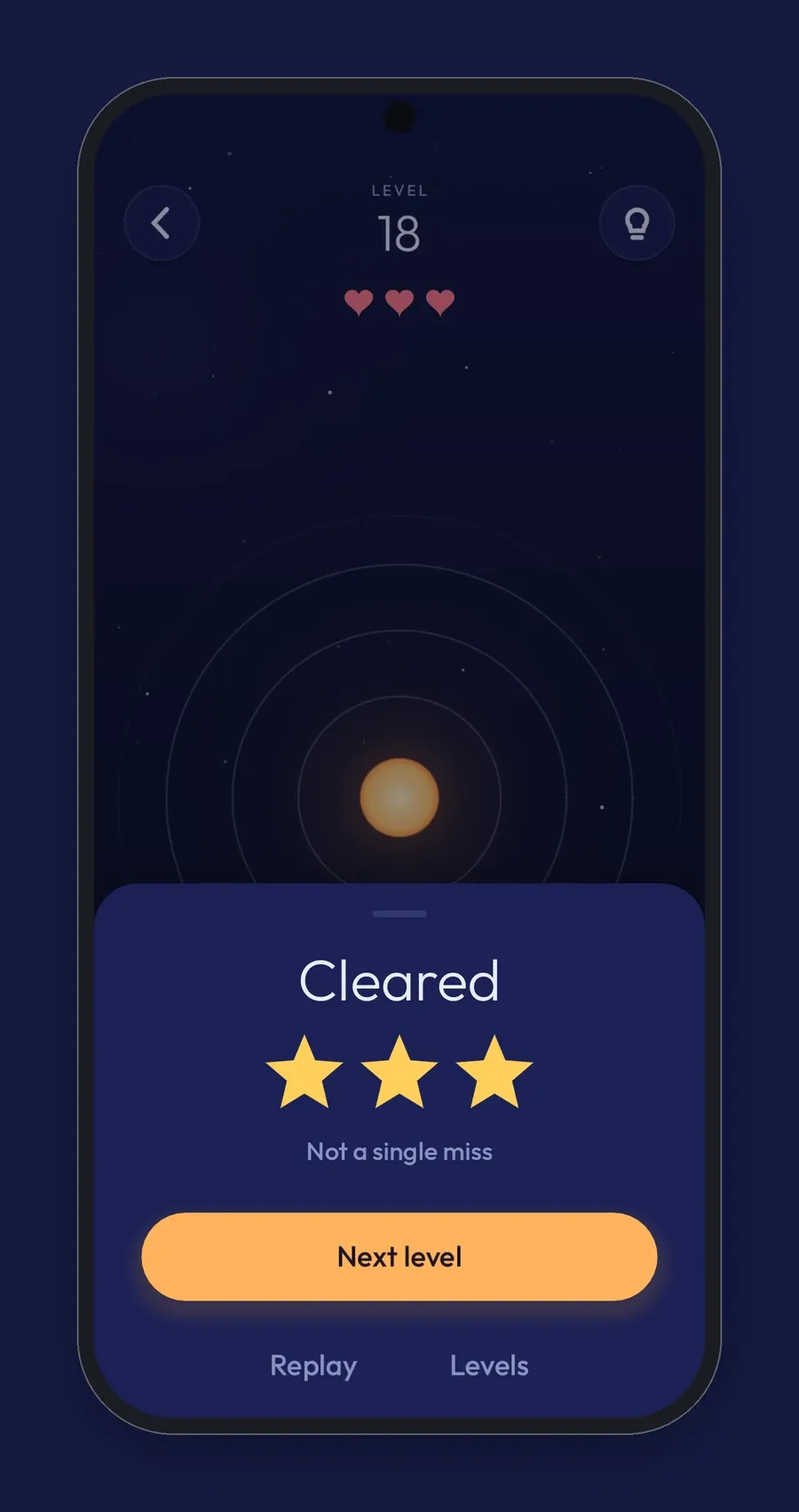
The result sheet tells you how it went: “Not a single miss”, or how many there were. If you earned fewer than three stars it adds one line, “Clear it without a miss for three stars”, and under the Next level button there is always Replay.
Your best result on each level is kept, so replaying can only ever raise it. Any clear, even a one-star one, unlocks the next level, and the level grid shows the stars you have earned on each tile.
What a miss really costs
A miss costs a heart and nothing else. The arrow springs back to exactly where it was, and every other arrow stays put. The board after a miss is the same puzzle as the board before it.
Two details make misses fair:
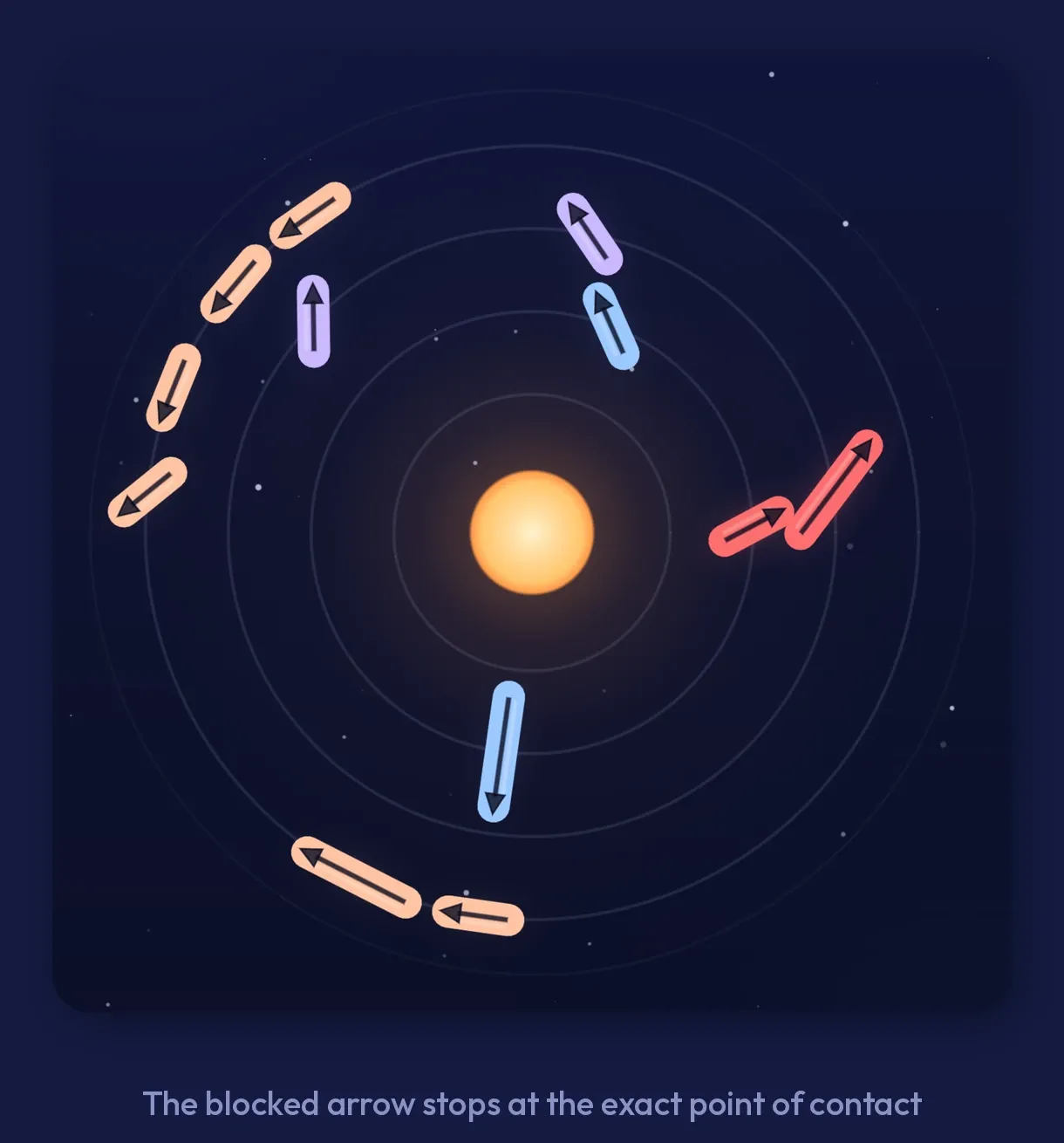
- The bounce stops at the true point of contact. A blocked arrow lurches forward and stops exactly where its pill touches the other one, and both flash coral. The reason it failed is always on screen.
- A double tap costs one heart, not two. While an arrow is still bouncing, taps on it are ignored, so a nervous second tap does no harm.
When the third heart goes, the fail sheet rises a moment later over the board, which is still exactly as you left it. There is nothing more to play until you retry, and nothing is lost by retrying: the stars you already earned on the level stay.
A routine for clean runs
Three stars is about attention, not speed. Here is a routine that works on every level:
- Look along each arrow first. Before any tap, trace where each arrow would go. The ones with nothing in front of them are your first moves.
- Hold when in doubt. A held arrow shows its path as a band exactly as wide as the arrow. If anything touches the band, don’t lift on it: slide off into open space and nothing happens.
- Tap only what you are sure of. Since a free arrow stays free, there is never a reason to gamble. Any sure tap is a good tap.
- Look again after every launch. An arrow that leaves may have been the one blocking two others. Your list of free arrows changes after each move, and usually grows.
- Use the hint instead of guessing. A hint does not cost a heart or a star. It lights an arrow that is free now, so a hinted tap always gets out. How the hint works explains how it chooses.
Where misses come from
On early levels, most misses come from not looking. On later levels, with more than twenty arrows on five orbits, they come from two things: an arrow’s width, and a finger that lands on a neighbour.
Width is the classic trap. An arrow’s centre line can pass a neighbour while its edge still clips it. The band in the hold view is the honest picture, so trust the band, not the line.
The wrong-neighbour press is why the hold exists. On a dense board, a press can catch the arrow next to the one you meant. With the finger still down, the lifted arrow and its path show you what you caught, and sliding onto the right one fixes it before anything counts. We measured how often a quick tap picks the wrong arrow, and the numbers are in the geometry of straight lines across circles.
Stars add up
Your star total is shown on the title screen, and each tile in the level grid shows what you earned there. There are no bonuses and no multipliers: a star is a heart you kept. For habits that keep more of them, see the beginner tips.
Written by

Shravan Goswami
Game designer and developer
Claude Opus 5.5
AI co-developer
Comments
Sign in with GitHub to leave a comment or a question.