 Carillon
Reach, sources and decoys: reading a Carillon field
How to read a Carillon field before you tap: trace the reach circles, find the dots nothing reaches, look past the showy decoys and, once rules arrive, plan the order.
 , updated , 5 min read

A Carillon field is a map of who reaches whom, drawn in faint circles. Most of getting good at the game is learning to read that map before your finger comes down. I read a new field in roughly the same order every time, and this is that order.
Start with the circles
Every dot wears a faint circle, its reach. When a dot pops, its ring grows out to that circle, and any dot whose edge falls inside it pops next. So the circles are the whole map, and the rest is detail.
You can trust what you see. The level generator keeps every dot’s edge clearly inside a circle or clearly outside it, with at least 10 units to spare either way on a field 640 units wide. It also keeps every pair of dots at least 14 units apart, edge to edge. If a circle looks like it touches a dot, it does, and if it looks like it misses, it misses.
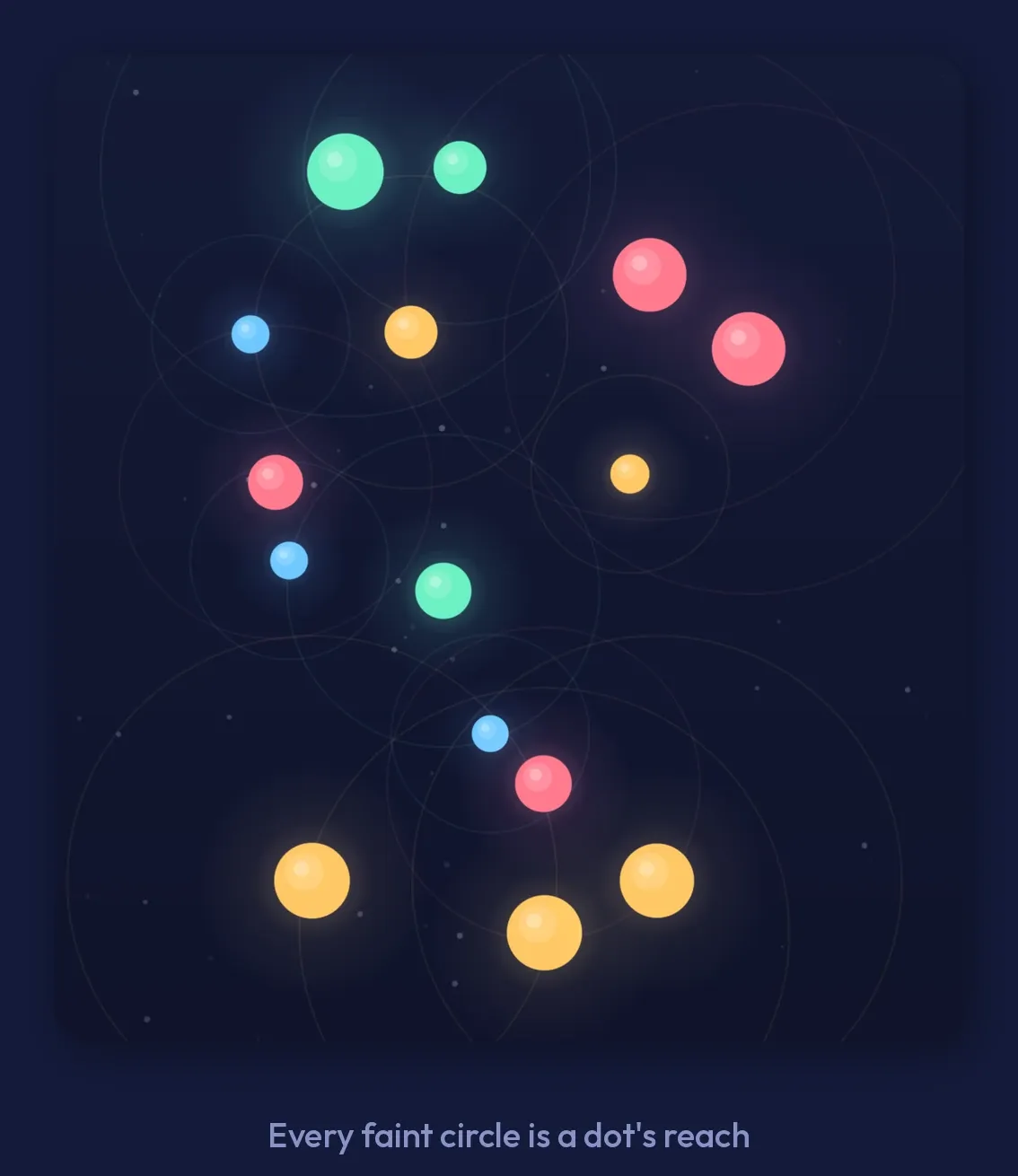
Then remember that reach runs one way. A big dot’s circle can swallow a small dot whose own circle stops far short of the big one. “These two are close” and “these two pop each other” are different questions, and only the circles answer the second one.
Look for what nothing covers
Now look for a dot whose edge sits inside no other dot’s circle. Nothing can pop that dot except your finger, so it is where a chain has to start. I call these dots sources, after the maths behind them, though the game never names them.
The bright pips at the top tell you how many to look for. In the first four chapters, a field needs one tap for each source and no more, so two bright pips mean two sources somewhere on the field.
Sometimes a source is two dots that reach only each other. Chapter 2 is built around exactly that, and its card says it plainly: “Two dots that reach only each other start one chain”. Either dot of the pair starts it.
To test a candidate, turn the question round. Hold its neighbours one at a time. If the candidate never shows up in their outlines, nothing reaches it, and you have found a start. Holding is free, so test as many as you like.
Distrust the loud dot
The dot that lights up the most when you hold it is the tempting one, and it is often wrong. If any other ring can reach it, it is not where a chain starts, however much it pops. Tap it and the real start is still sitting there, waiting for a tap of its own.
Chapter 3 is named for this, with the line “The dot that lights up most is rarely where a chain starts”. Every level in it has at least two of these decoys: dots that light up at least as much as the best winning tap, and win nothing.
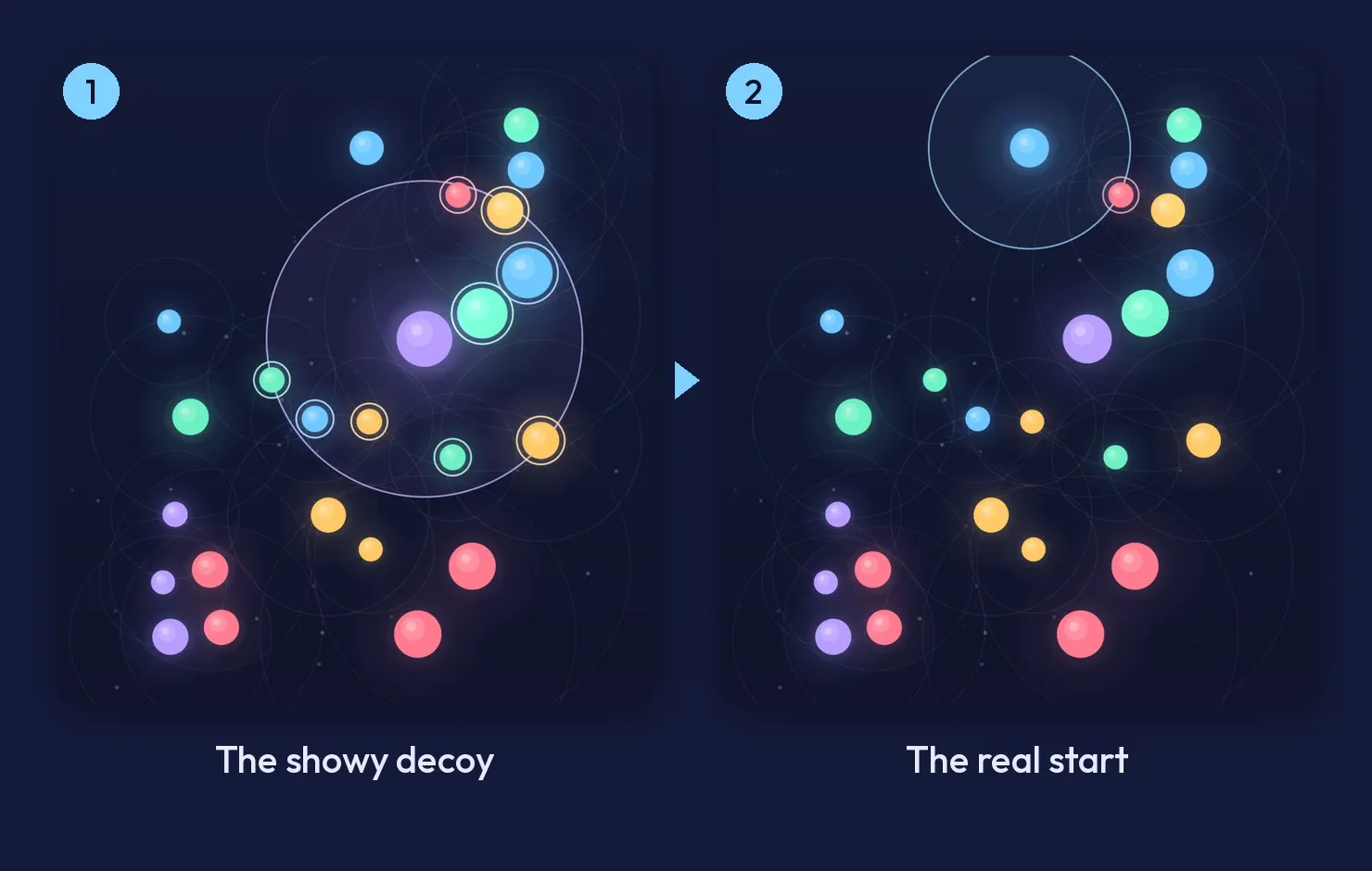
Later on the real starts get quieter still. From chapter 5, the generator lets a chain’s first ring touch only one or two dots, and the rest of the chain arrives by relays. So the start of a long chain often looks like a dead end when you hold it.
Read backwards
That is why I often read a field backwards. Pick a dot near the edge and ask which circles cover it. Then ask which circles cover those dots, and keep going. Sooner or later you reach a dot that no circle covers, and that is the start of the chain you were tracing.
Reading forwards works too. Each outlined dot sends out its own ring when it pops, so a dot with a small outline can still clear half the field through relays. Follow the outlined dots’ circles outward until they stop finding anything new.
Look far away for the next start
The generator grows every chain from its own root, and it spreads the roots out. On a field 640 units wide and 900 tall, roots sit at least 300 units apart, and only a little closer on the busiest fields. Once you have found one start, look across the field for the next one, not beside it.
I like to find every start first, by holding, and only then tap them one by one. The field takes no new tap while a chain is still spreading, so each chain finishes before the next begins.
When rules arrive, read the order too
In the first four chapters, reach is all there is. Hold every dot, tap the ones that never show up in another dot’s outline, and the field clears.
From chapter 5 the rules change that. A heavy bell rings only once two rings have struck it, so two chains may have to meet there. An hour bell rings by itself once its number of taps has gone by. Damped dots ignore every ring until the pedal has rung. The gold home note must ring on your last tap, so the chain that holds it has to come last. Round bells ring in order, one per tap, and a beat dot rings only on odd taps.
So the question grows from “where do the chains start?” to “in what order do I start them?”. Holding still shows what a dot would do now, so the reading habits stay the same. You just read a step further ahead.
Spend the spare on a question
Every level gives you one tap more than its goal. In the first four chapters, a tap that misses every start still leaves every start in place, so a wasted tap costs a star and never the level. That makes the spare a good place to ask a question that holding cannot answer.
With rules in play, be more careful. A tap in the wrong order can leave no clear at all, even with the spare. Hold more, and tap less.
If you do run out, the sheet says “Out of taps” and how many dots are left. Those dots hold the chain you missed, so hold one of them before you press Retry.
When you want a nudge rather than the answer, the best next tap shows how to use the hint as a teacher. For why “the dot nothing reaches” is exactly the right test, read chain reactions as graphs.