 Hako
Secret boxes from Hakone, and the boxes in Hako
Hako comes from the secret boxes of Hakone, wrapped in yosegi wood mosaic. What I borrowed from that craft, and how every box got a name, a maker and a story.
 , 6 min read
If you have never seen one, look up a video of a Hakone puzzle box being opened. A small wooden box with no lock, no key and no hinge you can see. Someone pushes one side panel a few millimetres, then the top slides a little, then another side, then the top again. After some moves the lid just comes off.
It is very hard to watch only once.
Hako is my game about those boxes. “Hako” simply means “box” in Japanese.
The real boxes
Hakone is a mountain area in Japan, south-west of Tokyo, famous for hot springs. The old Tokaido road between Edo and Kyoto passed through it, and travellers stopped there to rest. Woodworkers in the area have made puzzle boxes for well over a hundred years, and they are called himitsu-bako, which means “secret box”.
A himitsu-bako looks like a plain little box covered in a beautiful pattern. But its panels can slide, a tiny bit each, and only in the right order. Simple boxes open in a handful of moves. Serious ones take dozens. I have read about boxes that take more than a hundred moves, which I can’t imagine doing without losing count.
What I love is that there is no trick hidden inside. Everything that matters is on the outside, under your fingers. You just have to find the order.
Yosegi, a mosaic made of wood
The pattern on the boxes is called yosegi. It is made only from wood, in the wood’s own colours, with no paint.
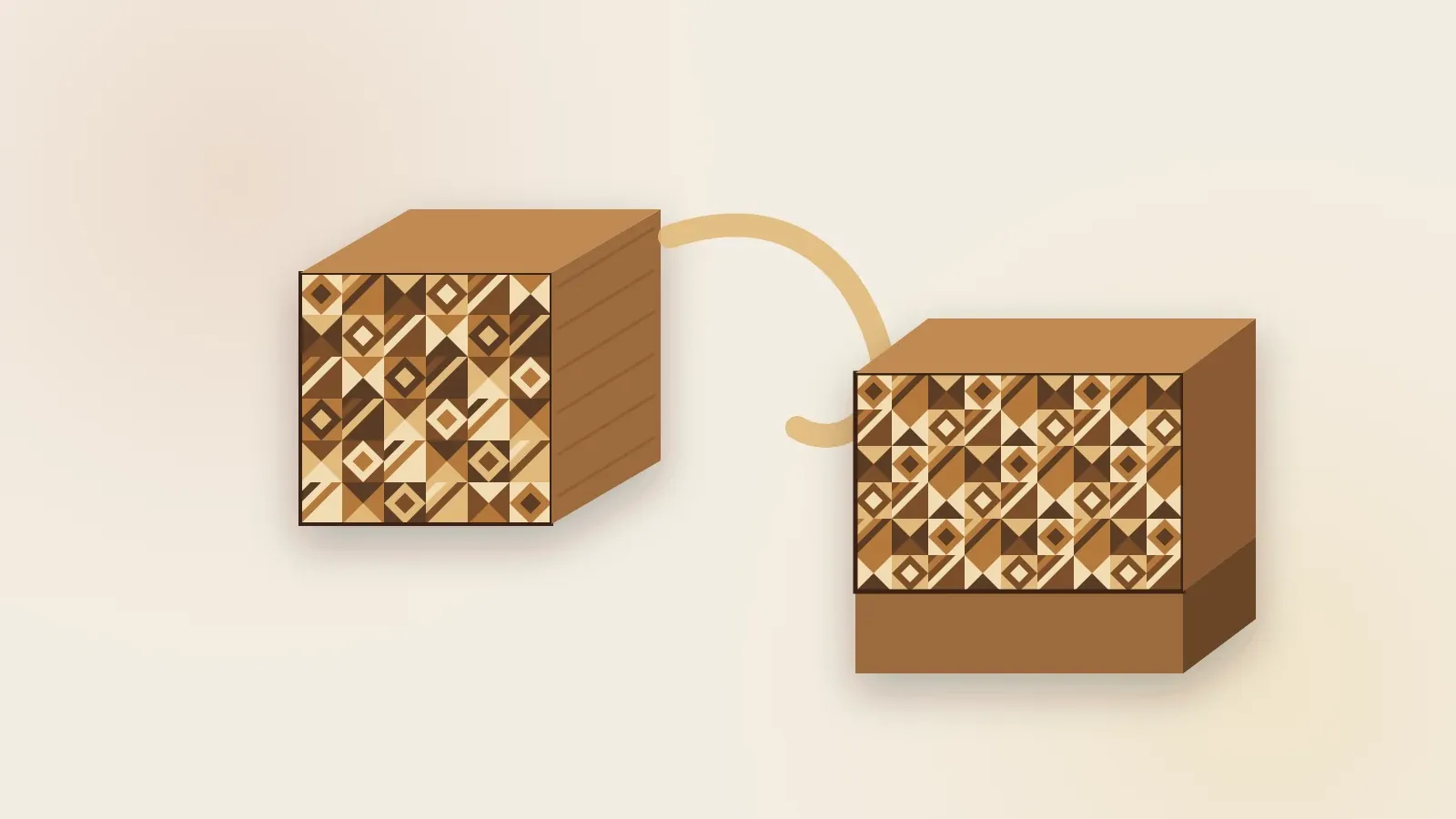
As I understand it, craftsmen cut thin sticks from many different trees, pale ones and dark ones and reddish ones. They glue the sticks together in a block so that the end of the block shows a pattern, like diamonds or hexagons or waves. Then they shave the face of that block with a big plane into sheets as thin as paper, and every sheet carries the same pattern. Those sheets are glued onto the boxes.
So one block of wood, built once with a lot of care, can dress many boxes. That idea stayed with me. It is a little bit like how our games are made too: a lot of care in one place, so that many levels can be good.
The cover of this post is my own small drawing of that: a block with its pattern on the end, a sheet curling off, and a box wearing it.
What I borrowed, and what I did not
I want to be honest here. Hako is not a simulation of a real himitsu-bako. I am not a woodworker, and a real box is a 3D object with hidden steps inside.
What I took is the feeling. Panels that slide only along their own line. An order you have to discover. Nothing hidden. And at the end, a lid that comes free.
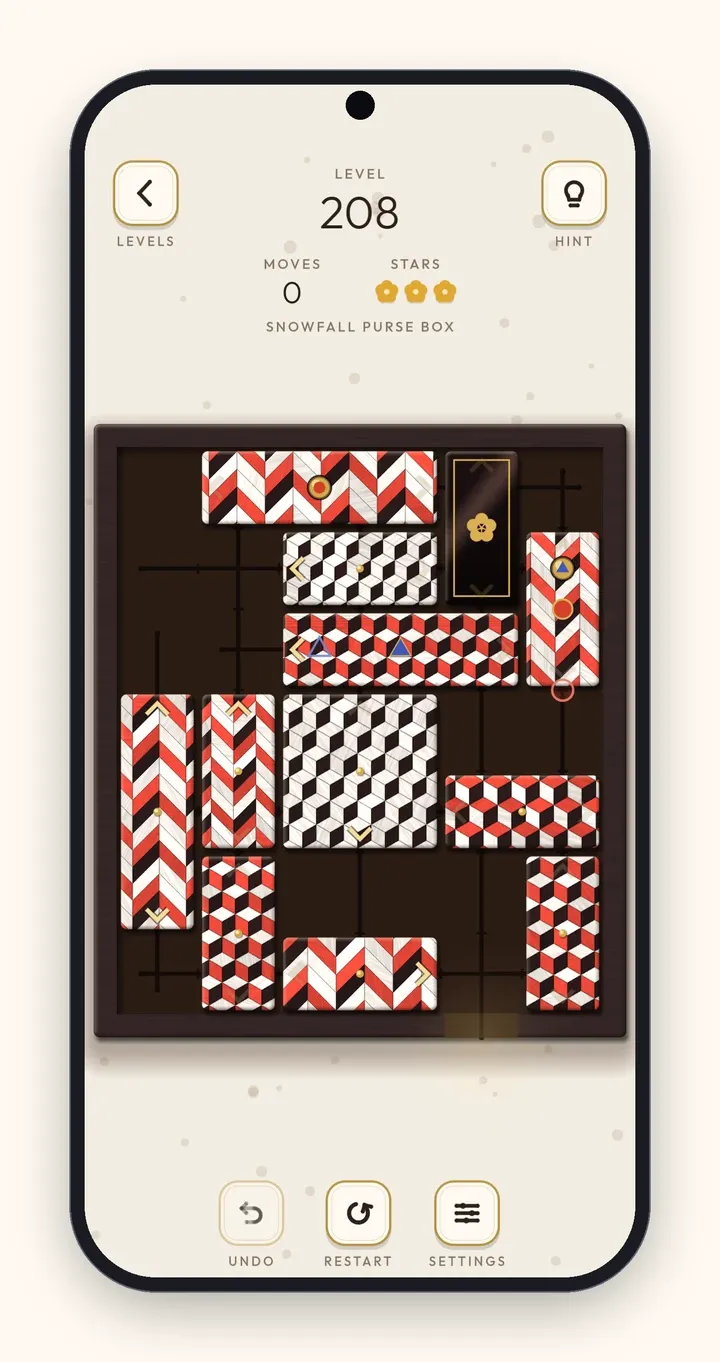
In the game, each box is one face of a puzzle box seen from above. The panels lie in grooves cut into the floor and slide only along them. The black panel with the gold crest is the lid. Slide the other panels out of its way until it can leave through the gap in the frame, and the box is open.
The guide on the rules of Hako explains the details, like how a move is counted.
There is one extra thing in Hako, the brass pin. A pinned panel cannot move at all until another panel, carrying the same mark, rests on the matching ring in the floor. That is the closest I came to the real boxes, where one panel has to be in the right place before the next one will move. Later chapters chain the pins, so a key is pinned too, and you have to free them in order. That is a real secret box’s order of moves, in a flat game.
Every box has a name
Once the puzzle was working, I had a problem. Every box is made by a program, and in the first version many of them looked the same at a glance: brown panels in a brown frame. A real Hakone box is special because someone made it, for someone, with a pattern they chose.
So now every box in Hako has its own concept. It has a name, a maker, a person it was made for, a pattern, a scene, and its own woods.
Level 1 is the Pine Practice Box, made by the apprentice Kenta for his little sister, in plain stripes. Level 21 is the Milestone Travel Box, made by a roadside carver for a pilgrim heading west, at a tea house on the Tokaido. Level 208 is my favourite: the Snowfall Purse Box, made by a sweet potato vendor for a child with cold hands, in the seven treasures pattern.
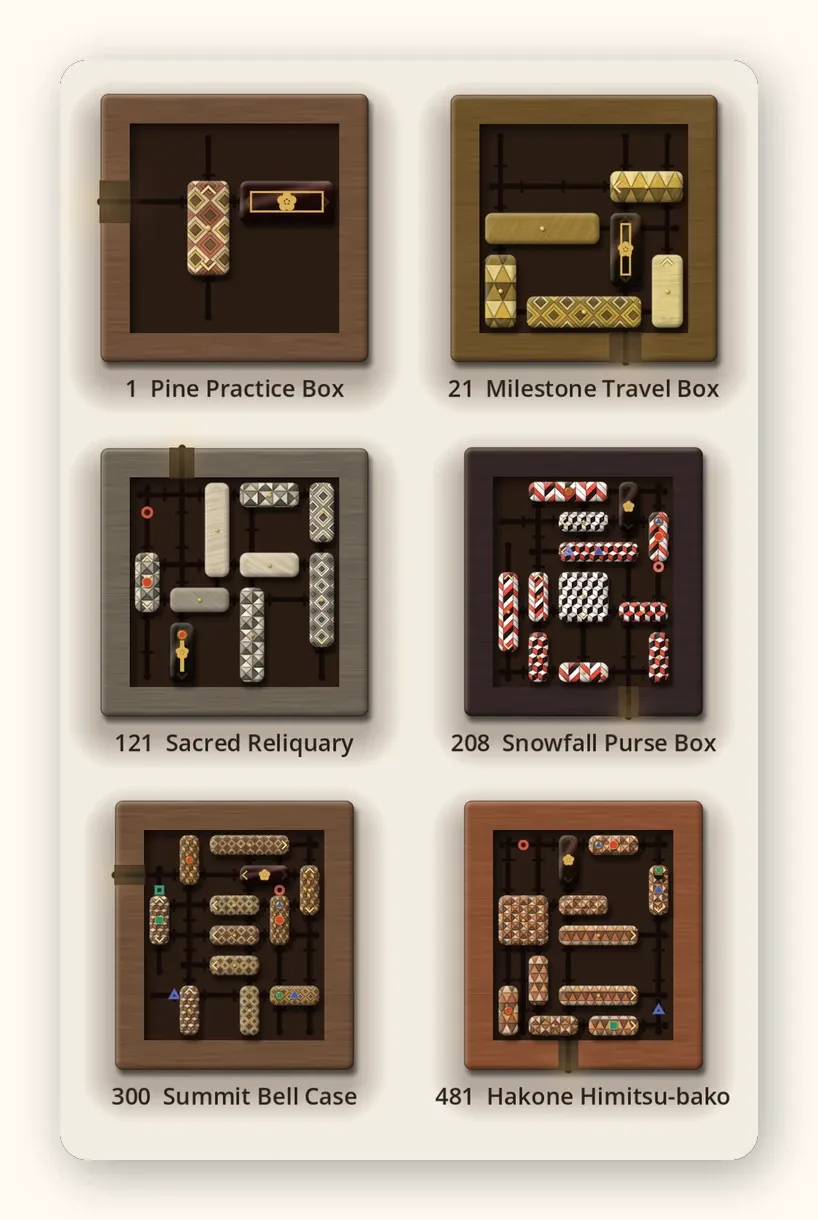
You see the box’s name under the moves while you play it. When you open it, its little story closes the win sheet. And behind the table, faintly, there is the room the box was made in: paper screens, mountains, waves, lanterns, gates or falling snow.
Chapters as places in old Japan
Every chapter is a family of boxes from one place, and the place gives it its woods and colours.
The first is the Apprentice’s Bench: pale hinoki, pencil lines and sawdust cream. Then the Tokaido Road in cedar brown and straw gold, and the Tea House in moss green, matcha and unglazed clay. The Brass Fitter’s Street, where the pins arrive, is warm brass, soot and polished copper. Later there is a Lantern Festival in lantern red and night indigo, a Winter Market in snow white and roast chestnut, a Ninja House in shadow charcoal with a hidden red, a Sake Brewery, a Clockmaker’s Workshop, a Scroll Library.
And the last chapter is the Hakone Masters, in every wood of the mountain. Level 481 there is simply called the Hakone Himitsu-bako, made by the Hakone grandmaster for whoever opens it. I won’t tell you about the very last box. You should meet that one yourself.
Inside a chapter, the boxes come in four rooms. The room gives the scene and the kind of box. The maker, the person and the first word of the name keep turning, so all the box names are different. The family’s colours turn a little from room to room too, so no two boxes look alike, but a chapter still feels like one place.
The patterns
The patterns are named after traditional Japanese designs, the kind you see on cloth and paper as well as wood. They start simple and get richer as you go deeper:
- Early: stripes, checks, ladder, well frame, diamonds.
- Middle: arrow feathers, fish scales, hemp leaf, tortoiseshell, waves, seven treasures, pine bark.
- Later: thunder, fawn spots, cherry diamonds, linked rings, snow rings, a lattice of cranes.
- Last: chrysanthemum wheel, dragon scales, a hundred flowers, a thousand cranes and the phoenix tail.
The pattern decides how a box’s panels are inlaid, and the woods come from its family. So even inside one chapter, every box has its own face.
Why go to this much trouble
Honestly, the puzzle would work without any of it. A box opens the same whether it is called “Box 208” or the Snowfall Purse Box.
But a box with a name and a maker is a box you want to open. Read “made by a boat builder for the lighthouse cat” and you smile a little before you start sliding. The story does not make the puzzle easier. It makes it matter.
That is what the real Hakone boxes do too. Someone made it, for someone, and now you are the one opening it.
If you want to know how every box is made sure it can be opened, that is in every box can open. And the treasures waiting inside are in treasures, woods and a lacquer lid.