 Hako
Treasures, woods and a lacquer lid: what you collect in Hako
What waits inside Hako's boxes: a treasure at the end of every chapter, a shelf to fill, woods and lacquers for every box, and the story of the new lacquer logo.
 , 6 min read
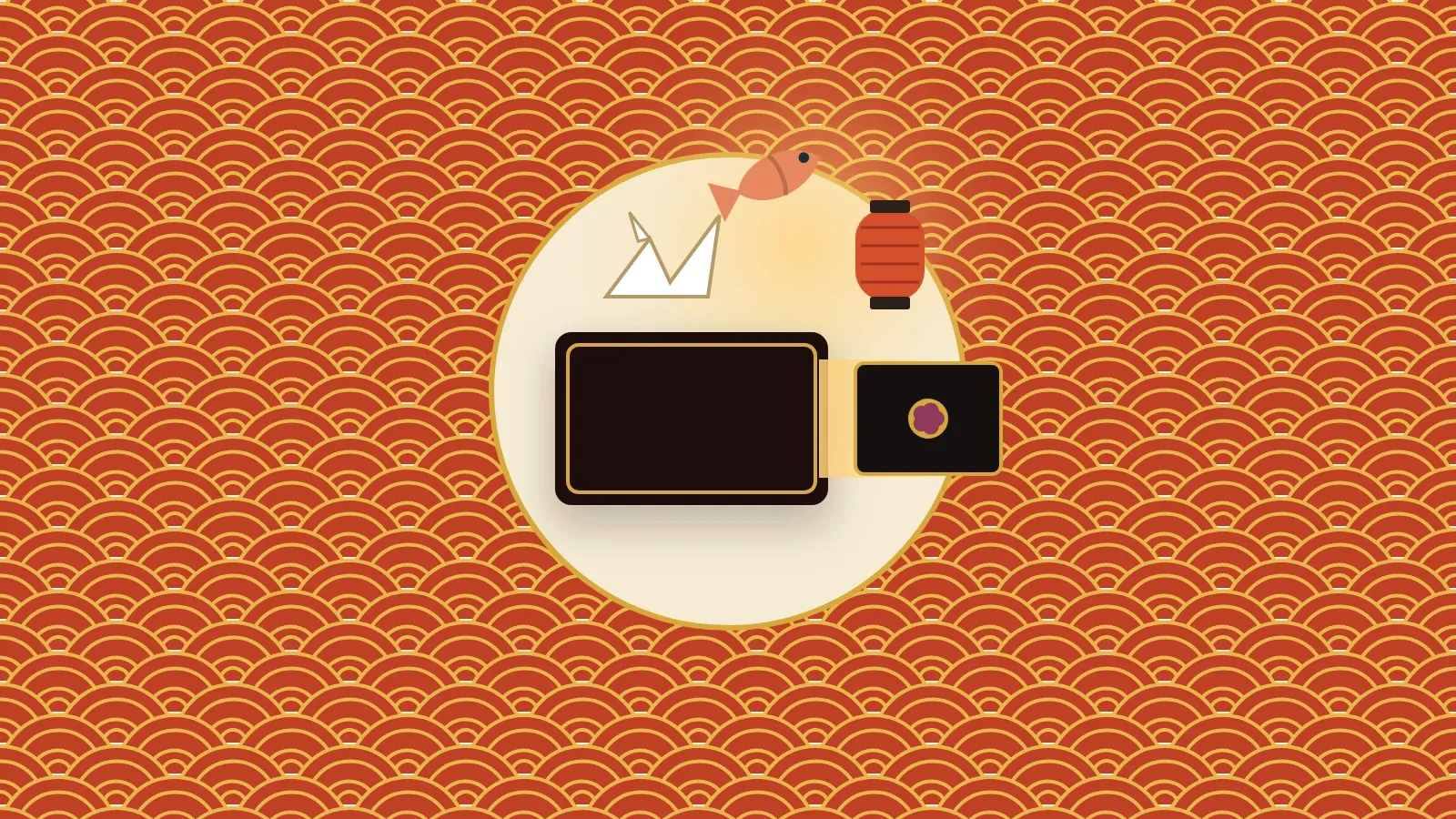
A puzzle box is only half the fun if there is nothing inside.
That idea was there from the very first version of Hako, and it stayed true all the way through. Opening a box should feel like opening something. So this post is about everything you find and collect in Hako: the treasures, the woods, the lacquers, and the new logo, which is a box opening too.
A treasure at the end of every chapter
The last box of every chapter holds a treasure. It is the same treasure for every player, at the same box, so you can talk to a friend about the box with the fox mask in it and they know exactly which one you mean.
The treasures are small things from old Japan, each drawn in the game’s own code, each with one line about it. Here are a few, in their own words:
- Copper mon: “A worn coin with a square hole, warm from many hands.”
- Paper crane: “Folded from one sheet of washi, never cut.”
- Brass bell: “A suzu bell. Shake it and something good listens.”
- Iron key: “It opens a door nobody has found yet.”
- Daruma: “One eye painted. Paint the other when your wish comes true.”
- Fox mask: “The mask of the fox who guards the rice fields.”
- Bronze mirror: “A shrine mirror. It shows the room a little brighter than it is.”
- Little hako: “A puzzle box inside the puzzle box. Nobody has opened it.”
That last one is my favourite line in the whole game.
The treasures come in five rarities: common, uncommon, rare, epic and legendary. Rarity never drops along the way. A harder box is always worth at least as much as the one before it, so the deeper you go, the rarer the light that spills out.
How a treasure comes out
When a treasure box opens, the lid slides out as usual. Then the light comes first, in the treasure’s rarity colour: warm brown for common, green, blue, purple, and gold for legendary. The treasure rises out of the box on that light, with a bell for each step of rarity. Its name appears, its line, and a button that says Keep it.
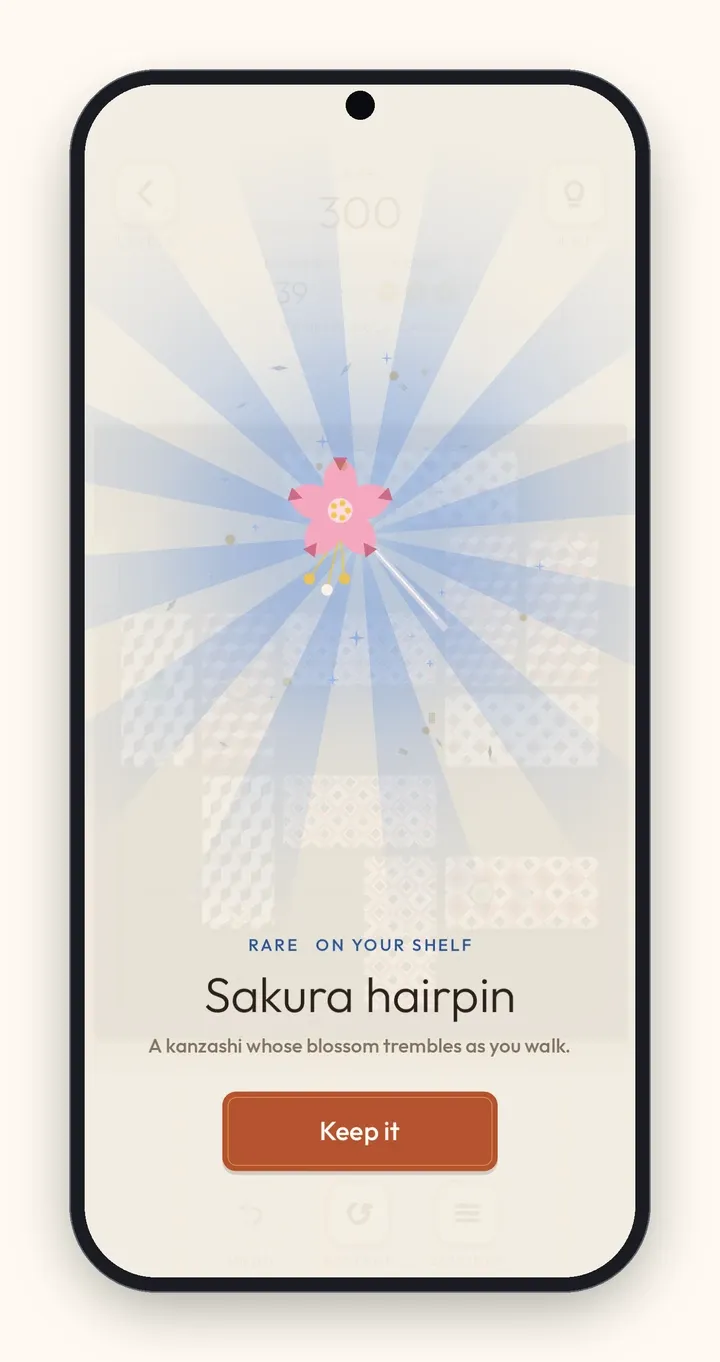
The timing matters more than anything here. Too quick and it feels like a pop-up. Too slow and you want to skip it. It is meant to take about as long as lifting a real lid and looking inside.
The shelf
Every treasure you find goes onto your shelf, from the title screen. It is a little wooden cabinet with a cubby for each treasure. Found ones sit in their own light, and you can tap one to read its card again. The ones you have not found yet are dark shapes, with the level that holds each one written under it.
So the shelf is also a map. You can see a dark fox shape and know exactly how far away it is.
The shelf keeps nothing of its own, by the way. A treasure is yours the moment its box is open, so the shelf just reads which boxes you have opened. Nothing can go missing.
Woods
Then there are the boxes themselves.
Every box in Hako has its own woods, chosen from its chapter’s family, as I wrote in the post about Hakone’s secret boxes. That is the way the game looks by default, and it is called As made.
But you can also choose a wood for every box. Hakone’s classic yosegi and walnut are free. The Woods pack in the shop adds cherry, maple, ebony and rare woods: zelkova burl, camphor, mulberry, black persimmon and spalted maple. A wood changes only the panels and the frame. The pins, the keys and their marks always stay readable, in every wood.
Box looks you earn
Beyond the woods there is a whole collection of box looks, and most of them come from playing.
- The workshop: hinoki after your first few boxes, then persimmon wood, bamboo and cedar.
- Lacquers: one for every 100 stars you collect. Vermilion, black, ivory, plum, indigo, pine, persimmon, gold-fleck black, red over black, and carved cinnabar at the end.
- Precious: mother-of-pearl, gold leaf, bronze, jade and silver inlay, at big milestones of boxes opened.
- Seasons and play: cherry blossom, ice, candy, stone, origami paper and a starry night, for daily streaks or for boxes opened, and a pixel look for the very patient.
- Families: a look in each chapter’s own colours, for finishing that chapter.
- Festival: festival neon, ink wash, paper cut and glass, with the Themes pack.
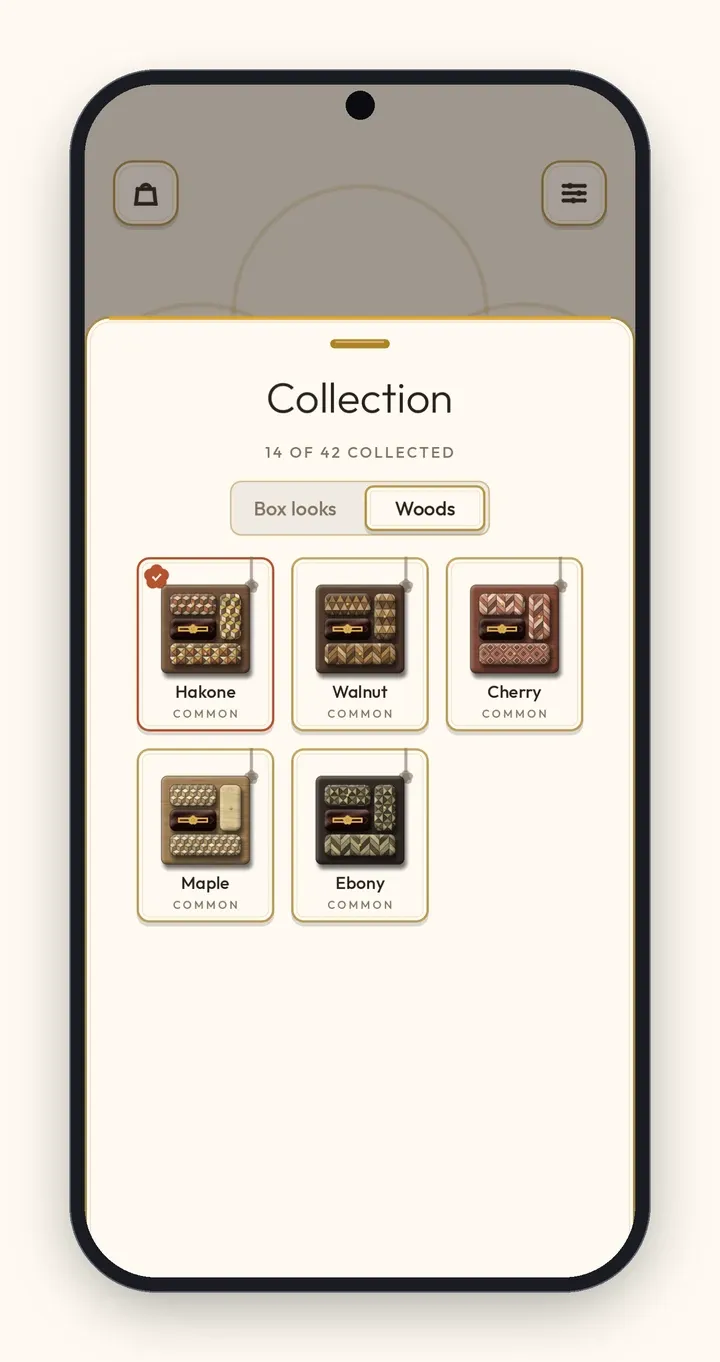
The first one, hinoki, opens after the third box. I did that on purpose, so a new player sees a card turn over in the first few minutes and knows the collection is there.
A worn look changes the woods but keeps the box’s own pattern. So even if you wear gold leaf on everything, no two boxes look the same. That was a lesson I took from Block Blast: the rules stay the same while the pieces keep changing, and collecting the looks is half the fun.
The lacquer lid
Now the logo, because it changed recently and I am quite happy with it.
The first Hako icon was a wooden box face in yosegi triangles and diamonds, with one gold panel sliding along. It was fine. It was also very brown, and a bit busy at the small size of an icon.
When I worked on the store art, I tried a few directions side by side, and the one that stood out was lacquer. An ivory lacquer lid, gold seigaiha waves (the old pattern of overlapping half circles that means calm sea), and a plum blossom crest in gold at the centre. That became the game’s look: ivory as the light ground, ink brown for the text, gold for the line work and plum as the one accent. The dark look is black lacquer with the same gold.
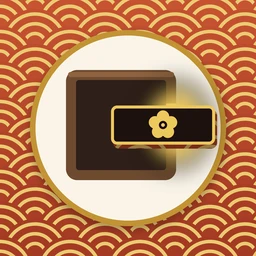
The new icon puts it all in one picture. A dark box sits inside an ivory moon, on vermilion and gold waves, and its black lid is sliding out to the side with the gold crest on it and a little light behind it. It is the moment a box opens, which is the moment the whole game is about.
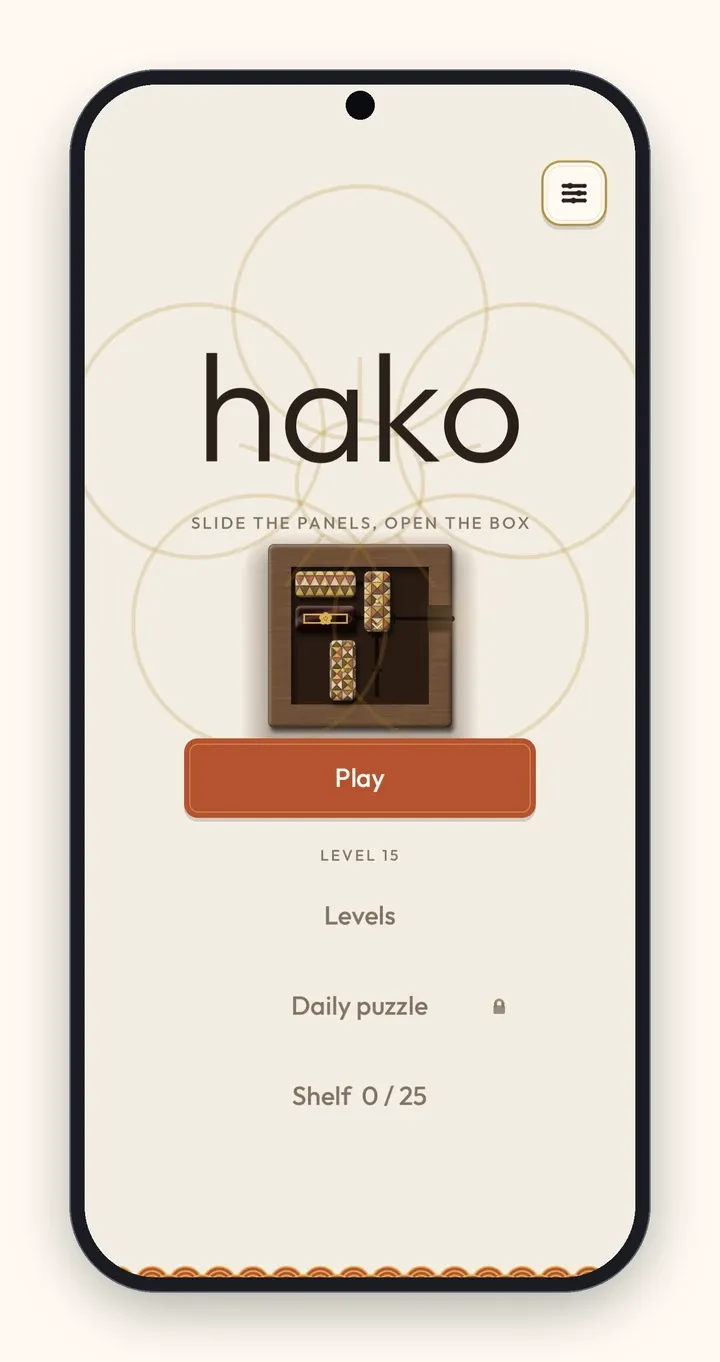
The lid also moves between screens now. When you go from one screen to another, a gold-edged lid slides across, and the next screen is behind it. It sounds like a small thing. But when every screen change is a lid sliding, the whole game starts to feel like a box you are slowly opening.
Why collect anything
I know some players will never look at the shelf, and that is completely fine. Every box is a full puzzle on its own.
But for me, a treasure at the end of a chapter changes how the chapter feels. You are not just doing a row of puzzles. You are working towards a fox mask, or a daruma, or a little hako that nobody has opened. And a lacquer you earned with your own stars makes the next box feel a bit more yours.
That is all Hako is, really. Wood, a little gold, and something waiting inside. If you are new, the rules of Hako will get you opening your first box in a minute.