 Rinse
A snowman, a lighthouse, a rocket: every level in Rinse is a thing
Every Rinse level is one grimy thing to wash, from a patio slab to a rocket. How the things are built from shapes, painted, and put in an order that only gets harder.
 , 7 min read
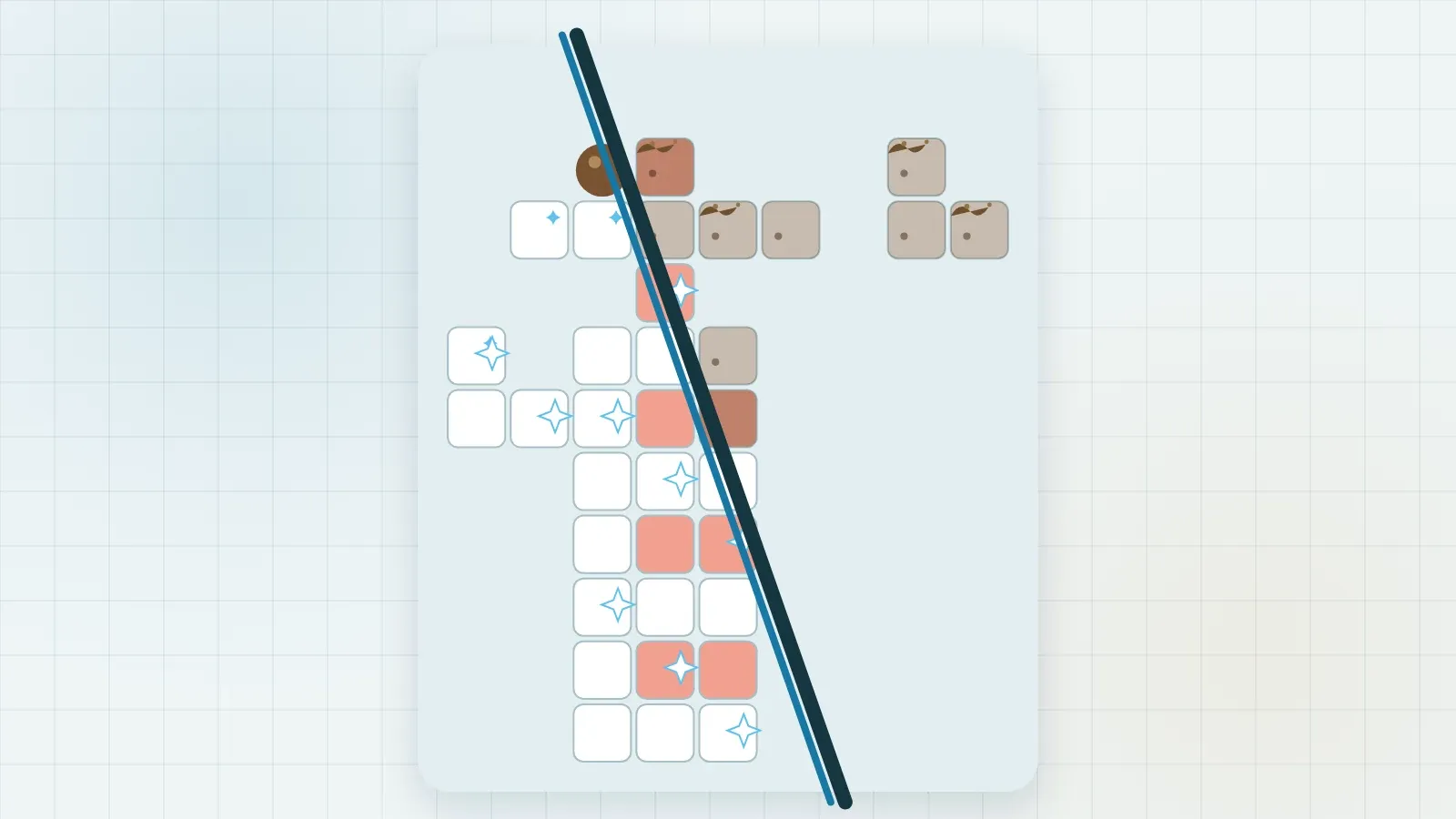
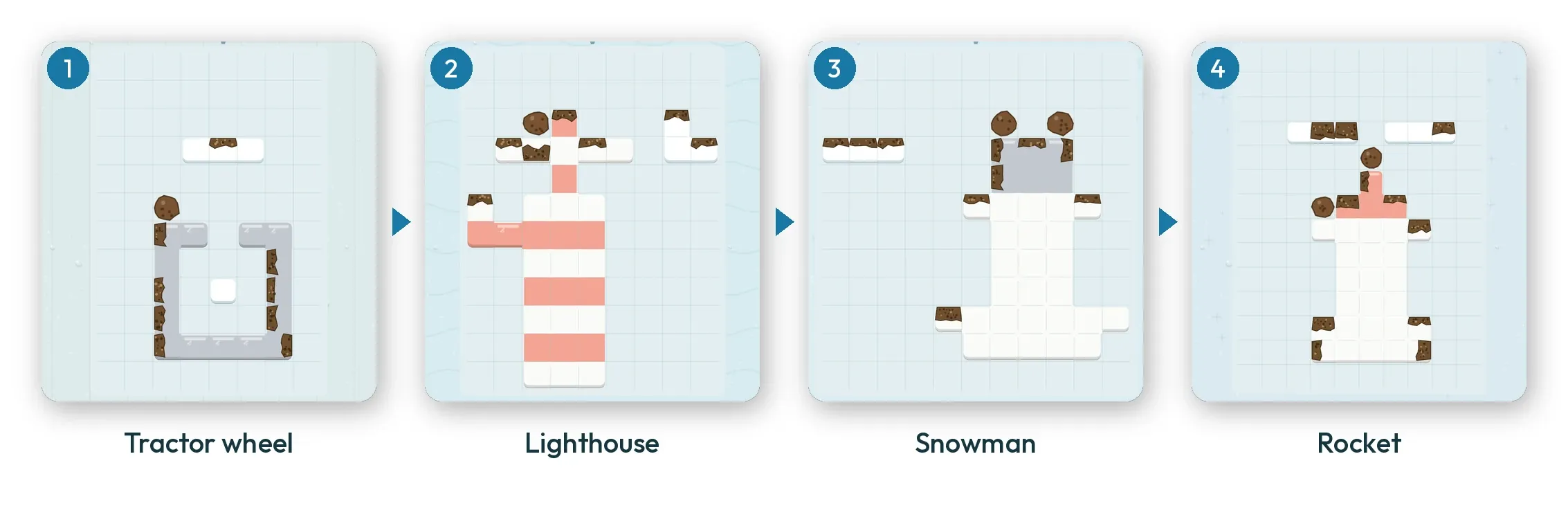
The first level of Rinse is a patio slab. Level 224 is a lighthouse. Level 364 is a snowman, and level 461 is a rocket.
Every level in Rinse is one thing to wash, and each one has its name written under the board like a label in a museum. This post is about why I did that, and how all those things got made without me drawing any of them by hand.
Why things, and not just boards
The rule of Rinse never changes after the first few chapters. Pour, and dirty water runs downhill. I wrote about the water in how water washes.
With one rule, the danger is that level 150 feels exactly like level 50. Harder, sure, but the same grey blocks. And a cleaning game lives on its before and after. A clean grey block is not much of an “after”.
So I made every level a thing. A garden bench. A pig trough. A toaster. A bird table, a fish tank, a phone box, a tugboat, a grand piano, an igloo, a cement mixer. When you wash it clean, you have washed something.
Families of things
Each chapter is a family: a place, and the things you would find there.
The garden has a stone bench, a sundial, a hedgehog house and toadstools. The porch has a shoe rack, a letterbox and a mailbox post. The kitchen sink has a pot stand, a cheese grater and a bread loaf. Then the farm, the bathroom, the park, the water park, the street, the beach, the playground, the garage, the harbour, a pet corner, a museum with a dinosaur and a pharaoh mask, a railway station, a funfair, a castle, a campsite, a ski resort with a snowman and a gingerbread house, the rooftops, a building site, a market, a greenhouse, a space centre, and at the end a town square with an old well.
Each family has its own short line on its first levels. The harbour says “Bail out each boat before you scrub it.” The museum says “Old dust runs thick. Work from the top down.” The ski resort says “Ice and snow. Every pour has to count.”
How a thing is built
Of course I did not draw every one of them. A program builds them from shapes.
A thing is a shape builder with its own sizes. For example, there is a builder for a cup on a stand. With a small cup, a shallow bowl and a tall stand, it is a bird bath. The same builder, wide and flat on a short base, is a shower tray. A tower builder with a lamp on top and a little gallery is a lighthouse. A figure builder with three round parts stacked, two arms and a brim hat is a snowman.
Every time the program draws a thing, it picks sizes inside that thing’s ranges, maybe mirrors it, and stands it somewhere on the board. So one name gives many different boards, and the program can choose the one that fits the level best.
A shape also leaves slots for pieces: a place for a plug in a cup’s floor, a tray, a drain. The chapter decides which slots come alive and how dirty the tiles are, and adds a few small ledges above the thing to catch its runoff.
Then every column is poured into a few times over, and any dirty tile that no water could ever reach is wiped clean. No level ever asks you to wash something you cannot reach.
Painted so you can tell what it is
A thing made of square tiles can be a bit hard to read. Is that a lighthouse or just a tall stack?
So the board draws a thing as one piece. Tiles that touch are joined, with fine grout lines between them, so the outline reads before the squares do. And the thing is painted by its name and its shape:
- a kettle or a pan in steel, a bucket in red, a watering can in green
- a gnome in blue with a pointed hat, a rocket in white
- a house with its roof, a car with its tyres and windows, a boat with its keel
- a lighthouse in red and white stripes, a traffic cone in orange and white, a helter skelter in red and yellow
The colours are soft pastel glazes on purpose. Grime has to stand out clearly on every one of them, in every tile set, so you are never unsure whether a tile is clean.
Before and after
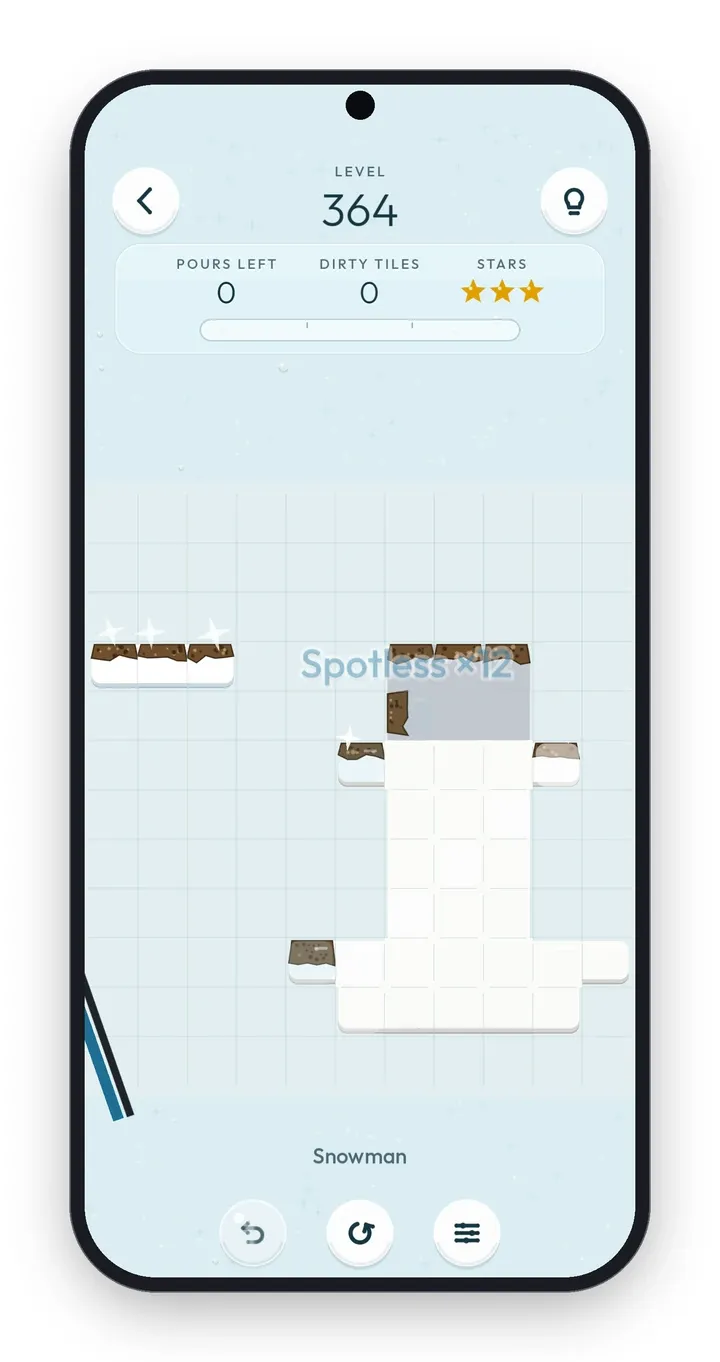
When you wash the last tile, the board shines, and then comes my favourite part. The grime the thing started with comes back across the board for a moment, and a squeegee wipes it off from left to right, sparkling where it passes. Then the result comes up.
So every level ends on its own before and after, right on the board, where you were already looking.
An order that only gets harder
Now, the order of levels. In a puzzle with a solver you can count moves. In Rinse, how hard a board feels is not just how many pours it needs. A board that needs three pours but can be washed by almost any three pours is easy. A board that needs three pours in one exact order is hard.
So I measure something I call bits of luck.
Six hundred pretend players, each pouring into random columns until the tank is empty, play every board. If half of them wash it clean, the board scores one bit. If one in four does, two bits. If one in sixty-four does, six bits. More bits means more of the solution is planning and less is luck.
The tank is part of this too. An extra pour in the tank makes luck more likely. So every board is measured with each tank size its chapter allows, and the program chooses. That is why tanks are generous early and tight late, without any rule saying so. In the garden, most levels give you spare pours. In the town square at the end, most give you none.
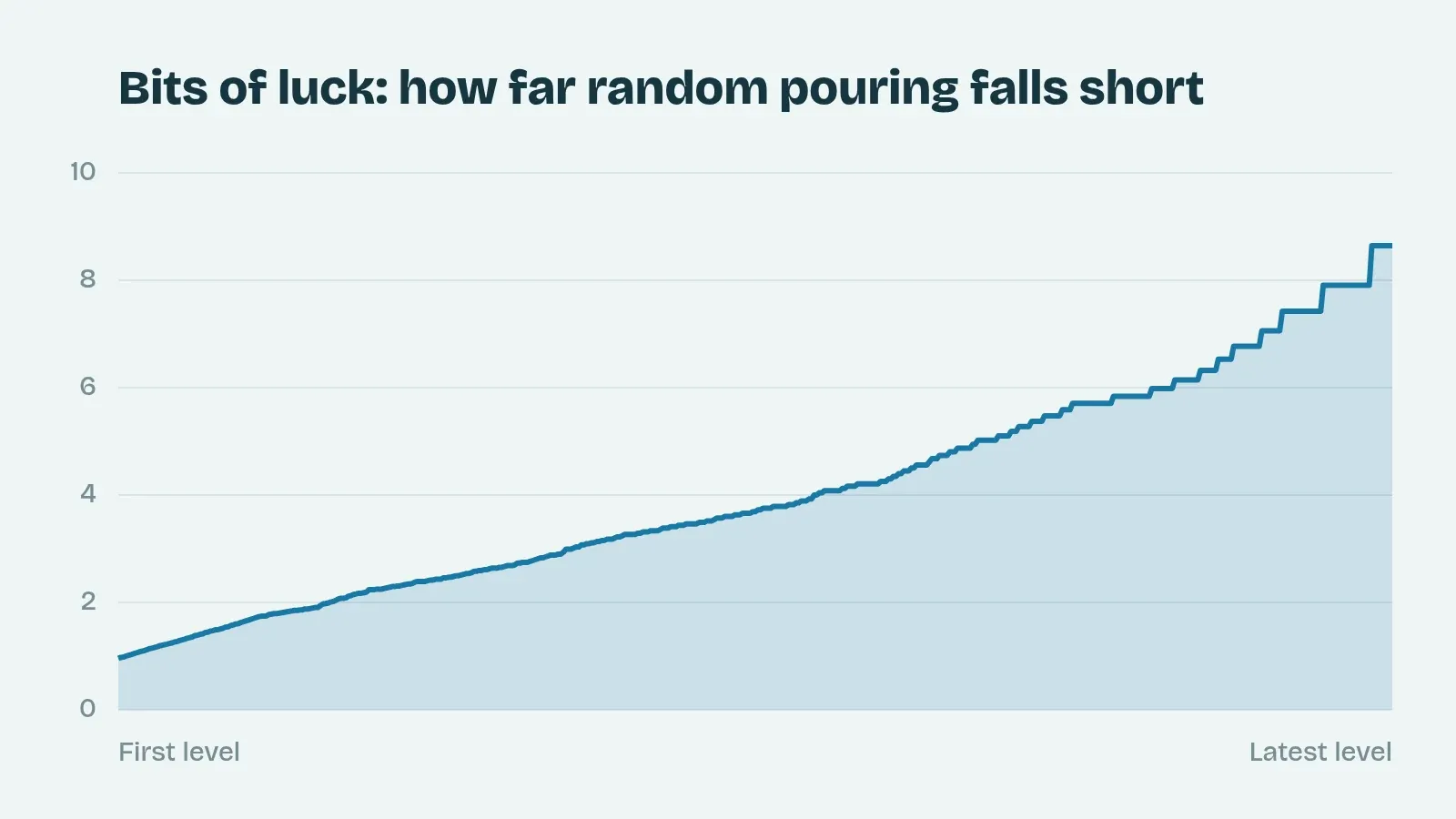
Then a program picks the levels so the bits never fall from one level to the next, chapter starts included. Each chapter gets a band of bits that starts where the last one ended, and fills it with different things, one board each, in rising order. The bands are chosen to stay close to one straight line from the start of the game to the end. There is no easy last chapter. The last chapter is simply the hardest.
The very first version tried to follow that line one level at a time, with the things in a fixed order. It could not find any way through at all. A thing’s boards spread over several bits, and a whole chapter of them in a fixed order climbed too steeply. Letting each chapter choose its own order inside its band, and letting the tank size vary, is what made it work.
Most goals are three or four pours. The longest are three building site levels, 403, 406 and 407, at ten pours each. I am a little proud of those.
Every level is checked
Every level ships with a plan that washes it within its tank, and that plan is played through the game’s own water before the level is saved. On top of that, the whole set is checked again: every goal washes clean within its tank, the bits never fall, no two levels look alike, and every level names its own thing. Every level is checked again whenever the game changes.
And no thing is ever used twice. Every level is its own.
That is the idea in one line: the rule stays the same, so the thing changes every time. If you ever wash a level and think “wait, that was a dinosaur?”, that is exactly the reaction I hoped for. How it all looks and feels, the wet glass and the squeegee and the Spotless counter, is in glass, a squeegee and Spotless.