 Rinse
Glass, a squeegee and Spotless: making Rinse feel clean
Why every screen in Rinse sits behind wet glass, why screens change with a squeegee wipe, and how a Spotless count and a rising note make washing satisfying.
 , 7 min read
A puzzle can be perfectly fair and still feel like homework. In a cleaning game that would be a real shame, because the whole point of a cleaning game is the feeling. The dirt coming off. The squeak. The shine at the end.
So once the water in Rinse worked, a lot of the work went into how it feels. This post is about that part: the glass, the squeegee, and all the small sounds and sparkles that make a pour satisfying.
One picture to start from
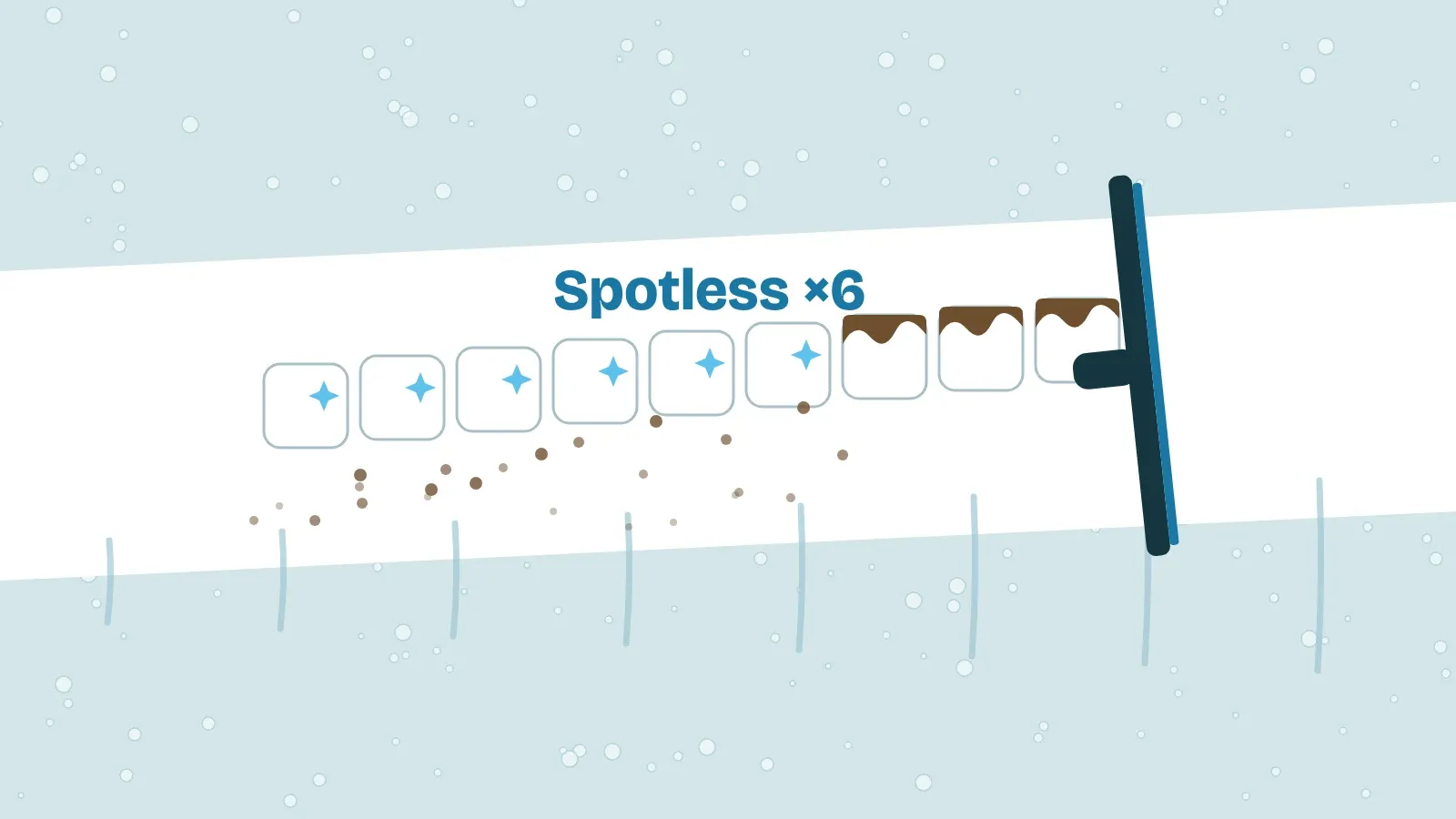
It started with the store art. When I made the Play Store graphics for Rinse, I tried a few directions side by side, and one picture won easily. A squeegee wiping down a pane of wet glass. Above the blade, the glass is clean and beaded with drops. Below it, the glass is still streaked and brown.
That one picture says “Rinse” better than any sentence I could write. So I decided every screen in the game would be that pane of glass.
Everything is behind wet glass
Every screen in Rinse sits behind a pale aqua pane, frosted with a light mist, with bigger beads of water that catch the light. Now and then a drop runs down one edge. In the dark look it becomes deep sea-green night glass, with the beads dimmed.
On the title screen, the word “rinse” is written in a clean streak across fogged glass, as if a squeegee just went over it, with drops running down from the streak’s lower edge. Under it there is a small grimy slab you can tap, and it washes clean. And if you touch the fog anywhere, you leave a clear fingerprint on it, which slowly mists over again. That fingerprint is a silly little thing, but it says “glass” without a word.
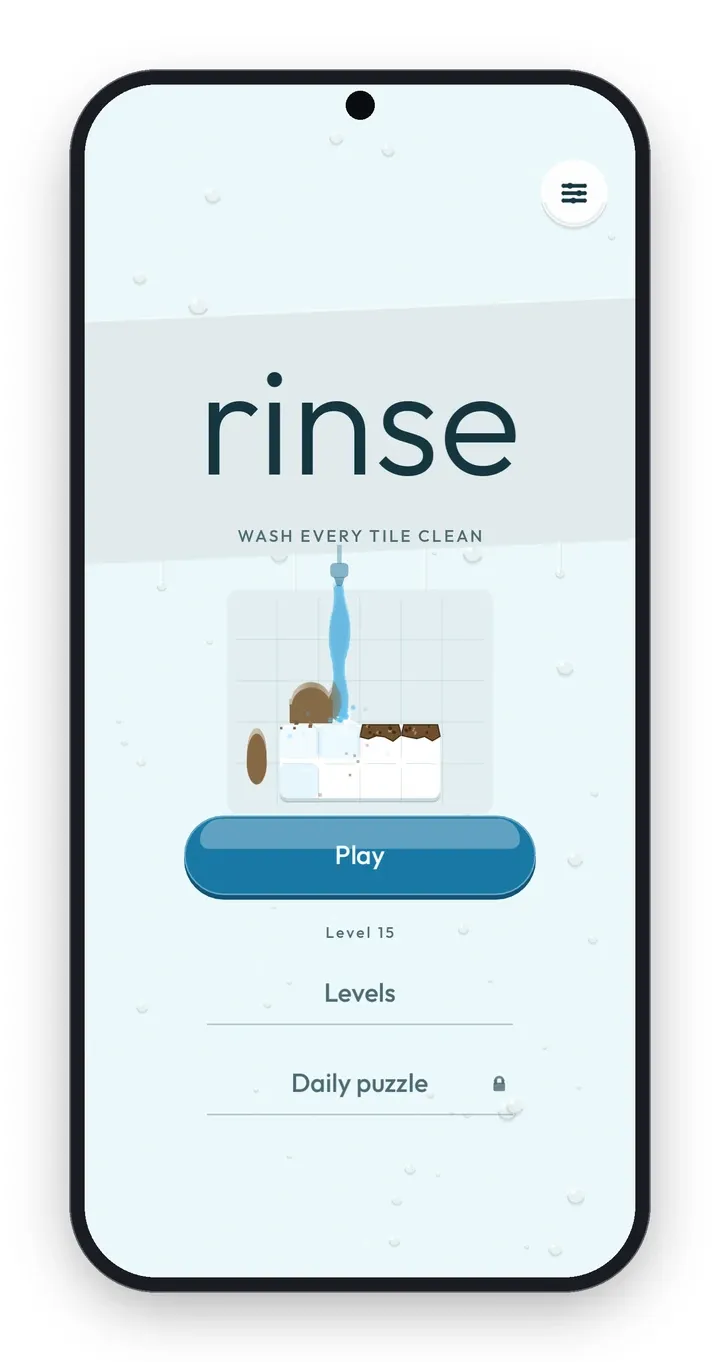
The sheets are glass too. The result card, the hint offer, Settings and the shop all slide up as panes of glass with beads running down them.
Every screen change is a wipe
When you move from one screen to another, a rubber blade crosses the screen on a slant. The old screen goes with the water it pushes, and the new screen is behind the clean streak. A few beads are left trembling at the edge. Going back wipes the other way.
It takes about a quarter of a second. Anything longer gets tiring by the tenth screen. A quarter second is enough to see it and not enough to wait for it.
The board
On the play screen, the board is a tile panel set into the glass. The thing you are washing is drawn as one piece, with soft pastel glazes, and its name sits under the board like a museum label. I wrote about the things in a thing to wash.
Pours left, Dirty tiles and Stars are written along a strip of glass at the top, each with its word, never a bare number. Under them, the tank is a little glass gauge: water up to the level of the pours you have left, with a notch for every pour. Each time you pour, the water sinks a notch with a slosh.
Clean and dirty never depend on colour alone. Dirt is a lumpy crust with specks on top of the tile. A clean tile gets its glaze line back with a sparkle.
Grime popping off
Now the satisfying moments, one by one.
When a tile comes clean, its crust cracks and pops into four to six little brown drops that fall away with the water, and the tile’s glaze line flashes. There is a short click, pitched by how high the tile is on the board.
When one pour cleans several tiles, a counter rises from the last one: “Spotless ×3”, counting up as each tile pops. Each tile plays one step higher on a musical scale, a pentatonic one, so a big pour plays a little rising run that never hits a sour note.
From the fourth tile, each step also stops time for a tiny moment, 45 milliseconds at first and a little longer each step, up to 85. You would not notice it as a pause. It reads as weight, as if each tile is heavy to clean. The board gets a small punch too. At ×4, ×6 and ×9 there is a burst.
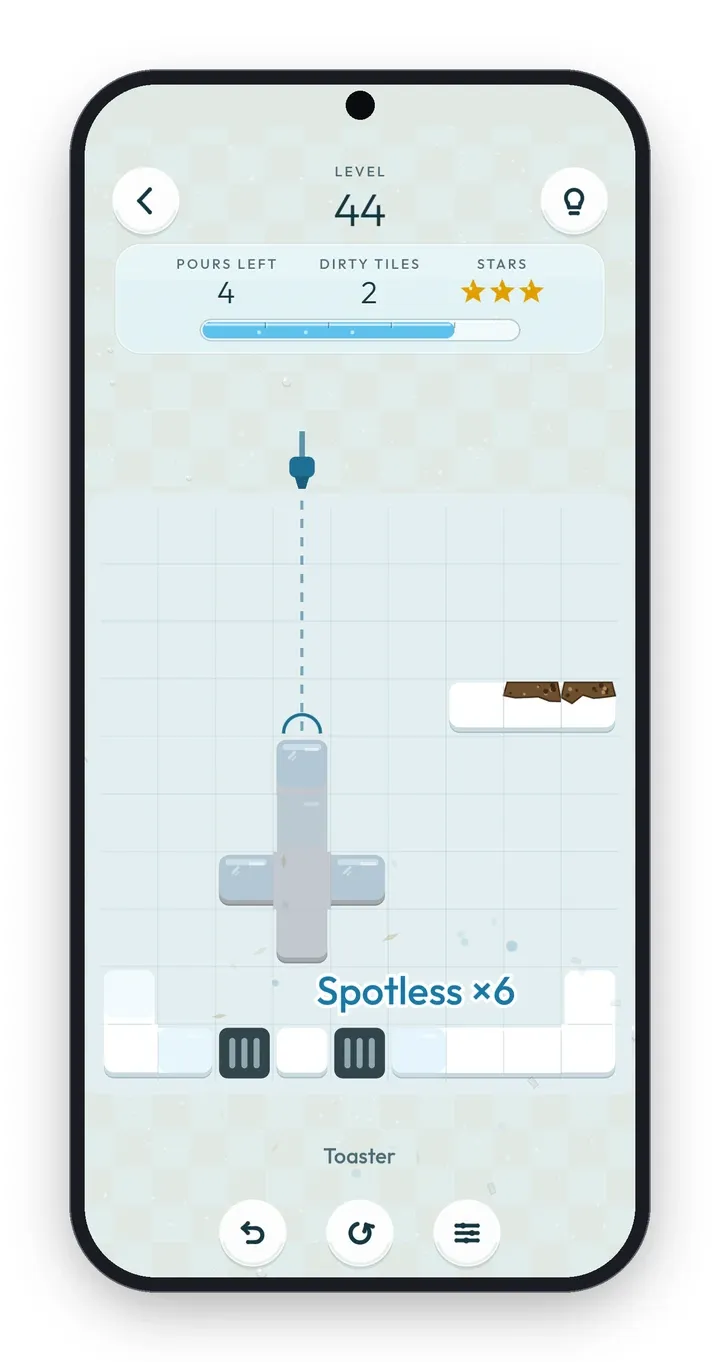
The hit-stop starting at the fourth tile was a real choice. Starting from the second, every pour stutters, and the big ones stop feeling special. Starting from the fourth, small pours stay smooth and big ones land.
A pour streak
Pours that each clean at least one tile build a streak. Each pour in the streak sounds a semitone higher, and the stream gets a little thicker. A pour that cleans nothing ends the streak with a soft gurgle. No buzz, no shake. Just a gurgle, which is honestly what a bad pour sounds like in real life too.
There is also a short praise word now and then, in Rinse’s own words: “Squeaky”, “Gleaming”, “Sparkling”, “Spotless”.
The end of a level
When the last tile comes clean, the water drains away, a diagonal shine sweeps across the board, and every tile sparkles in turn behind it. Then the before and after: the old grime comes back across the board for a moment, and the squeegee wipes it off from left to right. Then the stars drop in one by one with a rising chime, and the pours against the goal, like “3 pours, goal 3”.
If the tank runs dry instead, the glass fogs over softly. “Out of water”, how many dirty tiles are left, and three ways on: One more pour, Restart or Levels. Never a dead end.
Mud has its own moment, a thud, a splatter and a tiny shake. A tray creaks, tilts and drops its water with a whoosh. And on your phone, you feel a light tick for each clean tile, a firmer one from the fourth, and one long soft one when you win.
Looks you collect
The last part is the collection. Three things on the board can change: the tiles, the water and the grime. And any of them goes with any of the others.
- Tiles: Porcelain and Mint to start, then Terracotta, Slate, Delft blue, Pool blue, Brick, Seaside pebbles, Toy blocks, Marble, Ice, Copper, Jade, Neon, Mosaic, Glass, Chalk, Candy, and Gold leaf for a hundred-day streak.
- Water: Clear, then Soap bubbles, Bubble bath, Sea, Peppermint, Rain, Lemonade, Fizzy, Foam, Rose water, Moonlight, Rainbow and Glitter. Bubbles ride the surface, fizz rises, glitter twinkles.
- Grime: Dirt, then Autumn leaves, Mud, Moss, Rust, Soot, Candyfloss, Sand, Chocolate, Jam, Slime, Paint splats, Ketchup, Ink and Glitter glue. Each has its own crust, and dirty water takes its colour.
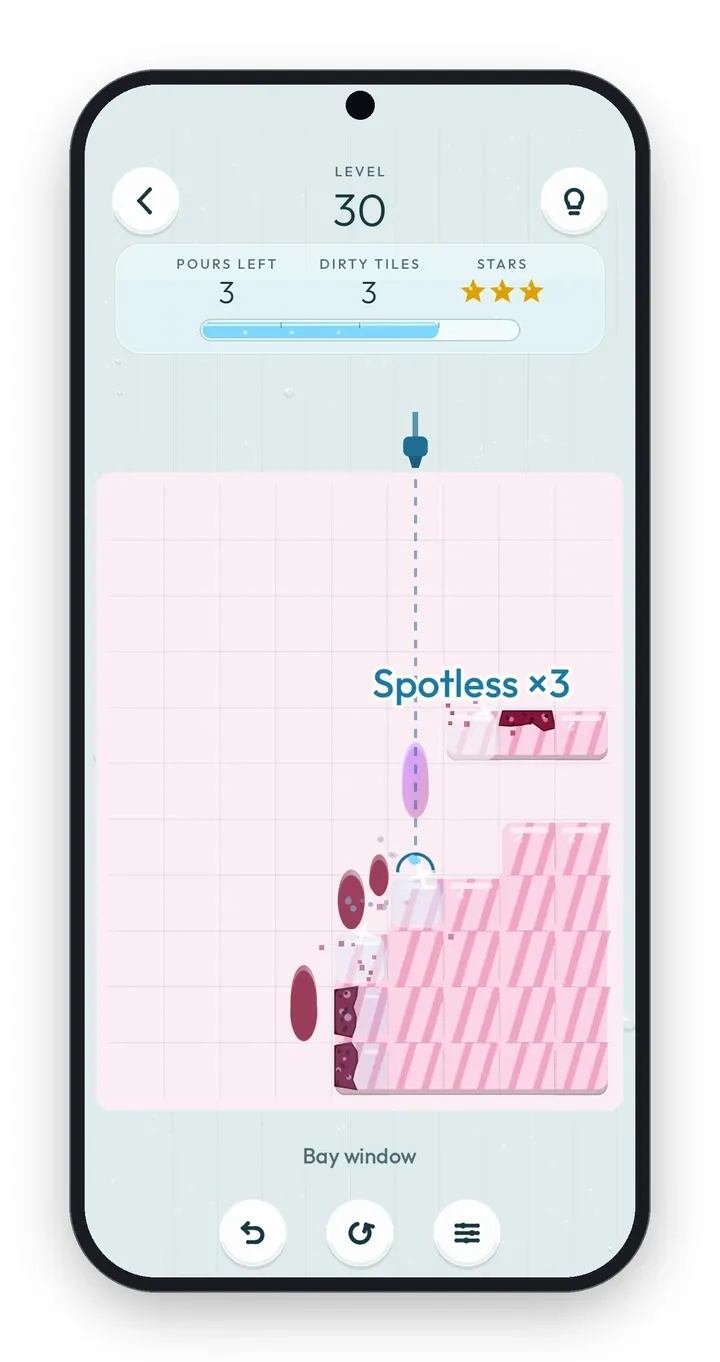
Mixing them is the fun part. Washing jam off candy tiles with rainbow water is, I can say with full confidence, not something any real person has ever needed to do.
You earn them by playing. The first, Soap bubbles, comes when you wash your third level, so you see a card turn over in your first few minutes. Then every chapter you finish opens one, every 60 stars opens one more, and daily streaks open a few. The Tile pack in the shop adds some too. And Shuffle wears a different mix you own on every level.
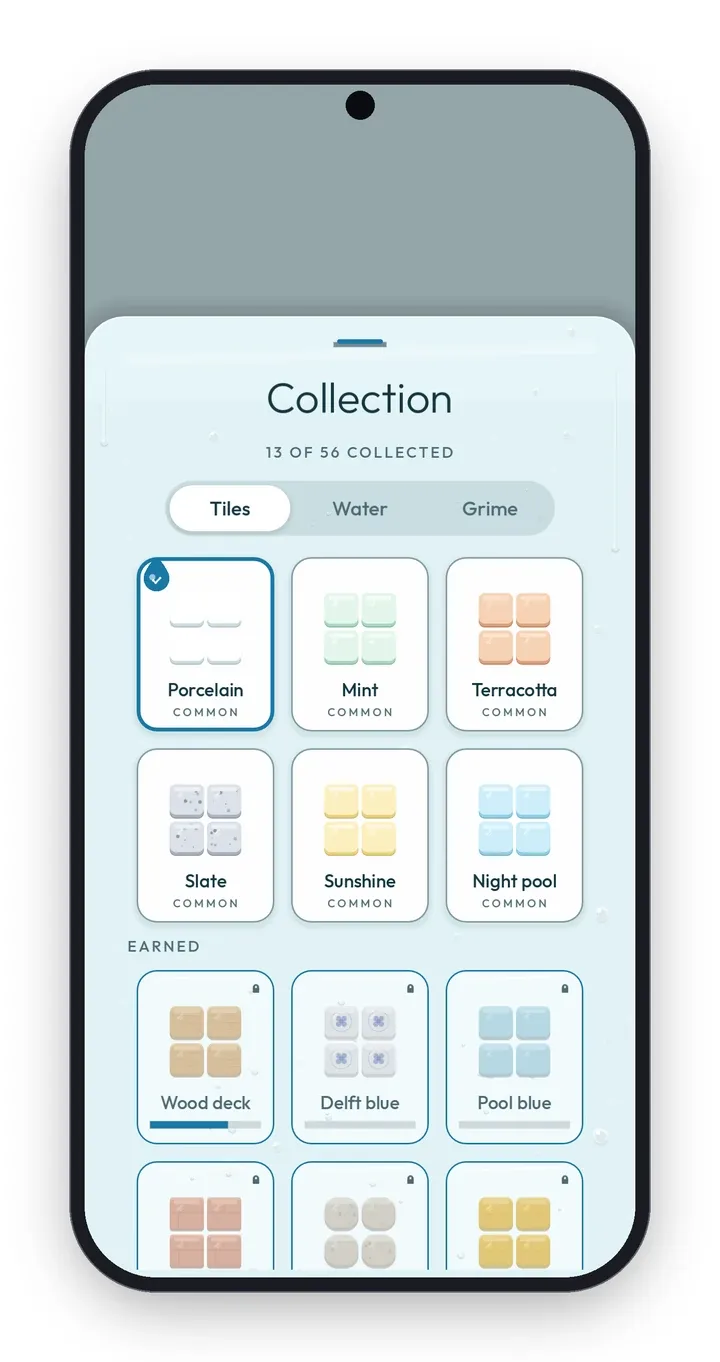
One rule held for every look: grime always stands out clearly from every tile set and every painted thing. A look can change how a level feels. It can never make it harder to see what is still dirty.
Why all of this
You could play Rinse with plain squares and no sound and the puzzle would be exactly the same. But a puzzle game is something you hold in your hand for a few minutes at a time, often when you are tired. I want those minutes to feel good. A squeak, a sparkle, a note going up. A board that ends cleaner than it started, and a quick wipe to remind you how dirty it was.
That is all the glass is for. If you want to know how the water itself works, how water washes has every rule.