A stranger played my game for 74 minutes, then installed two more
Someone in the United States found Plumb on Google Play, played it four days in a row, then installed two more of my games three minutes apart. Here is how.
 , 10 min read
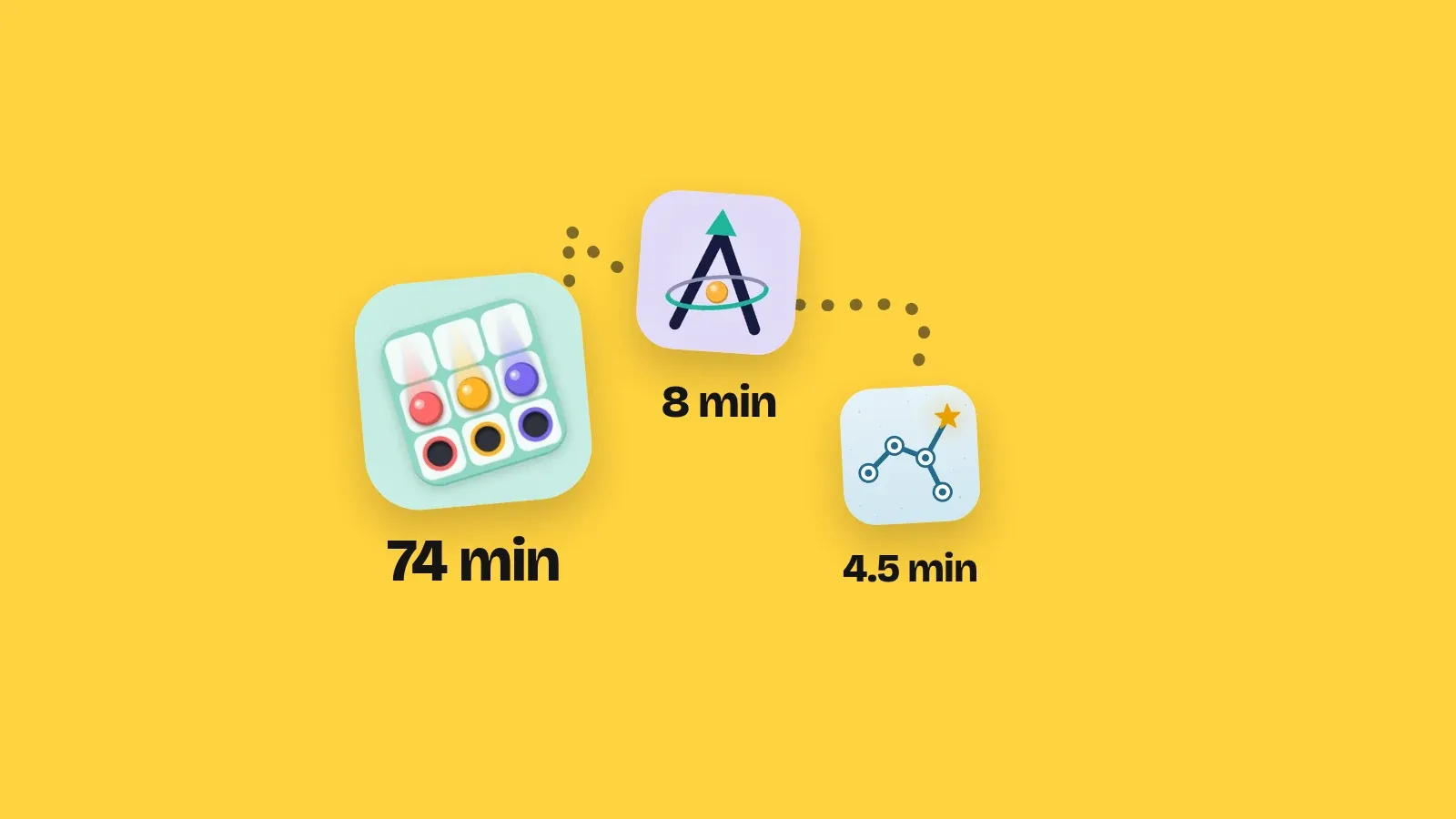
Someone in the United States found Plumb on Google Play. They played it for 1 hour 14 minutes, four days in a row. Then, on the fourth day, they installed two more of my games, three minutes apart.
As far as I can tell, they are a stranger. Not a friend, not one of my testers, not someone who came from my videos.
I did not pay for it. No ad network did it. My own games did.
Here is everything Google Analytics can tell me about it, and everything it can’t.
How I follow one phone
Analytics does not tell me who anyone is, and I do not want it to. It tells me a country, the kind of phone, and what happened inside each game.
When I worked out how 1,000 players turned out to be 83, I learned to take out Google’s test phones and my own phone first. What is left are real people.
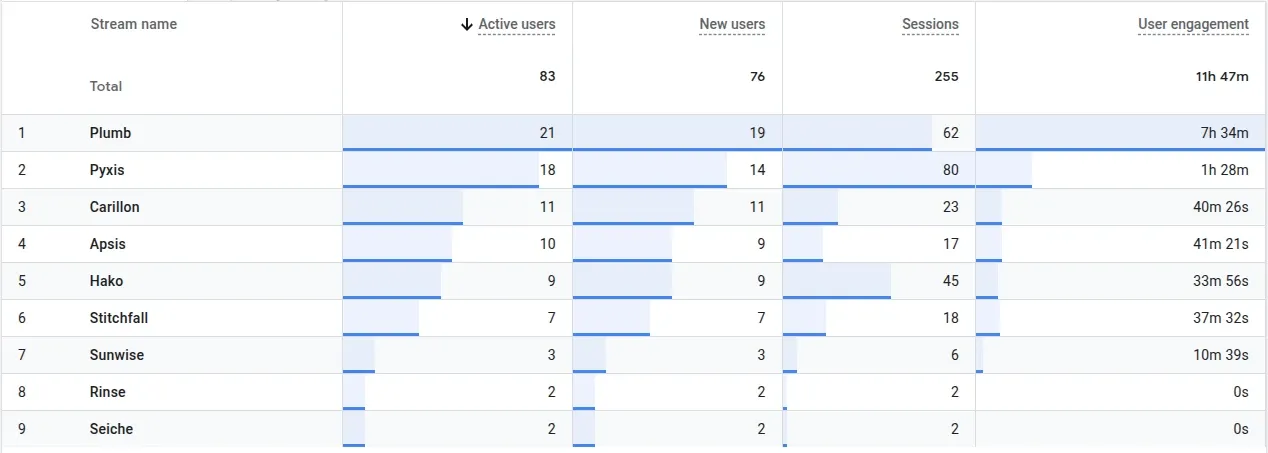
Then I use one trick. One country plus one phone model is my stand-in for one person. It can go wrong when two people in the same country own the same popular phone. For the two players in this story it does not: in every game, Analytics counts exactly one player on each of their phones.
I will not write the phone models here. A country is enough.
Four days of Plumb
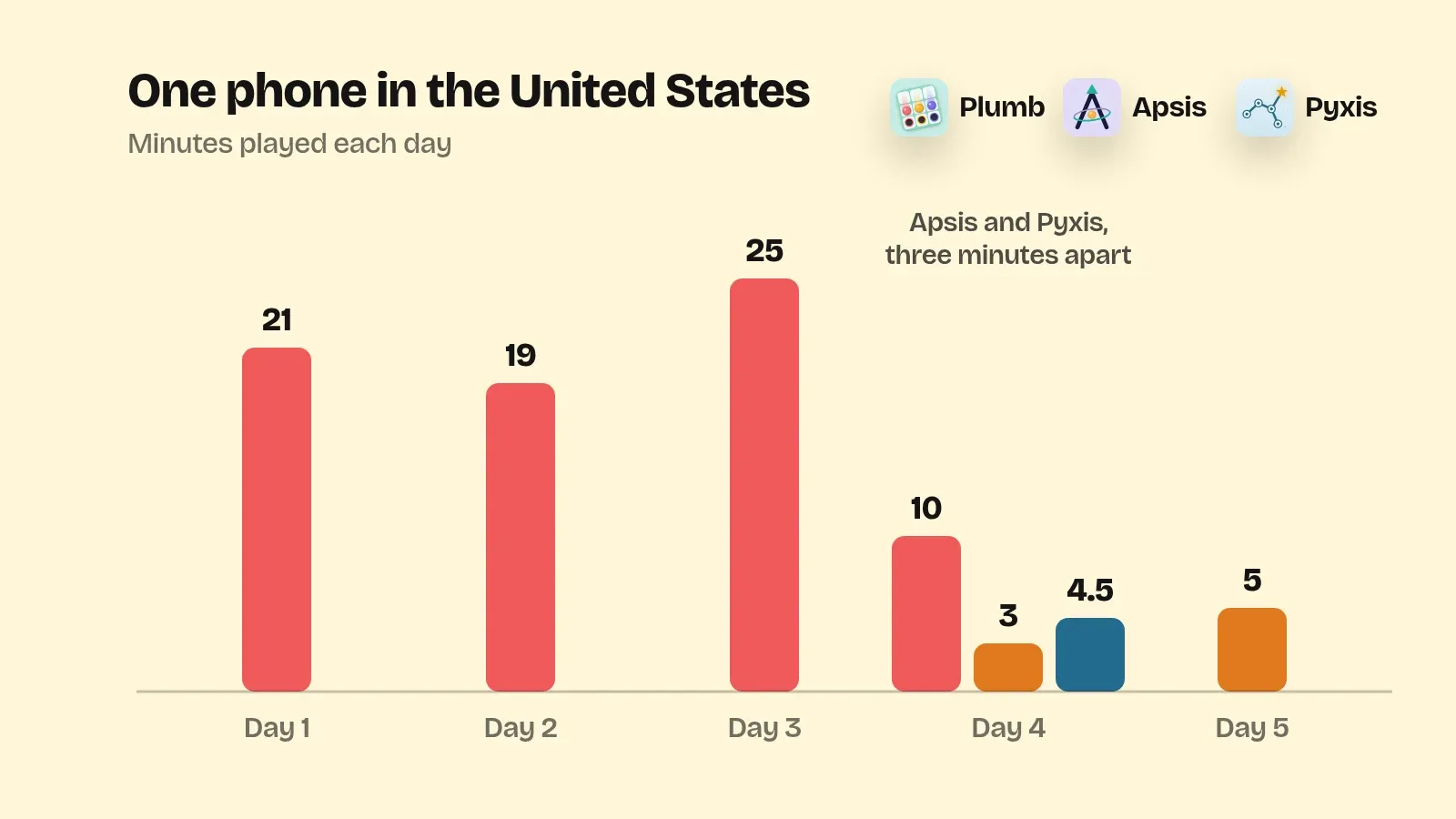
Day one, about 21 minutes. Day two, about 19. Day three, about 25. Day four, about 10.
Nine separate visits in four days. That is what a puzzle game hopes for: a few minutes here, a few minutes there, and coming back the next day.
They pressed the hint button three times along the way. That made me happier than it should have. Some players never press it at all, and I would much rather someone asks for help than quits.
Analytics also says how the install came in: from Google Play, organic. That means it did not come through any of my links or videos. They found Plumb on the store itself, by searching or by scrolling.
I have spent weeks making videos for Plumb. My best stranger came from the store.
They are also the second-longest Plumb player I have ever had. Only one player has spent more time in it.
Three minutes on the fourth day
On the fourth day, they opened Plumb again. One minute later, Apsis opened on that phone for the first time. Three minutes after that, they tapped the strip at the bottom of Apsis. In that same minute, Pyxis opened for the first time.

Plumb, then Apsis, then Pyxis. Three of my games on one stranger’s phone, inside four minutes.
The strip that earns nothing
My games are free, and they are meant to earn from ads. Google’s AdMob has not approved my account yet, as I wrote in How I earned $0 from 9 games.
So the space at the bottom of the screen, where a paid banner would go, shows my own games instead.
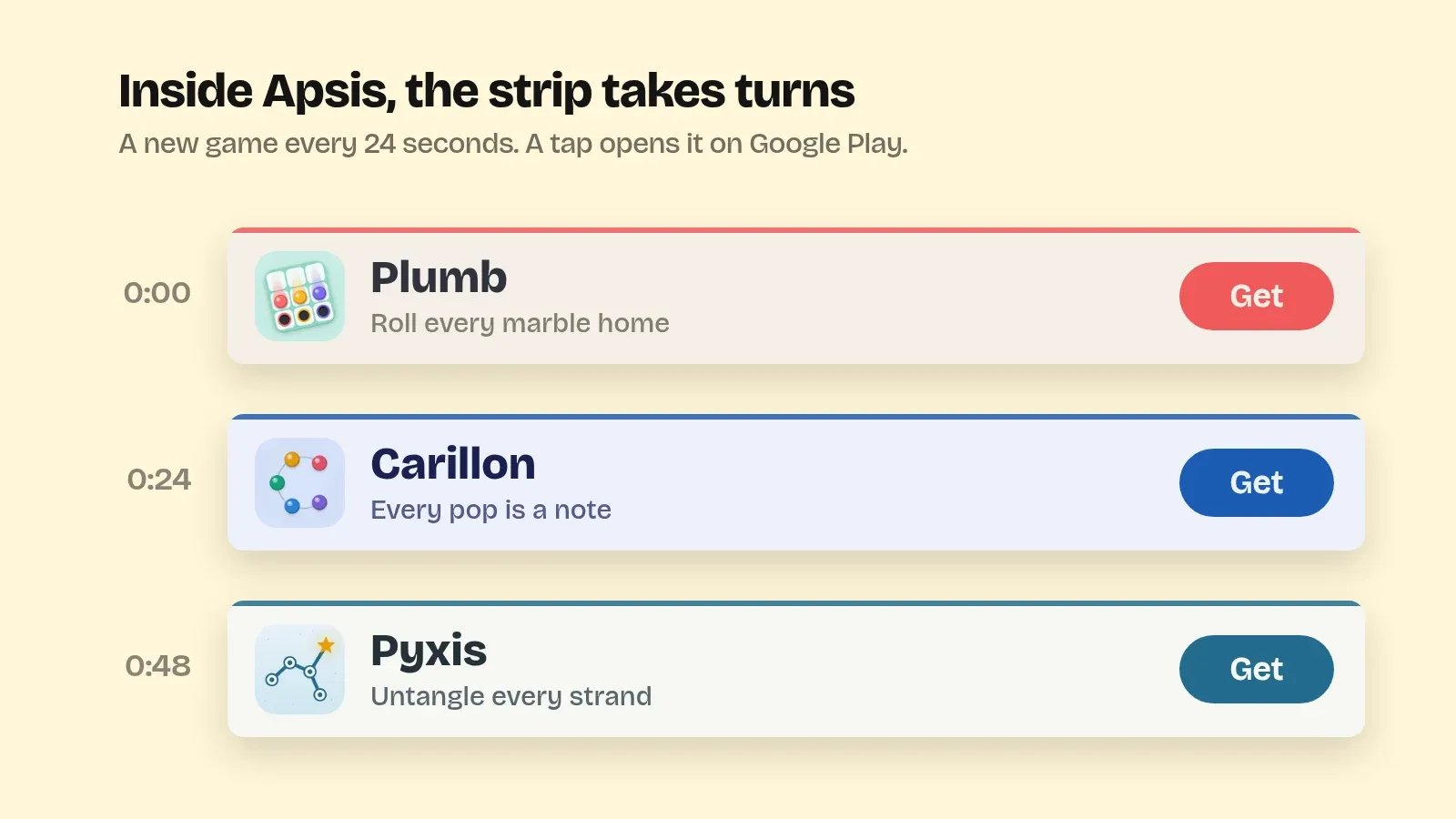
Each turn of the strip shows one of my other games in its own colours: its icon, its name, one short line, and a Get button. Every 24 seconds it moves on to the next game. A tap opens that game’s page on Google Play.
It only shows games that anyone can install. Right now that is Plumb, Carillon, Apsis and Pyxis. So inside Apsis, the strip takes turns between Plumb, Carillon and Pyxis.
It has earned exactly $0. Nobody pays me when you tap it.
For about three weeks it did one more thing. A hint could cost a quick game of one of my other puzzles instead of a video. I took that out this week. Now a hint is simply free when no video is ready.
What I know, and what I am guessing
Pyxis, I am fairly sure about. The tap on the strip in Apsis and the first open of Pyxis happened in the same minute. Pyxis is one of the three games that strip shows inside Apsis.
But I cannot prove it. My games send the name of the game on the strip when someone taps it. I never told Analytics to keep that name, so I cannot read it back now.
Apsis is a real guess. Plumb’s strip did not record a single tap from this phone. Plumb also has a list called More from Chaosmos in its About screen, with a card for each of my other games. That list does not record taps at all.
So they came through that list, or through my page on Google Play, or through something I have not thought of. My bet is the list, because Apsis opened one minute after Plumb did. That is fast for a search.
There is one more blind spot, and it is my fault. The links on my website carry a little label, so Play Console can tell me which page sent each install. The links inside my games carry no label at all. So when one of my games sends someone to another, Google Play has no idea where they came from.
The one in Sweden
The second player is in Sweden. They opened Pyxis first. Eleven minutes later, Apsis. One minute after that, Plumb.
Three games in twelve minutes, and about two and a half minutes of play across all three. That looked like someone trying things and moving on.
Then they came back the next day. They opened all three again, one after another. About five minutes in Plumb, four in Pyxis and one in Apsis.
There is no tap on the strip from this phone at all. I do not know how they got from Pyxis to the other two. My page on Google Play lists every game I have out, so that is one honest guess. The More from Chaosmos list is another.
Coming back the next day to all three is the part I keep thinking about. Nobody does that by accident.
Everyone else who played more than one
Since my games started counting real players, eight phones have played more than one of them.
Two are these strangers.
Five are in India, and every one of them opened one of my games before it was out for everyone. Only my testers could do that, so these are friends, family and the people who test my games. I love them, but they do not count as being found.
The sixth is also in India, and I cannot tell. It played Plumb, and two weeks later, Pyxis.
A few more phones opened several of my games for zero seconds each. They behave like the review phones from the 83 post, so I leave them out.
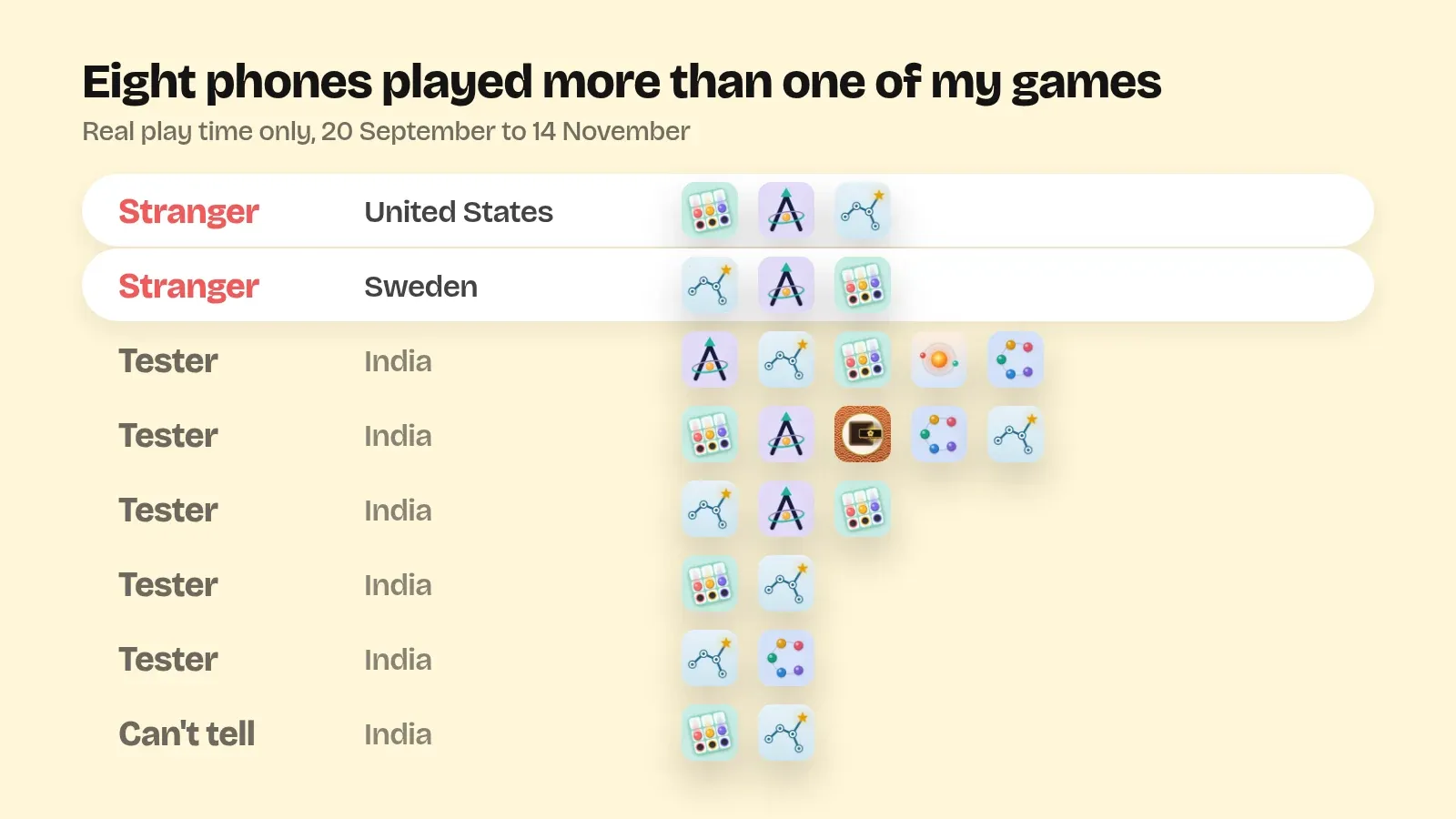
So out of everyone who has really played, two strangers have more than one of my games. Two. It is a tiny number. But they are not tiny players.
48 touches
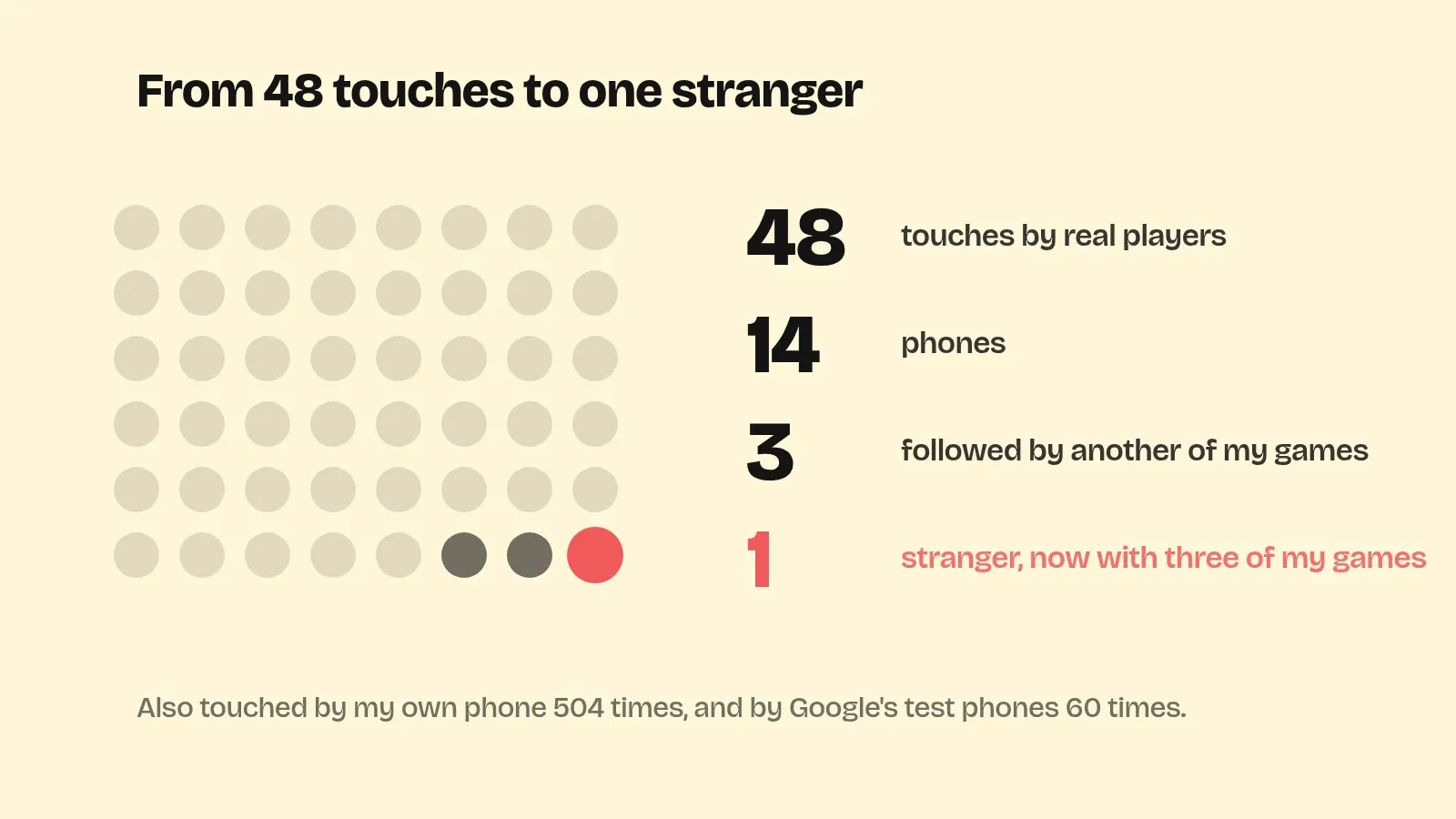
Since the house ads went in, real players have touched them 48 times, on 14 phones. A touch is a tap on the strip or, during those three weeks, a quick game started, finished or tapped through.
Pyxis players touched them 19 times, Plumb players 16, Apsis players 8 and Carillon players 5.
Three times, another of my games opened for the first time on the same phone within half an hour of a touch. Two of those were testers. One was the stranger in the United States.
For comparison, my own phone has touched them 504 times while I test. Google’s test phones, 60 times.
The robots are more interested in my ads than my players are. But the one player who used it the way I hoped turned into three games.
A door, not a wallet
I put my own games in that strip because I had nothing else to put there. It was meant to be a stand-in for money. As money, it has done nothing.
As a door, it might be the best thing in my games.
Think about who sees it. Not a stranger scrolling past a reel for one second. Someone who has already chosen one of my games, and is sitting in it for twenty minutes a day. That is the warmest person I will ever reach.
My most watched reel got 1,617 views on Instagram, and Plumb’s new players did not move that week. This one stranger, reached through a strip that pays me nothing, ended up with three of my games.
When AdMob says yes, paid banners will take most of that space. But the strip still fills in whenever AdMob has nothing to show, so the door stays.
What I want to change
None of this is done yet. It is what this one phone taught me.
- Keep the name. Tell Analytics to keep which game was on the strip when someone tapped it. My games already send it.
- Count the list too. Make More from Chaosmos record its taps, the way the strip does, so next time I know which door they used.
- Label my own links. Give the links inside my games the same kind of label my website’s links have, so Play Console can count installs that came from another of my games.
- Watch the cost. In the two days since, this player has opened Apsis once more, and not Plumb. That is far too early to mean anything. But it is a fair question: did my own strip pull my best stranger away from the game they liked most?
- Every new game joins the strip. When Pyxis came out for everyone, I added it to the strip in my other games that same day. Every game after it gets the same.
If you make more than one game
If you have two games or more, a few things I would do on day one:
- Put your own games in the ad space while you wait for ads. It costs nothing, and it is the only cross-promotion you fully control.
- Show only games anyone can install. A strip that sends people to a closed test is a dead end.
- Log every tap with the game’s name, and make your analytics keep that name. I did only the first half.
- Label every store link, even the ones inside your games.
- Count your multi-game players by hand once. It takes ten minutes, and it is the happiest ten minutes you will spend in analytics.
To the two of you
To the person in the United States: thank you for four days of Plumb. I hope Apsis is treating you well. And if Pyxis ever looks like a bowl of noodles, the hint button is right there.
To the person in Sweden: thank you for coming back the next day. That is the best thing anyone can do for a small game.
If you want to see what they saw, start with Plumb.