2D, clay 3D or shadow puppets? One horror scene made six ways
To pick a look for our horror reels we made the same 8-second scare six ways, from 2D and clay 3D to manga and shadow puppets. Why the cleanest one won.
 , 8 min read
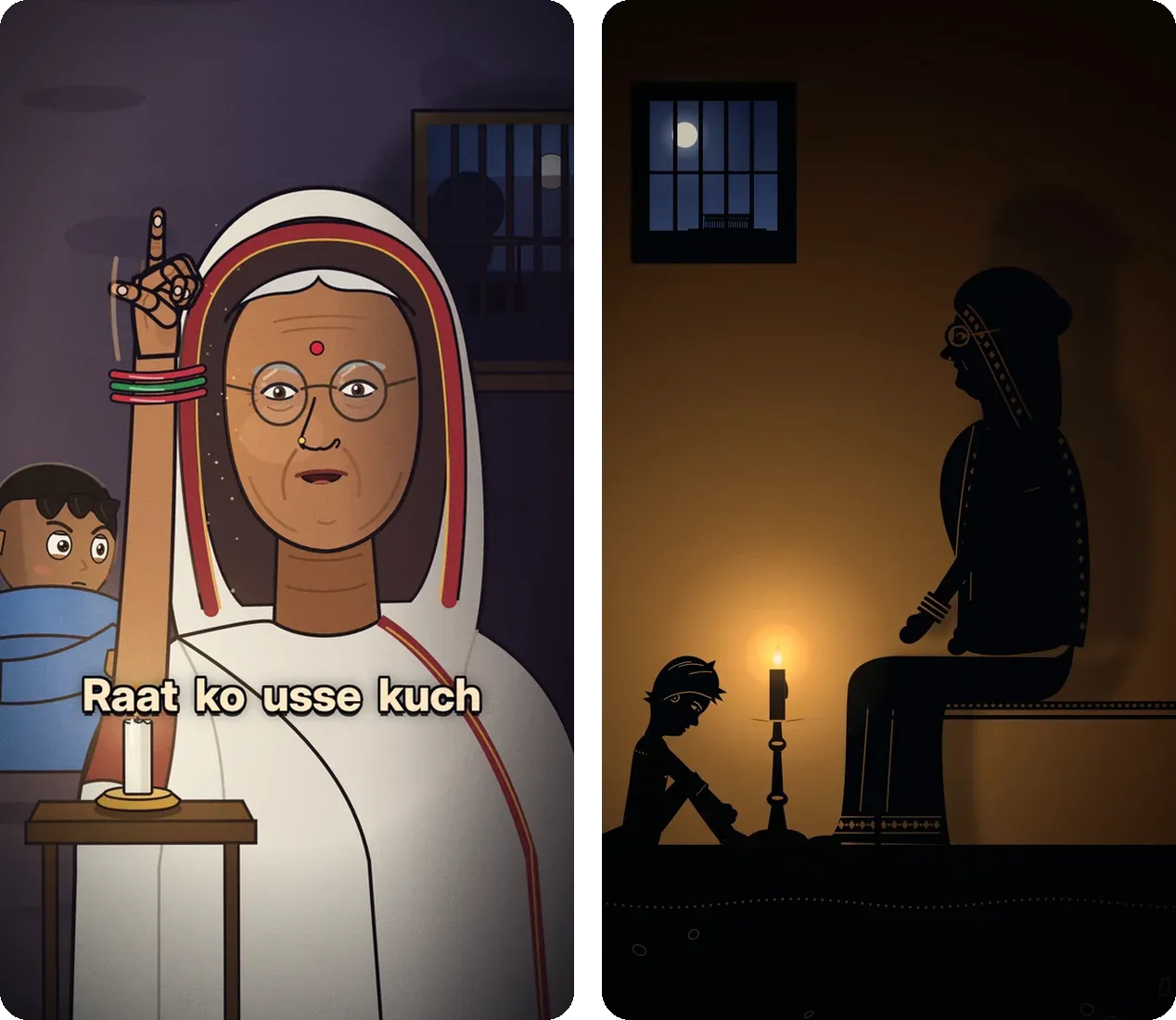
Our first horror reel, Dadi ke kanche, was a drawn story about a grandmother’s marbles. It had 1,115 views and 21 likes on Instagram in its first two hours, far more than our puzzle reels get. So more stories are coming. But in that first reel the camera slid over still drawings, and the characters barely moved. Before making more, we wanted the characters to really act, and to pick the look that lets them.
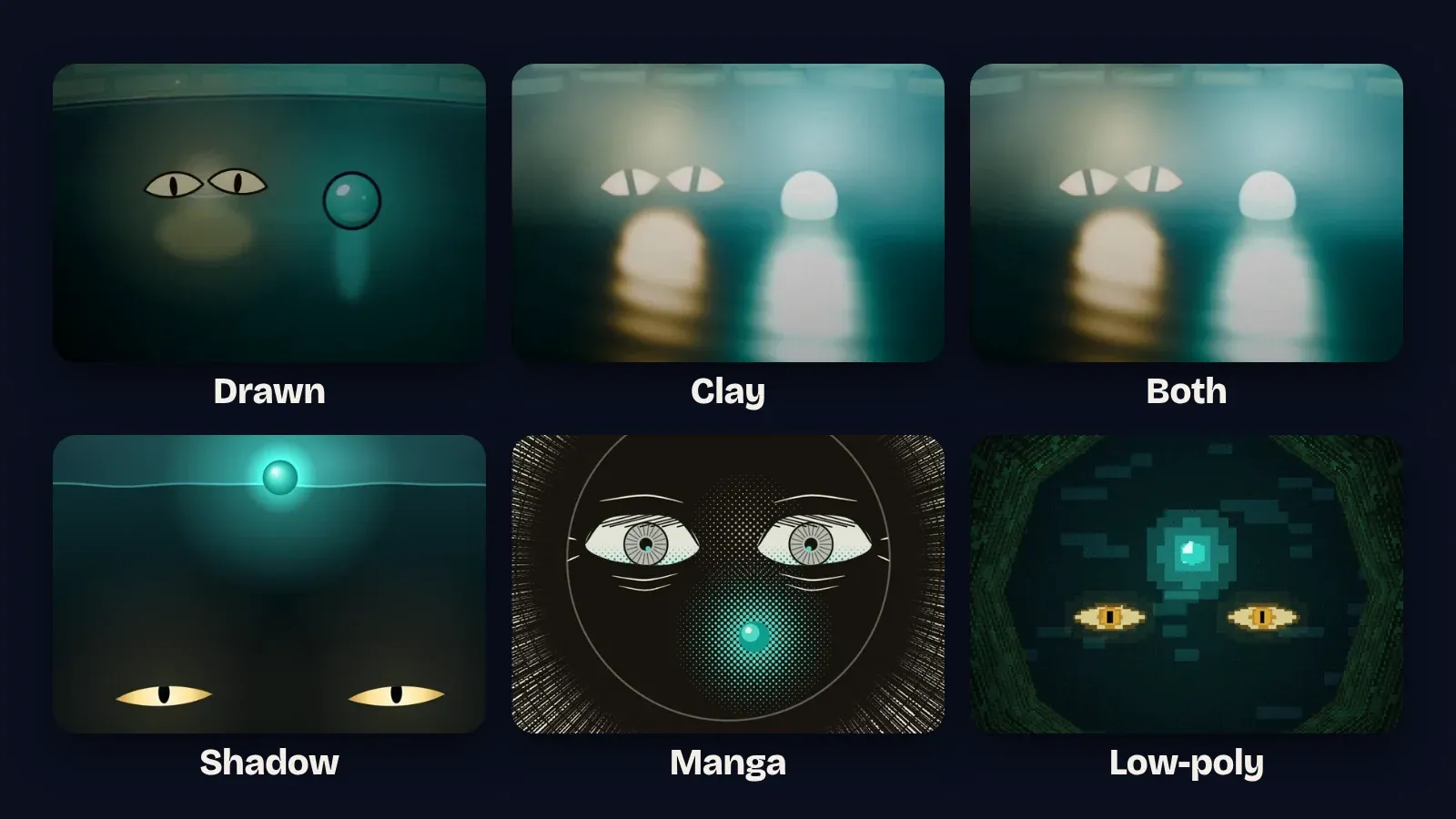
So on 18 November we took one moment from the next story, The Marble in the Well, and made it six ways, in two rounds.
It is 2:40 at night. A boy leans over the rim of the courtyard well, the moon behind him, and a marble glows teal on the water far below. The camera creeps in. In total silence, two eyes open in the water. He flinches back. Eight seconds.
Round one: drawn, clay and both
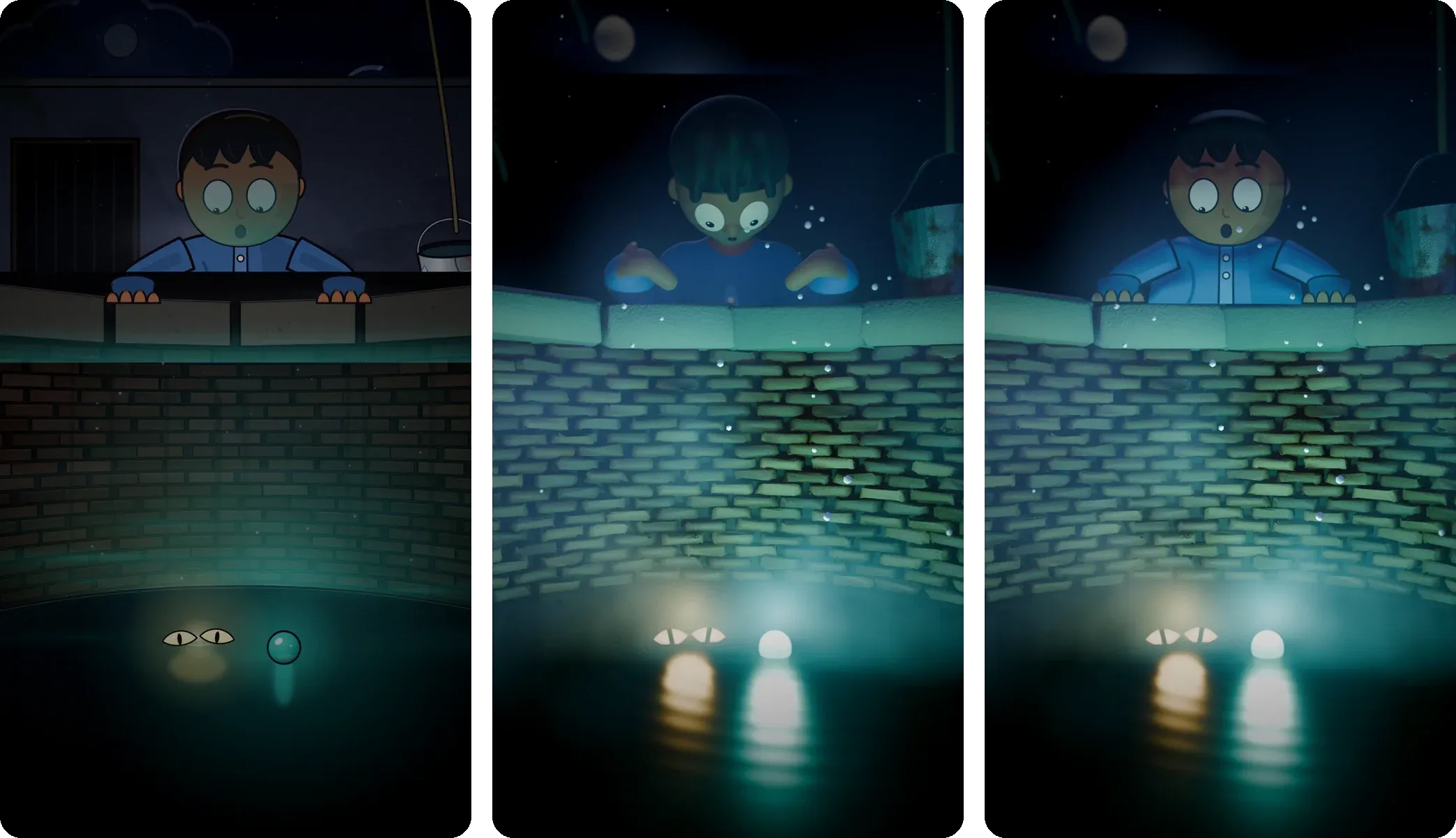
To keep it fair, all three read one performance and one set of beats. The boy’s acting (his lean, head, shoulders, hands, breathing and face) is written once, as keys. The drawn version lays out its bricks from the clay version’s 3D well, seen through the same camera, so the frames line up exactly. All three get the same grain, the same flash on the scare and the same soundtrack.
A tall phone frame cannot show a face you can read and water far below it from any real camera. His face looks down, so it only shows from below, and from below the water is out of view. So the well is built the way a stop-motion set would be: open on the camera’s side, its shaft narrowing toward the water in a forced perspective, and the boy’s lean cheated toward the lens.
- Drawn, a living illustration. The style of the first reel, with the boy as a cut-out puppet: pupils that look where they are told, lids that blink, brows, five mouths and three locks of fringe on springs. When he flinches he stretches on the snap and squashes when he stops, squash and stretch from Frank Thomas and Ollie Johnston’s twelve principles of animation. The camera works like a multiplane camera, every layer at its own distance, so near things slide past faster than far ones.
- Clay, a stop-motion set in 3D. Built in Blender. The boy is about thirty rounded shapes melted together with a smooth minimum, the blend Inigo Quilez describes, and his face is a set of nine painted faces swapped like a stop-motion puppet’s replacement faces. He moves on twos, and each held pose shifts the clay’s grain a hair. The set has about 1,700 thin lakhori bricks, and the light is real: the moon behind him, the marble’s teal flaring up the bricks, mist in the shaft.
- Both. The drawn boy as a flat card in the clay set, each part puffed into a dome so the teal can light his face. But a flat card cannot catch light from behind, and he cannot turn round.
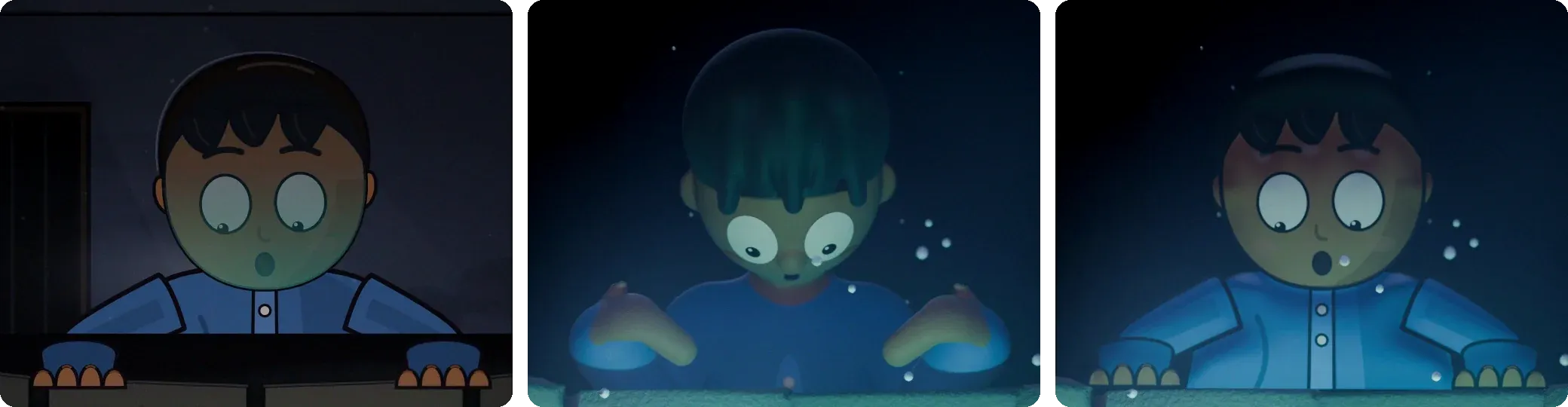
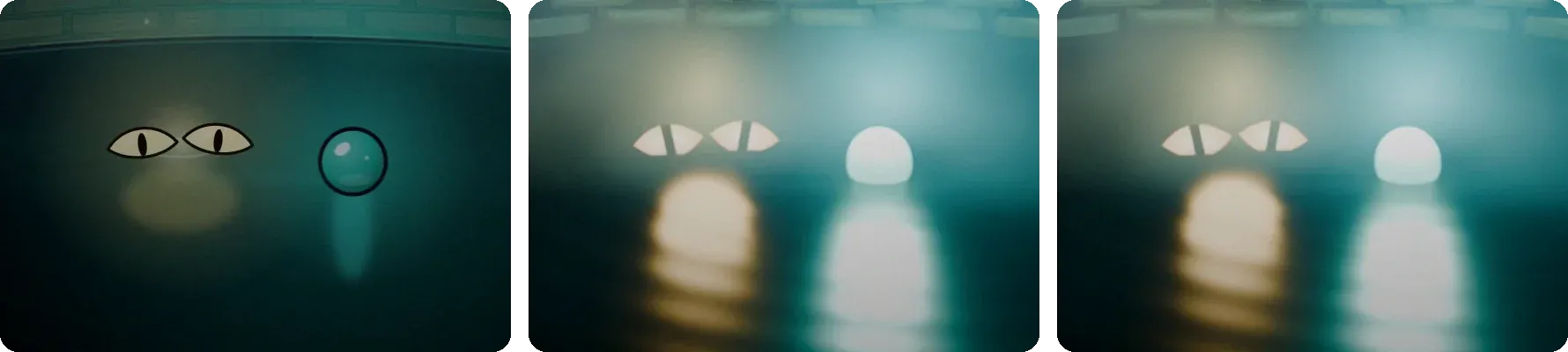
Review caught a few things on the way. Leaning as far as a real boy would, his face pointed at the water and the camera saw only the top of his head. The first clay pass was murky until a small light was kept on his face, the way stop-motion crews keep one on a puppet. And in clay, the springs on his fringe whipped the locks straight up like horns when he flinched. Scary, just not in the way we wanted.
The drawn look won, then lost
The drawn look won round one. It renders in minutes, it is the world of the first reel, and its big eyes read best at phone size. Clay was the biggest step up, with real light and mist, but every new character and place would be a build of its own, and a 75-second episode would take about four hours to render.
So the drawn look got a detail pass: moving holds instead of still ones, fingers that grip the rim and tighten one by one, the eyes opening slowly in the shaft, a trembling hand after the flinch, and a look back down. Then six key frames for the whole episode, with Dadi, the girl in the flashback and the one in the well.
I looked at them and said: “Animation is still not clean, let’s try some other horror animation style, different direction.”
More detail had not fixed it. The drawn puppet’s weak spot was acting, and every new detail drew more eyes to it.
Round two: shadow puppets, manga and low-poly
This time “clean” was the brief: motion that looks deliberate and finished at phone size, with no wobbly limbs and no smeary in-betweens. So each new look was one where motion can be made exact, instead of one that depends on acting.
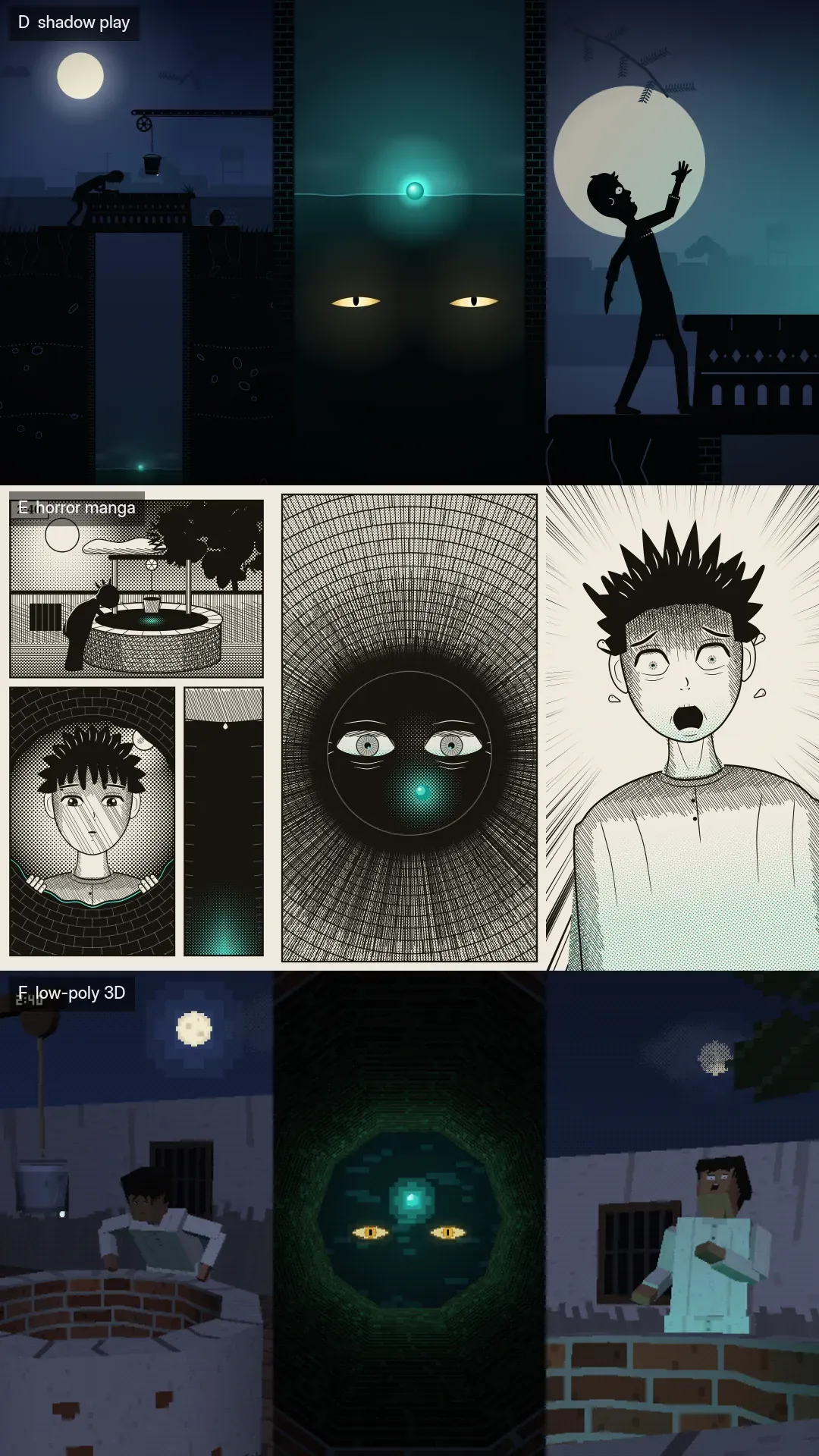
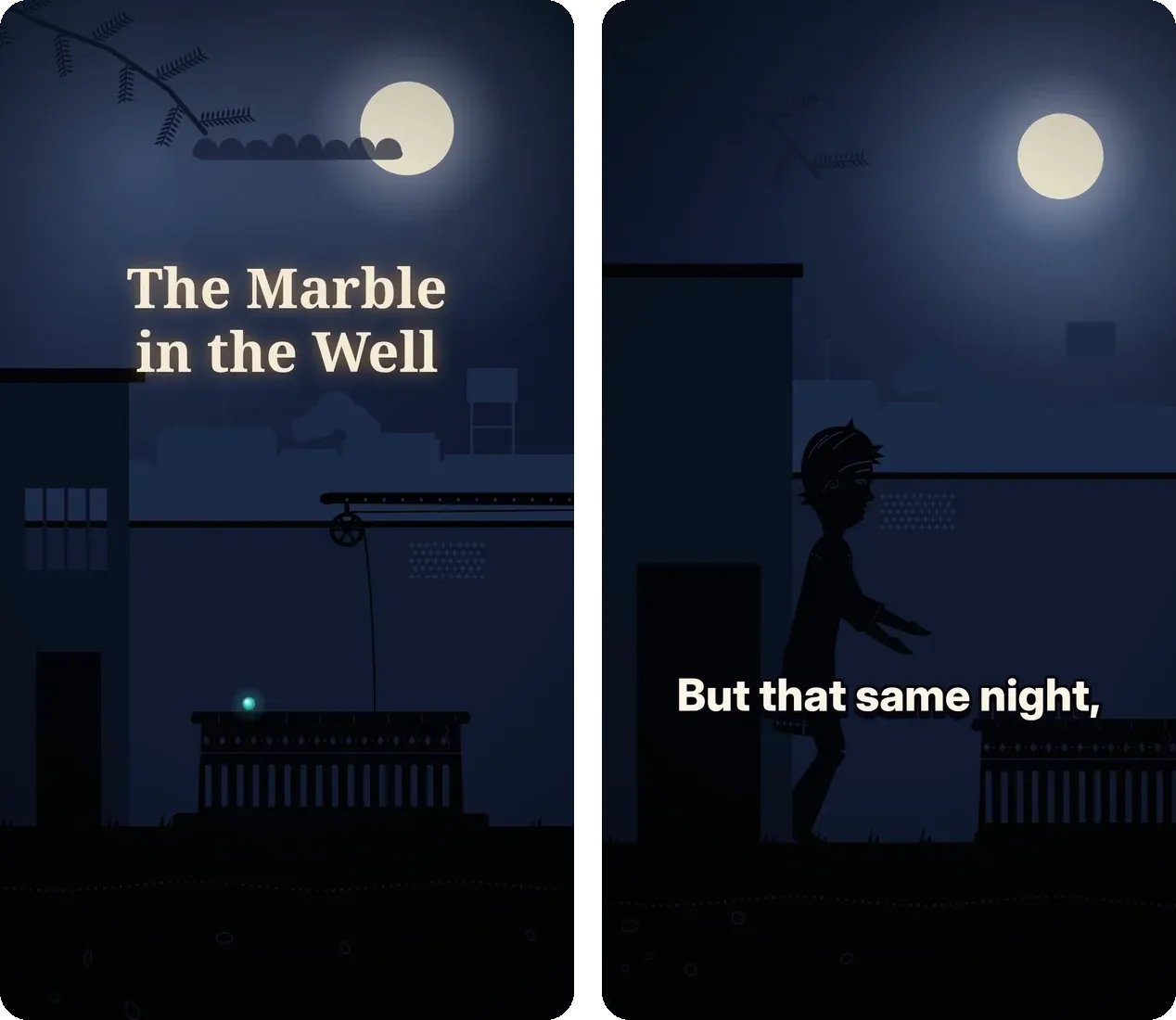
- Shadow play. Cut-out silhouettes on a lit night screen, borrowing from cut-paper silhouette films like Lotte Reiniger’s, and from Andhra Pradesh’s leather shadow puppets, tholu bommalata. Every solid thing is black, its decoration is punched through so the screen shows in dots and slits, and the distance is layers of grey paper. Only the marble and the eyes give light of their own. The boy is a jointed puppet in profile, his hands and feet held in place with inverse kinematics, and his eye and mouth are holes swapped on exact frames.
- Horror manga. Ink on warm paper, with hatching, dot screentone and panels that reveal one after another. Every frame is a held drawing, so nothing wobbles. The view straight down the shaft at the eyes was its best image. But his recoil, with his hair on end, read as a comic double-take, not horror.
- Low-poly 1990s console 3D. A real 3D well and camera, drawn at 270 x 480 and blown up four times, with every corner snapped to the pixel grid and the colours cut down through a dither. The render is nearly free. But the boxy boy risked reading as the famous block-building game.
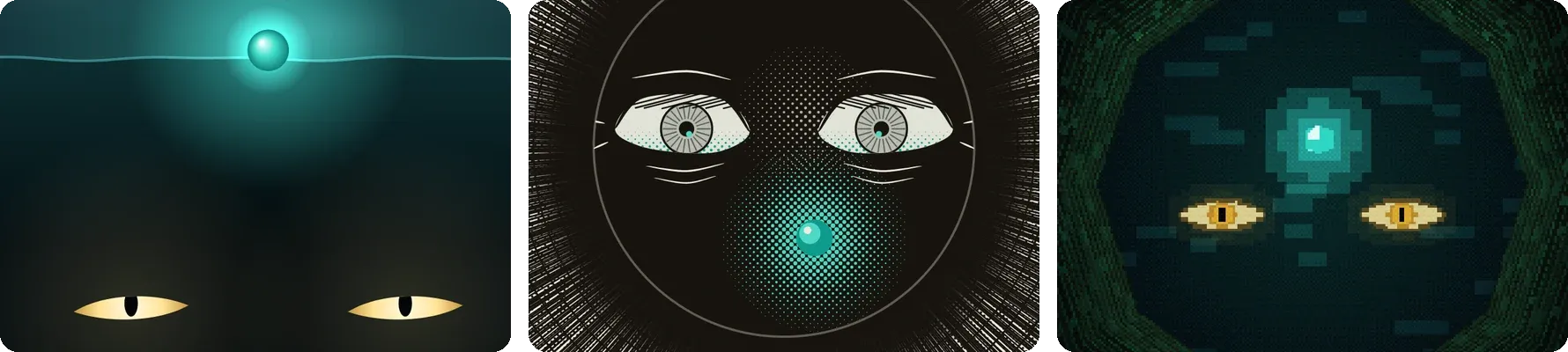
I picked shadow play. I liked the manga too, so it stays for other kinds of story reels, just not horror.
Why clean won over detailed
A silhouette is one shape, so it reads at once on a phone. It hides faces, which were the hardest thing in every earlier look, and turns that into the style. Whole black shapes moving on eased curves against a lit screen have nothing to smear or boil. And it is an Indian craft, so the series looks like nothing else on Reels.
The lesson for us: pick the look your tools can make clean, instead of polishing the one they cannot.
What each look costs
On this laptop, round one’s 8 seconds rendered in about 20 seconds drawn, about 25 minutes in clay and about 30 minutes for the mix. Round two was all fast: about 18 seconds for shadow play, a minute for manga, which draws its thousands of hatch strokes on the processor, and 6 seconds for low-poly.
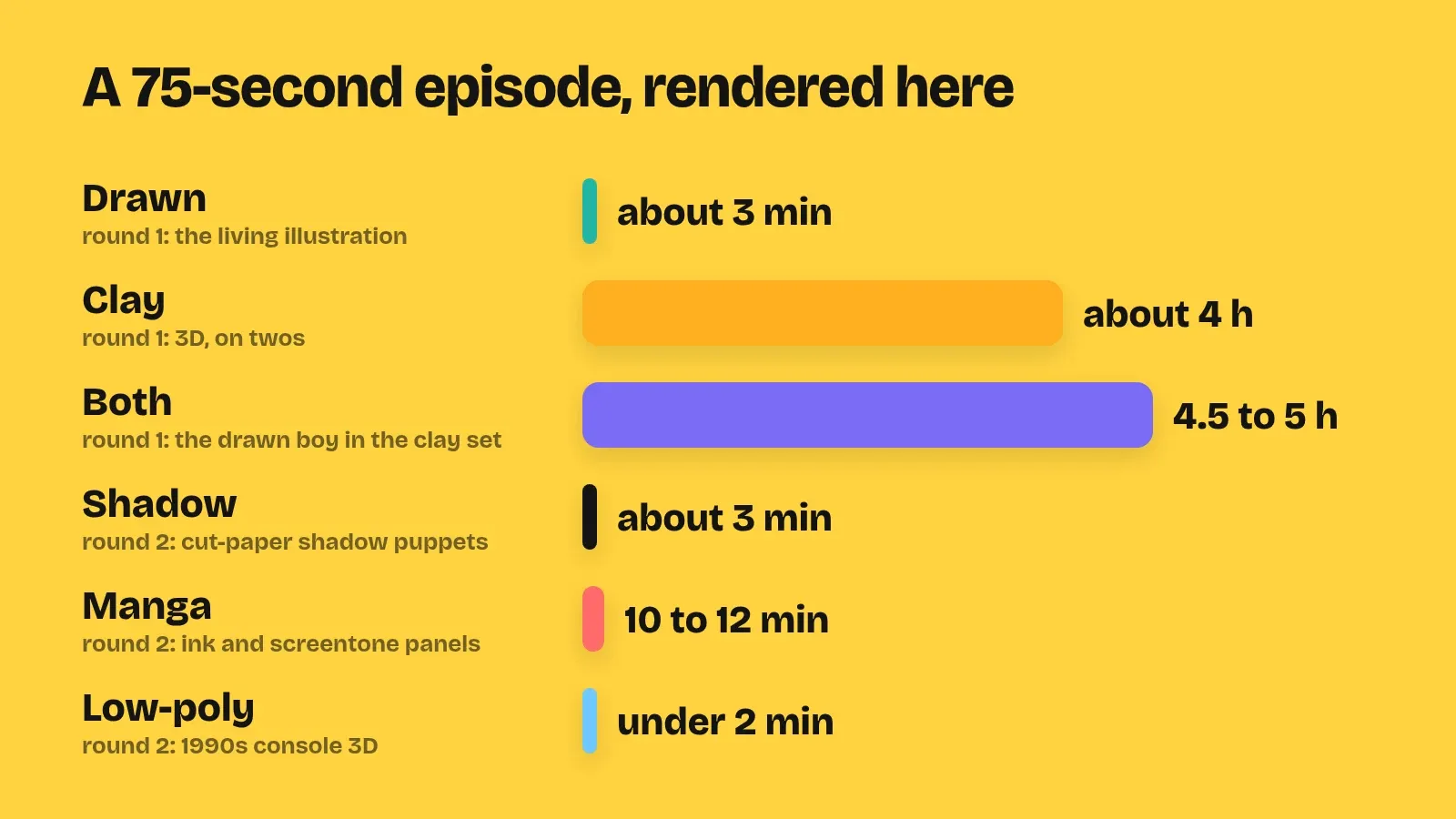
Render time was not the real cost, though. Every look but clay and the mix renders in minutes. The real cost is making each character and place, and making the motion clean.
The episode
The whole well episode, कुएँ का कंचा (The Marble in the Well), is now made in shadow play: 24 shots and 97 seconds, every one staged side on, with the well cut open in section wherever we need to see down the shaft. The Hindi cut comes out on Saturday 21 November at 11 pm, and the English one on Sunday 22 November.
Which look would you have picked? Tell me at hello@chaosmos.studio.
Sources
- Wikipedia. Forced perspective.
- Wikipedia. Twelve basic principles of animation, from Frank Thomas and Ollie Johnston’s The Illusion of Life: Disney Animation, 1981.
- Wikipedia. Multiplane camera.
- Inigo Quilez. Smooth minimum.
- Wikipedia. Stop motion, on replacement animation.
- Blender Foundation. EEVEE, in the Blender Manual.
- Wikipedia. Lotte Reiniger.
- Wikipedia. Tholu bommalata.
- Wikipedia. Inverse kinematics.
- Wikipedia. Screentone.
- Wikipedia. Ordered dithering.