A player spent 5 hours in my game, then deleted it
One player in Israel gave Plumb almost five hours, never pressed hint once, then uninstalled it. What the numbers showed, what I changed, and what I learned.
 , 9 min read
Someone in Israel played my game for 4 hours and 51 minutes. They opened it 15 times in five days. Then they deleted it, without once pressing the one button that was there to help them.
I only found out almost two weeks after they left. I have thought about this player more than any review, any download count or any video I have posted. So this is their story, as much of it as I know, and what I changed in my game because of them.
First, the game
Plumb is a small marble puzzle. The rule fits in one sentence: tilt the board, and every marble rolls until something stops it. Your job is to get each marble into the hole of its own colour.
The first levels are gentle. Then every chapter brings something new: pits that swallow marbles, pads that stop them, gates that let them through one way only. The boards grow, and the puzzles get deeper.
There is a hint button on every level. Press it and Plumb shows you the next tilt to make, from wherever your board is right now. Not the whole answer. Just one step. The first levels give you as many hints as you like, and after that you get three free hints every day. A small number on the button shows how many you have left.
How I found them
My games know very little about the people who play them. There are no accounts and no names. All I get are counts: a level started, a level solved, a hint used, how long a visit lasted, which country it came from.
For weeks I did not read those counts properly. When I finally did, I found that most of my “players” were not people at all. Every time I send a new version to Google Play, Google installs it on its own test phones to check it. And I install every version on my own phone too. Those phones were most of my numbers.
With them taken out, Plumb had 18 real players from 1 October to 10 November. Eighteen.
And one of them did not fit.
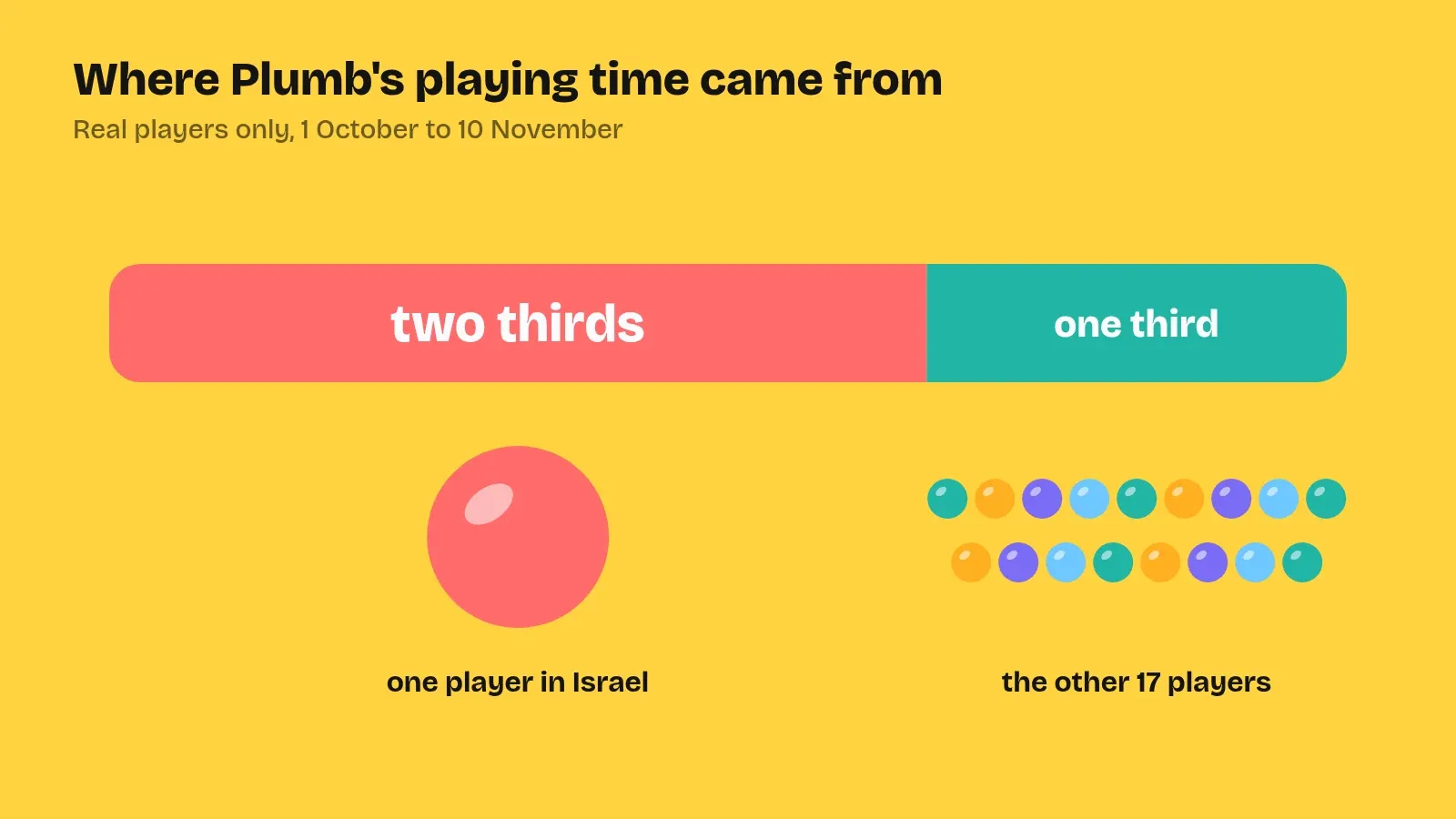
That one player, in Israel, had spent more time in Plumb than the other 17 put together. Two thirds of all the time real people spent in my game came from one person.
What the numbers showed
Here is the shape of their five days.
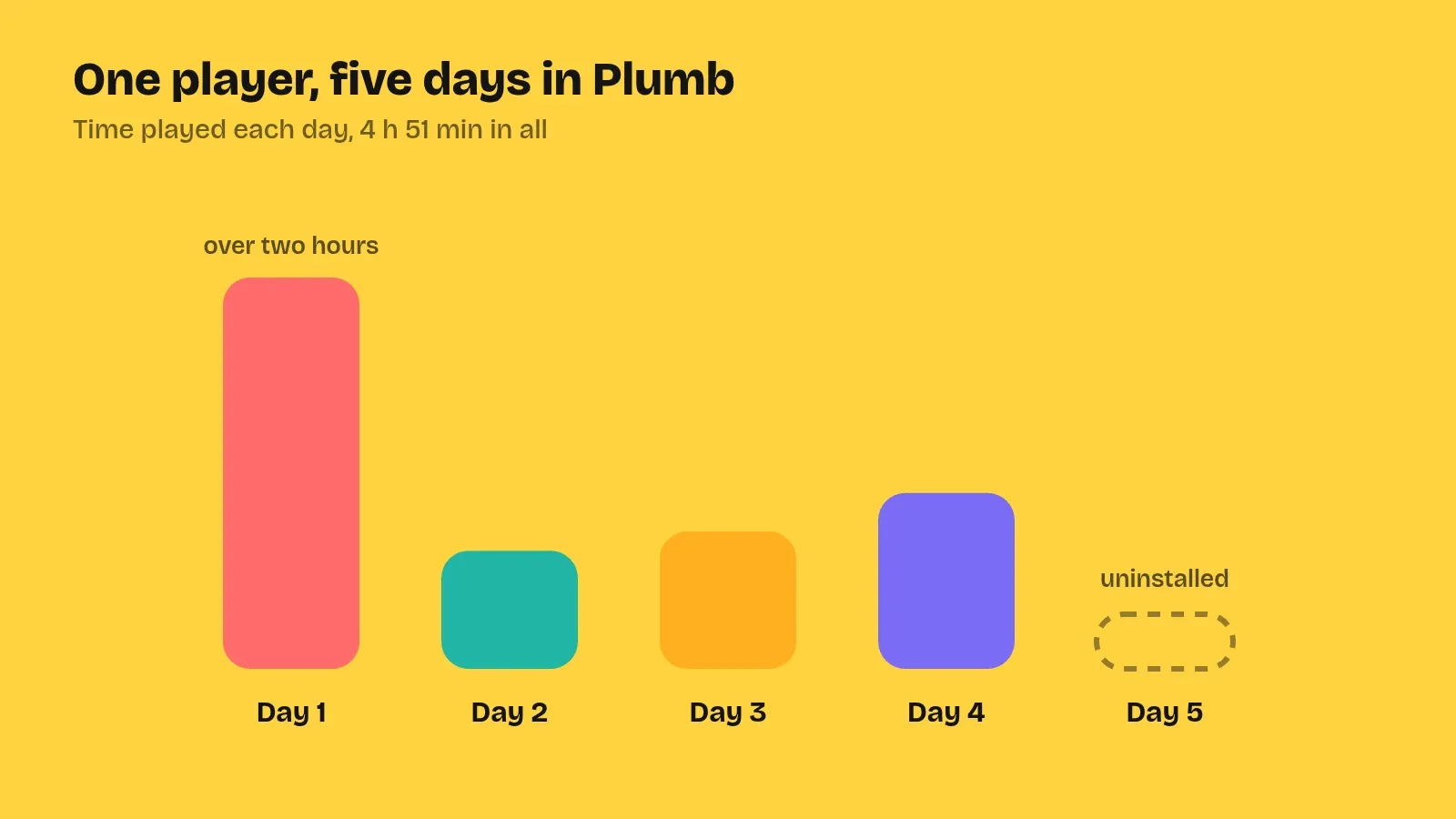

The first day was long, over two hours. They were flying through the early chapters. Then came three shorter days, each around an hour or a little less. They kept coming back, but they were moving more slowly now. On the fifth day they opened Plumb, started to play, and then uninstalled it.
Fifteen visits. 4 hours and 51 minutes. And in all that time, not a single hint.
How it felt
I did not read this calmly.
The first feeling was joy. Somebody I have never met, far away from me in India, played my little marble game for almost five hours. For a small game, that is a dream player. That is the person you make the game for.
Then I read the last line, the uninstall, and the joy turned into something heavier. They did not leave because they were bored. Bored people do not come back 15 times. They left because something stopped being fun.
And the button that could have helped was sitting right there on every level. With a small 3 on it, every single day.
What I think happened
I cannot know for sure. I do not know who this player is, and I like that my games work that way. Back then, Plumb did not even tell me which level a player was on.
But the shape of those five days tells a story most puzzle players will recognise.
On the first day, everything clicks. You learn the rule, you get good at it, and you fly. Then the levels get deeper. A board that used to take a minute now takes five. You try a tilt, it goes wrong, you undo, you try again. You close the game, come back later, and the same board is waiting for you.
At that point there are two kinds of players. One presses the hint button. The other keeps trying, and trying, until the game stops feeling like a game.
My player was the second kind.
Why would someone not press it? I have three guesses.
- Maybe a hint felt like cheating. Puzzle players are proud, and a hint can feel like losing.
- Maybe they thought it would cost something, like a video they did not want to watch.
- Maybe they never noticed it. A button that never moves becomes part of the wallpaper.
I will never know which one it was. But I could make all three less likely.
What I changed
I could not get that player back. But I could change Plumb for the next one. I made these changes the same week I found them.
The hint button now nudges you
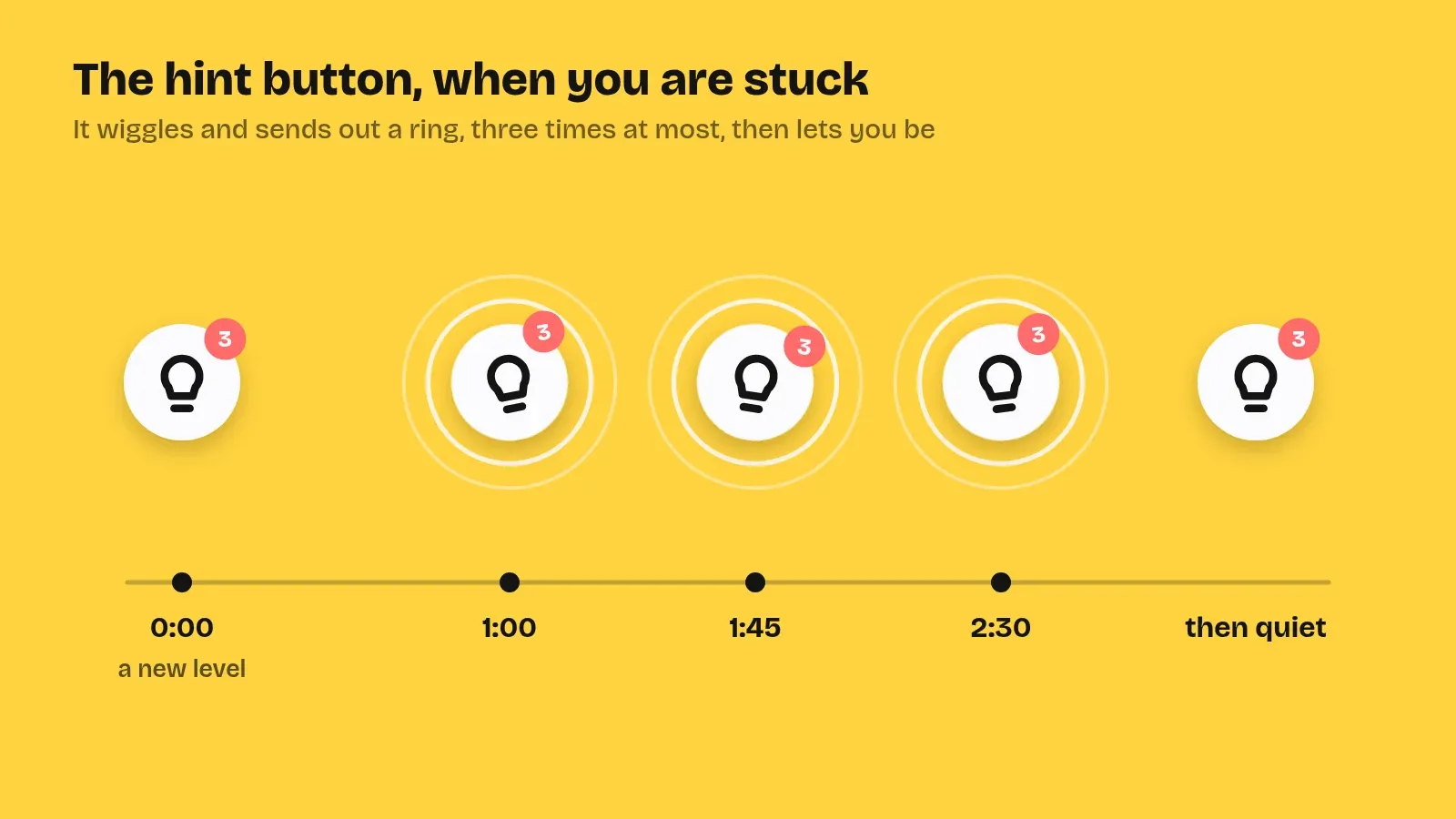
If you stay on one level for a minute, the hint button wiggles and sends out a soft ring. If you are still there 45 seconds later, it does it again. After the third time, it stops and leaves you alone. Start a new level or use a hint, and it waits a fresh minute.
There are no words, no pop-up, no “Need help?” box. I did not want the game to judge you, or to cover the board while you think. Some people like being stuck for a while. That is part of the fun of a puzzle. The nudge only says, quietly, that help is here if you want it.
It speaks to the third guess most of all. A button that moves gets noticed.
One video now gives three hints
Once your free hints for the day are used up, a hint asks for a short video. Before, one video gave you one hint. That felt like a toll booth: one video, one step, one video, one step. Now one video gives you three, the one you asked for and two more saved for later that day.
That one is for the second guess. If help has a price, it should at least feel worth it.
No video ready, no problem
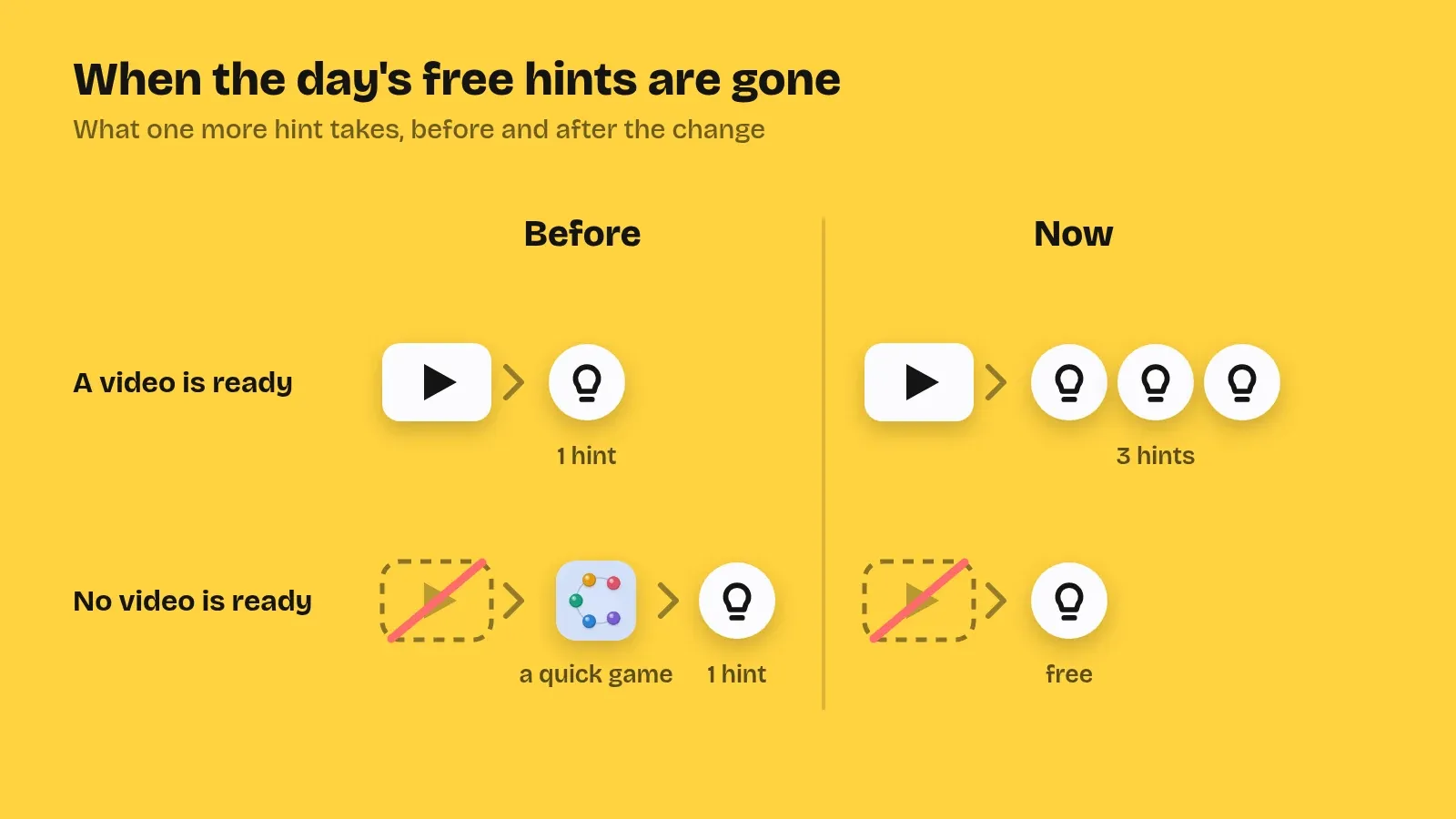
Sometimes there is no video to show. You might be offline, or there might simply be no ad ready. Before, when that happened, Plumb asked you to try a quick game of one of my other games first. Now the hint is simply free. Locked levels and pack tries work the same way.
Why give it away? Honestly, my ads are not earning anything yet. So right now a player who stays is worth far more to me than any ad. I would rather be generous.
And now I can see where people get stuck
Plumb now tells me which level a player is on when they start it and when they solve it. So the next time someone stops coming back, I will know where it happened, and I can look at that level properly.
The nudge is not only in Plumb, either. It lives in the shared base my puzzle games are built on, so every game of mine with a hint button has it now.
Players do not ask for help
The bigger lesson is not about hints.
A stuck player almost never tells you. They do not mail you. They do not leave a review. They do not press the button that says help. They just stop coming back, and the only sign is one quiet line in your numbers, weeks later.
I used to think of the hint button as a feature. Now I think of it as a question the game has to ask, because the player will not. A good teacher does not wait for the quiet kid at the back to raise a hand. They notice.
So this is what I try to do now, in every game:
- Notice when someone is stuck, instead of waiting for them to say so.
- Offer help quietly, and never make taking it feel like losing.
- Make help cheap. If it costs too much, the proud player will not take it.
- Read the numbers often, so nobody waits two weeks for me to notice them.
I go through my numbers every week now. Most weeks they are small. But I know now that one small line can be a whole person.
A note to the player in Israel
If you ever read this: thank you. You gave my game almost five hours, more than anyone else did.
You did nothing wrong. You got stuck, and my game did not notice. That was my mistake, not yours.
If you ever come back, the hint button will wave at you when you need it. The three free hints are still there, every day. And if you tell me where you got stuck, I would really love to hear it.
If you are stuck right now
If you are stuck on a level in Plumb, press the hint. That is what it is there for.
If you want to tell me where you got stuck, mail me at hello@chaosmos.studio. And if you want the rest of the numbers behind my games, I wrote them down in How I earned $0 from 9 games.