I gave up on 5 games before I made one people play
Before my nine games, I spent a summer on five I never finished. What each looked like, the moment it died, and what I would tell you about your fifth.
 , 10 min read
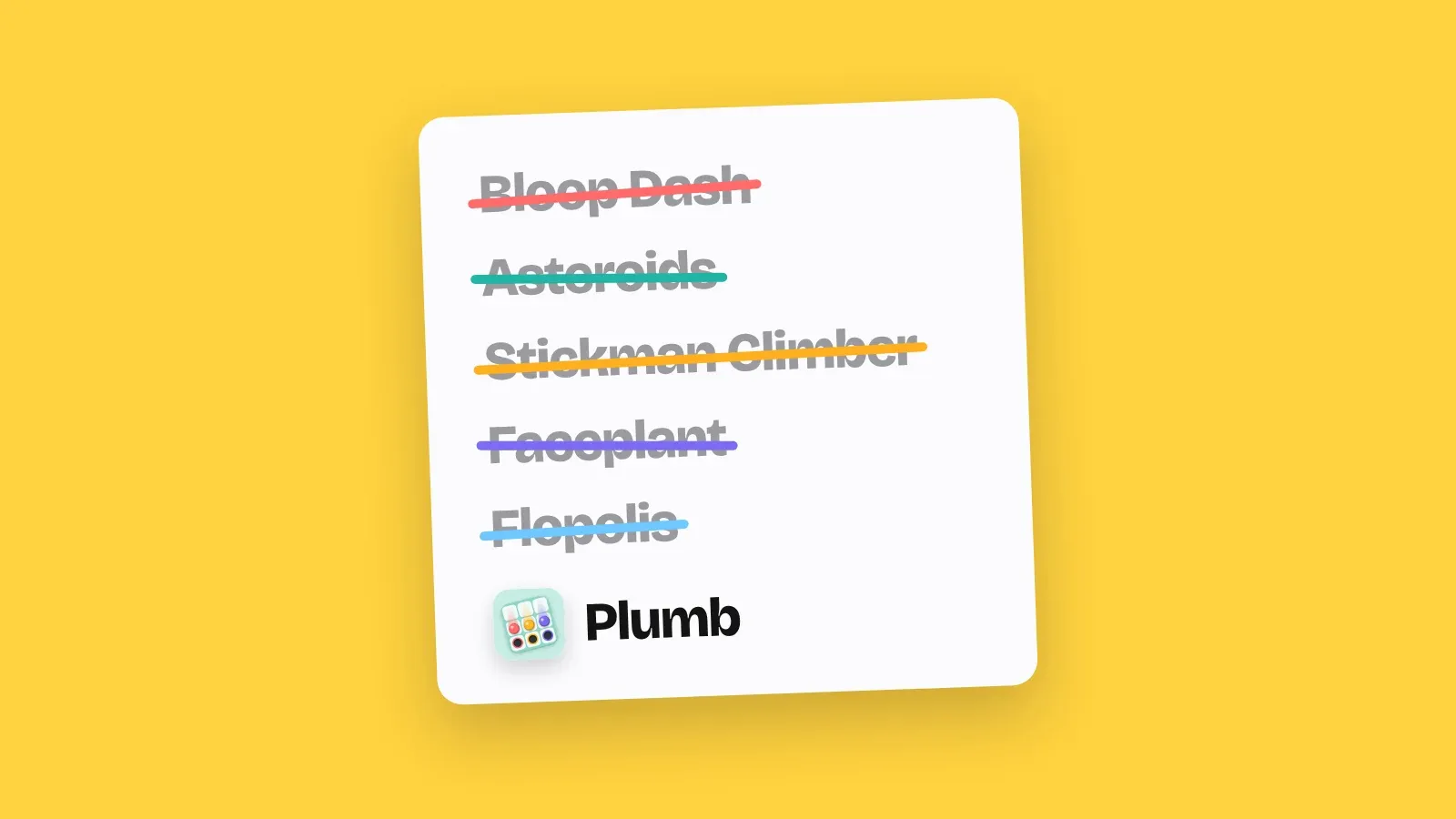
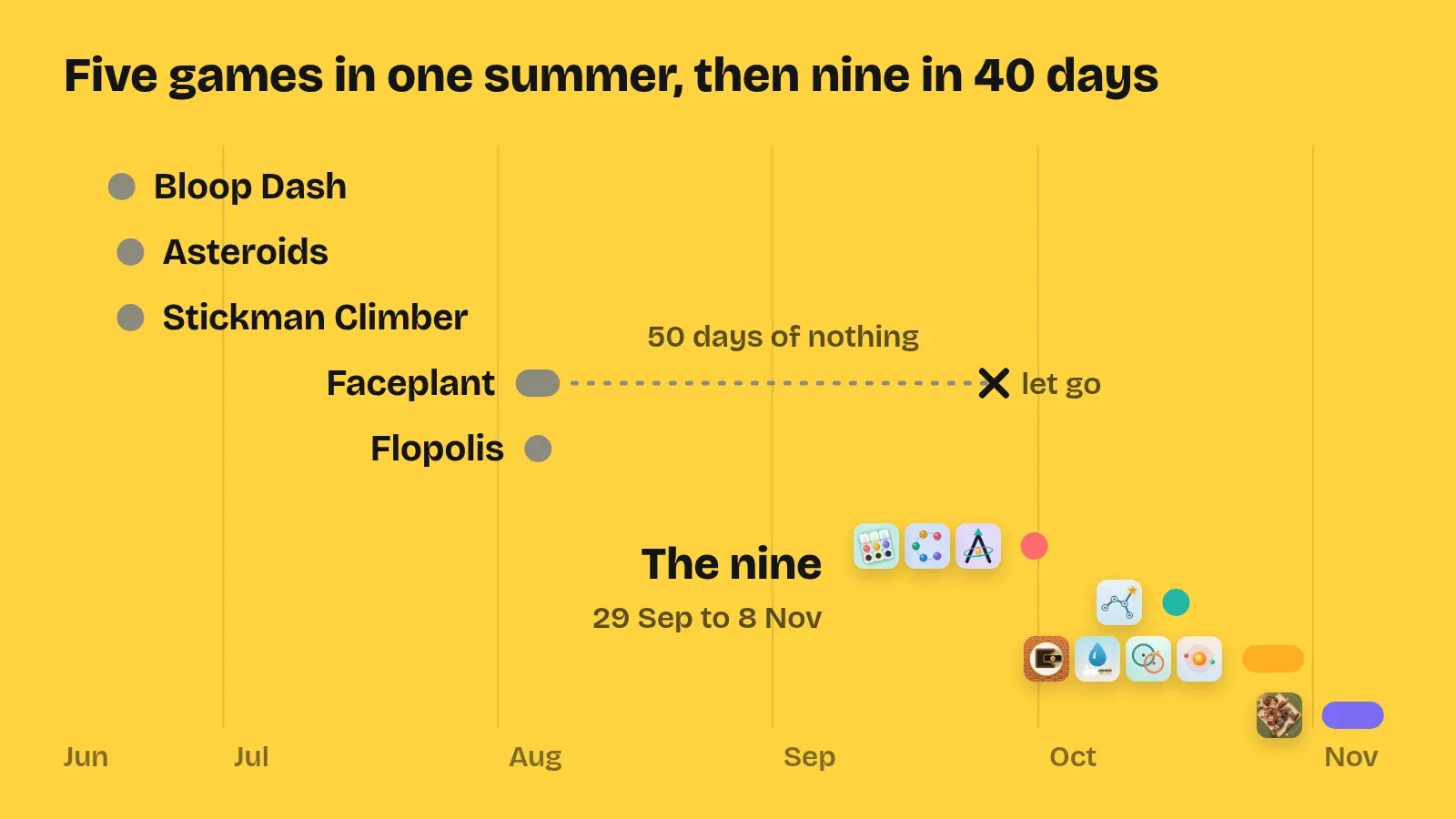
Between June and September, I started five games. One lasted 11 minutes. One lasted a single afternoon. The biggest got 140 changes in four days, then sat for 50 days without one more. I finished none of them.
Three days after I let the last one go, I started Plumb. Today nine of my games are on Google Play.
This is the story of the five that are not. What each one looked like, how it felt to make, and where it died.
Bloop Dash: the one I did not like
Bloop is a green blob. He runs on his own, and you tap to jump, twice if you need to. Spiky Nibbs and angry Flyers come at you, and red spikes wait on the ground. You grab stars for score and gems to spend, and three power-ups: a shield, a magnet and a rocket. The sky turns from day to sunset to night to dawn as you run.
By 18 June it had all of it. A menu, a pause screen, settings, and a shop with six skins for Bloop. On paper, a complete game.
Then, the same day, I changed what it was. No more endless running. Bloop got free movement, solid walls, one big floaty jump and checkpoints. It became a platformer in phases, each one longer than the last, up to 100 metres.
When a game changes its genre on the day its first version is done, it is telling you something. I did not listen yet.
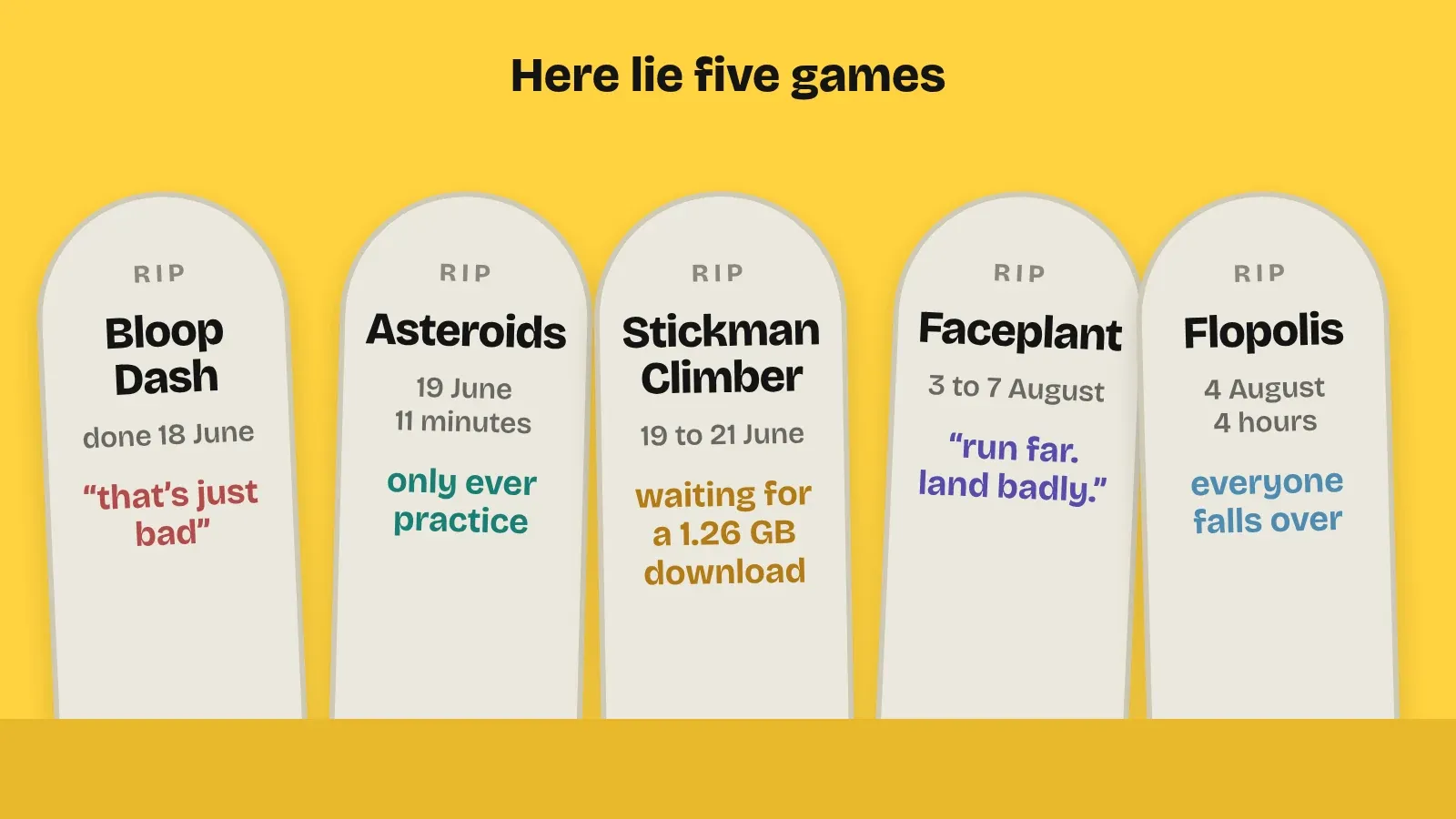
Where it died. Bloop Dash is the only one of the five with no saved history at all. What is left is a folder where nearly every file is dated 18 June. It never got another change.
On 3 August I started a new game to replace it. When Bloop Dash came up that day, I did not soften it: “that’s just bad”.
Asteroids: 11 minutes
The next afternoon, 19 June, I made Asteroids. Not a new idea. The old arcade one, a little ship among rocks.
At 4:27 pm I set it up as a learning project. At 4:28 the ship flew, turned and wrapped around the edges of the screen. At 4:29 it fired bullets that faded out. At 4:34 the rocks drifted, split when you shot them and cost you lives. At 4:36 I added a gravity star you switch on with one key, for orbital chaos. At 4:38 I wrote down the maths behind it, nine short notes, from timing each frame to splitting a rock.
Then I stopped.
Where it died. It was never meant to ship, so it did not die so much as finish being practice. I am counting it anyway, because of what I did ten minutes later.
Stickman Climber: built in a day, stuck on a download
At 4:48 pm, ten minutes after Asteroids, I started a ragdoll stickman. At 4:49 he flopped under gravity. At 4:50 you could grab one of his limbs and fling him around. At 4:52 there were bouncy bumpers and a score for your best fling.
That was a toy, not a game.
At 5:13 it became one: a wall, a camera that scrolls up, holds to grab. At 5:18 you gripped holds with his hands, and fell if you let go of both. At 5:35 his grip got stamina, so you had to keep moving or slip. 47 minutes, from a floppy toy to a climbing game.
Two days later, on 21 June, I built the real thing in one long sitting. From 1:51 at night to 2:09 in the afternoon, 55 changes.
You climbed with two thumbs, one for each hand. Wind gusts pushed you around on the storm and desert walls. At 2:18 in the morning I redrew the whole game in muted alpine stone. By 3:23 I had thrown that away for a sunny cartoon look, with a cream background and chunky candy buttons. Late in the morning the music got remade, with fuller pads and a deeper drone.
Its plan had a line I still like. The game records your run, so a great climb or a brutal wipeout is one tap from Reels or Shorts.
Where it died. The last step was the phone. Building it for Android needed a 1.26 GB download, and my internet cut big downloads short. So that step was left for later.
The last change went in at 2:09 pm on 21 June. Later never came.
Faceplant: the big one
Six weeks later, at 2 in the morning on 3 August, I wrote the plan for Faceplant. A 3D lane runner where crashing is the point. Its tagline was “run far. land badly.”
You run down three lanes, away from the camera. Swipe left or right to change lanes, up to jump, down to slide. When you fail, you do not just stop. A real ragdoll takes over, the crash plays out in full physics, and no two crashes look the same.
It got 114 changes on its first day. The camera widened with speed, leaned into lane changes and shook on a crash. Every hit froze the picture for a beat, so you felt it.
That night, Faceplant met real phones. At 10:32 pm the runner turned out to be invisible on someone else’s phone. At 11:42 pm, people on phones were being told to use the arrow keys, because their browser said it was not a phone. At 11:55 pm I found why the runner vanished: some older phones could not draw him at all. So I made a second runner out of plain boxes, just for them. At 1:08 am the box man got his own ragdoll, so even old phones would see the faceplant.
Past midnight, building a man out of boxes so that old phones could watch him fall over. That is Faceplant in one sentence.
On 4 August it got a proper Android version and a page to download it from. Just after midnight on 7 August, the last changes went in. The runner kept his stride through a jump. Obstacles became hurdles and gantries. Coins arced over the jumps. And after a crash, the game named the move that would have saved you.
Where it died. That was 12:35 am on 7 August. Then nothing happened for 50 days. I did not delete it. I did not decide anything. It just sat there, not alive and not dead.
Flopolis: one afternoon
Go back to 4 August, the day after I started Faceplant. At 3:24 pm, I started another game.
The first line of its plan: “A cheap, grubby little city where every fight ends with somebody flopping down a flight of stairs.” Third person, an open district, odd jobs, and almost every problem solved with your fists. The plan even says it would come out on Steam.
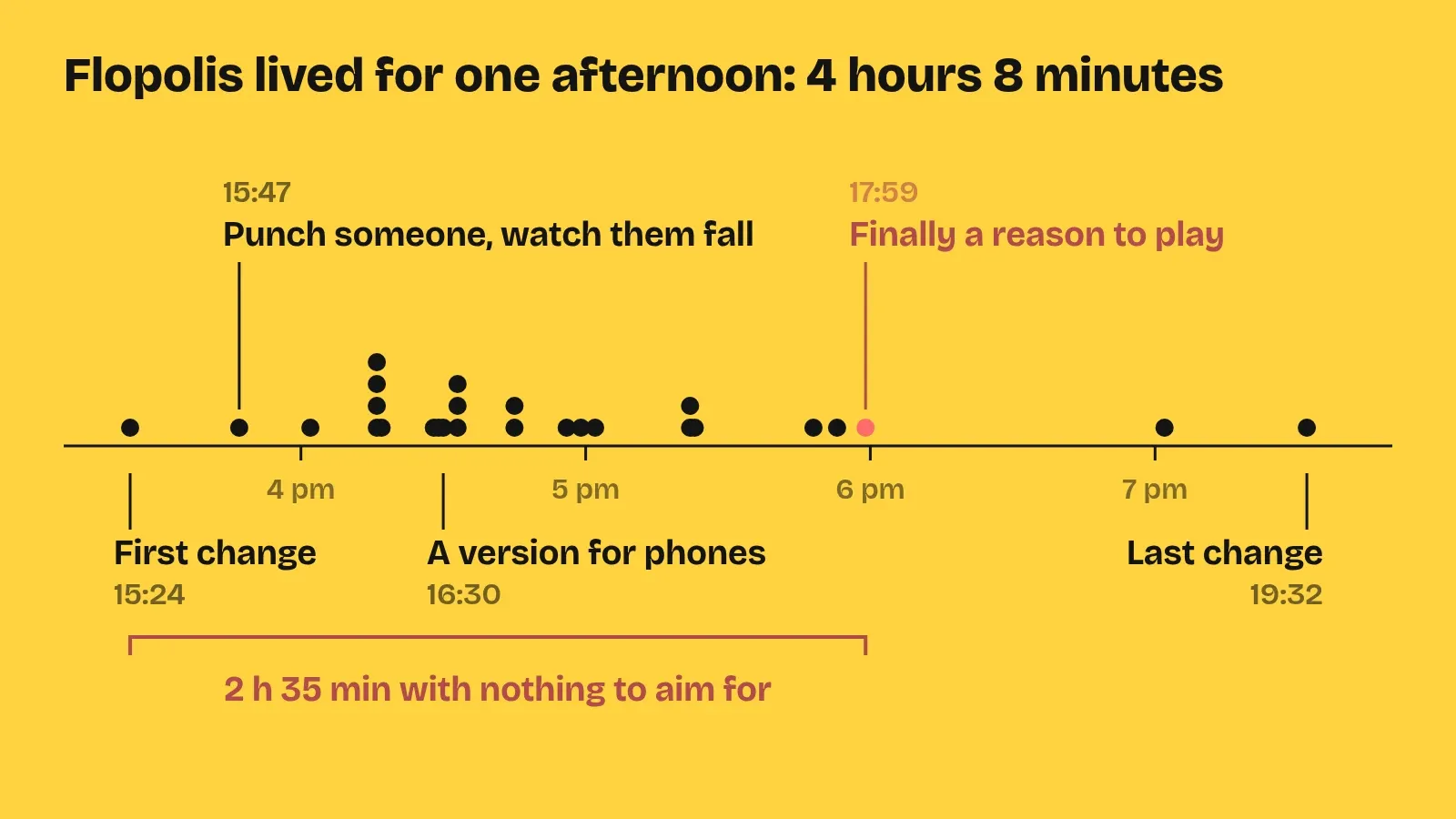
Its whole life fits on one clock. At 3:47 pm you could walk around, punch someone and watch them fall over. At 4:02 the city became every era at once. At 4:16 it got a thumbstick and buttons, so a phone could play it. At 4:17 I found the people walking around were most of what a phone had to draw, because of their shadows. At 4:30 there was a version you could install on a phone. At 5:48 I switched shadows off to chase a mysterious dark wedge on the screen. At 5:53 I switched them back on. The wedge was just shadows, doing their job. At 5:59, finally, a reason to play: you get paid for how badly people fall over. At 7:02 the crowd started wandering the roads instead of standing about.
Where it died. At 7:32 pm, with one last change so phones could draw the city fast enough. 27 changes, 4 hours and 8 minutes. For 2 hours and 35 minutes of that, Flopolis was a city where you could punch people, with no reason to do it.
50 days of nothing
After 7 August, not one of the five got a single change. Not the runner, not the climber, not the city. For 50 days they sat in their folders.
On 26 September I finally wrote it down: “I have no intention of continuing the faceplant, instead I want to make 3 mini games with cool simple minimalistic concepts”.
That one sentence did more than the 50 days before it.
What the five had in common
Looking back, the pattern is hard to miss.
Each one started as a kind of game, not a rule. A runner. A climber. A city. I could tell you what each one looked like. I could not tell you its rule in one sentence.
Three of the five were about someone falling over. The stickman, the faceplant, the flopping city. I clearly had a type.
They were big before they were fun. Faceplant spent its first night making old phones show a man made of boxes. Flopolis spent two and a half hours on a city, a camera, a thumbstick and its shadows before it had a reason to exist.
And it was never about effort.
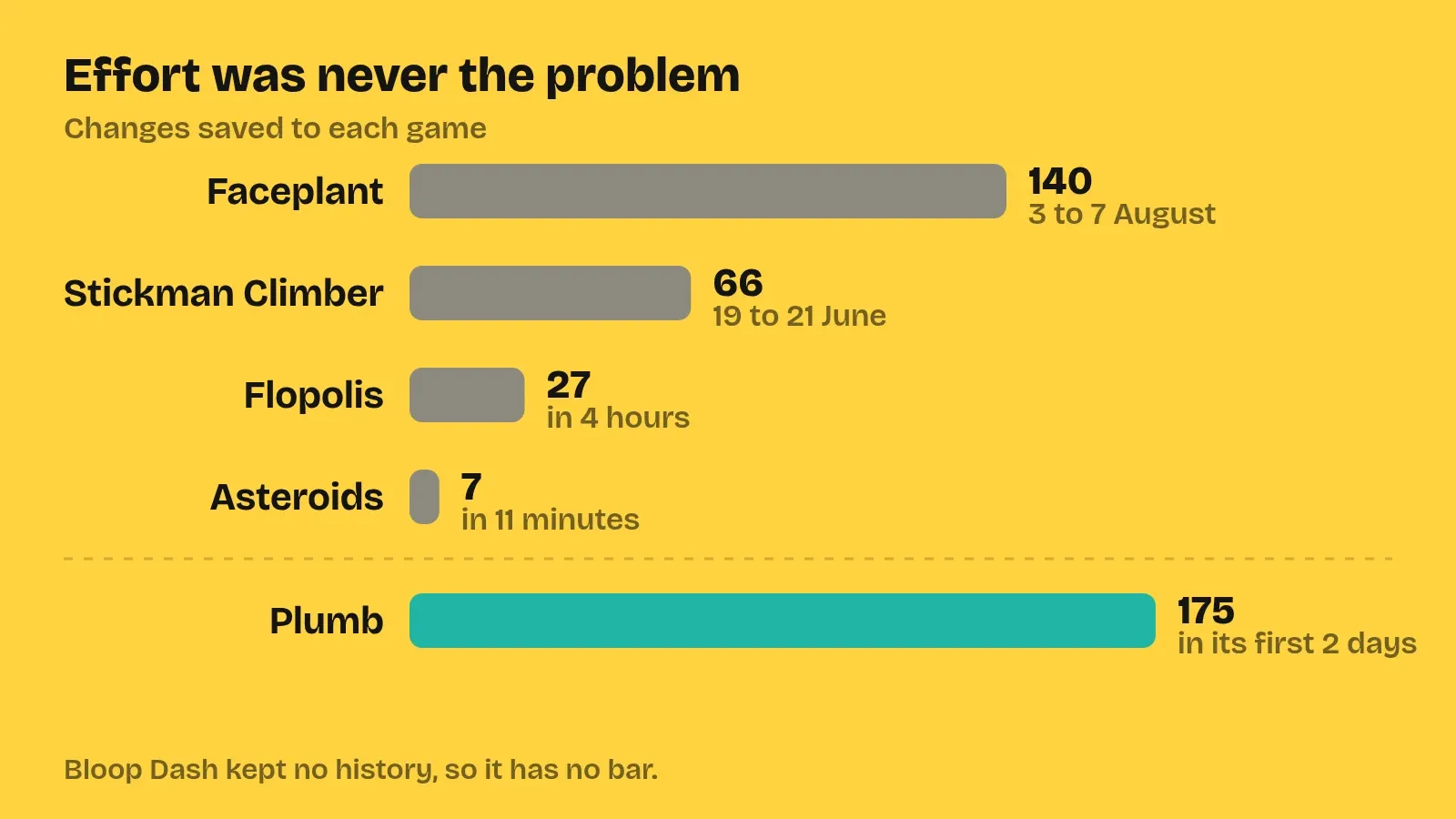
Faceplant got 140 changes and never reached a store. Plumb got 175 in its first two days and reached everyone on Google Play. Same kind of work. A different kind of idea.
Three days later: Plumb
On 29 September at 3:01 pm, I started Plumb.
It did not start from nothing. It started from a ready-made game setup, and that setup was worked out on Faceplant, Flopolis and Stickman Climber.
At 3:04, three minutes in, the rule was in. Marbles roll together like a train and sink into holes of their own colour, and a marble in a pit loses the level. Three minutes. Flopolis took 2 hours and 35 minutes to find its reason.
Plumb is a flat board. No 3D, no ragdoll, nobody falls over. Tilt the board, and every marble rolls until something stops it. That is the whole game.
Carillon started at 3:25 the same afternoon, and Apsis at 3:29. On 1 October, all three had their first versions. On 19 October, Plumb was out for everyone on Google Play. Today it is the game people play the longest.
If you are on your fifth unfinished game
This is not advice from a poster. It is what the five cost me to learn.
Write the rule before you open the engine. One sentence, the whole game. Plumb’s rule was in by minute 3. Flopolis found its reason at minute 155, and was gone by minute 248. If your sentence starts with a genre, “a runner, but”, it is not a rule yet.
Put it on a phone on the first day. Stickman Climber died waiting for the phone, at the very end. Faceplant met phones on its first night, and the invisible runner went from found to fixed in 83 minutes. If a part is going to hurt, let it hurt early.
Say it out loud when it is over. Faceplant got four days of work, then 50 days of silence. The sentence that ended it was one line. Three days later, Plumb existed.
Notice your type, then shrink it. My type was physics that looks funny. Plumb kept a little of it: one swipe and the whole board rolls at once, and marbles squash when they hit a wall. The rule got small. The taste stayed.
Keep the shelved ones as a toolbox. None of the five shipped. But Plumb, Carillon and Apsis all started that afternoon from the setup they left behind.
The other half of this story is how the nine came together: How I made 9 games in 40 days. And if you want to see what came after the five, start with Plumb.