7 of my 9 games changed their name. One did it twice
Seven of my nine games got a new name before Google Play ever saw them, and one had three names in four days. Every rename, the real reason, and how I check a name now.
 , 10 min read
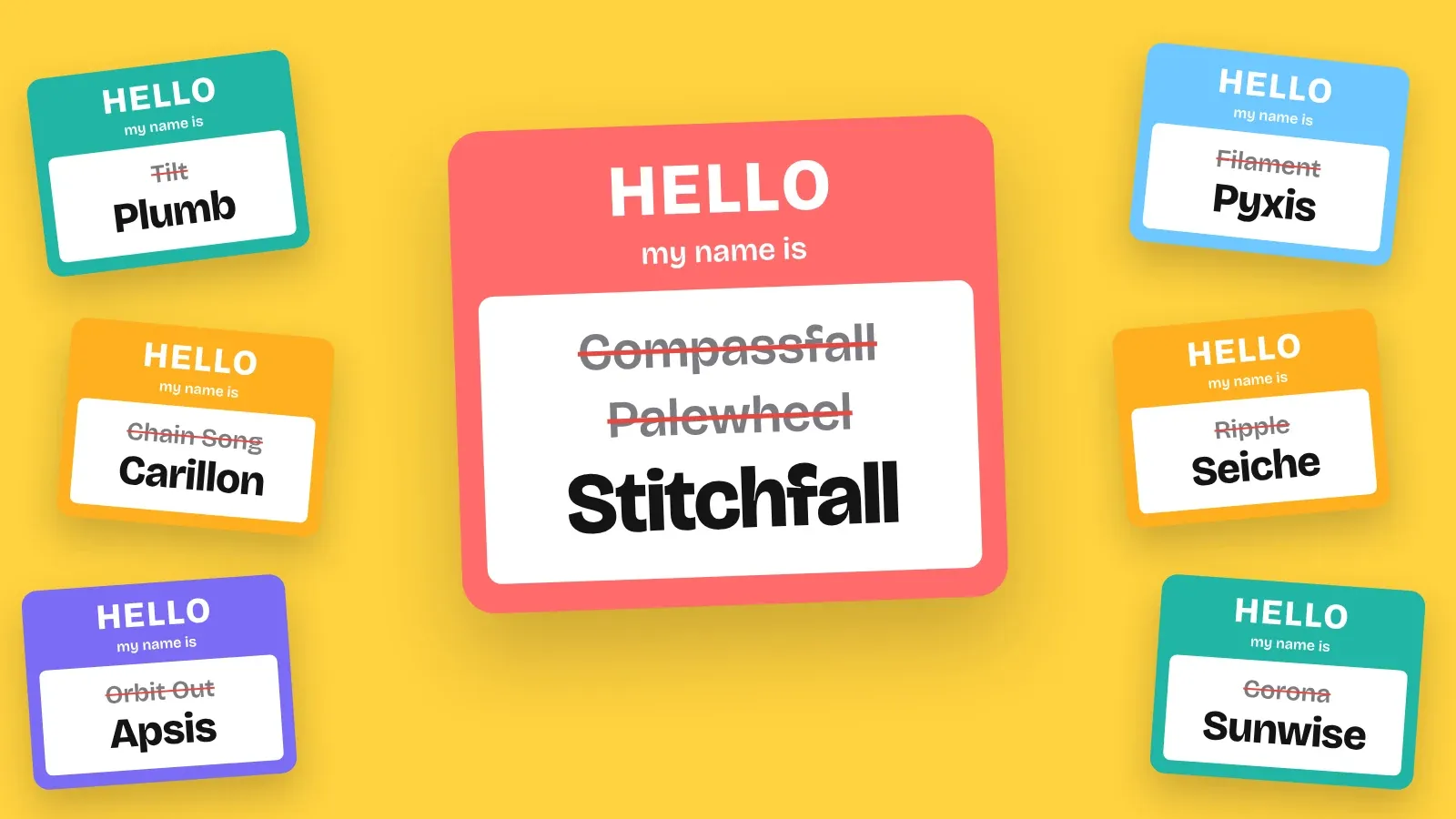
For three days, one of my games was named after a wheel it did not have. Another shared its name with the word the whole world used for COVID. And three of them got new names in the same minute, at 9:48 one night.
I have made nine games. Seven of them started life with a different name. Only Hako and Rinse kept the name they were born with.
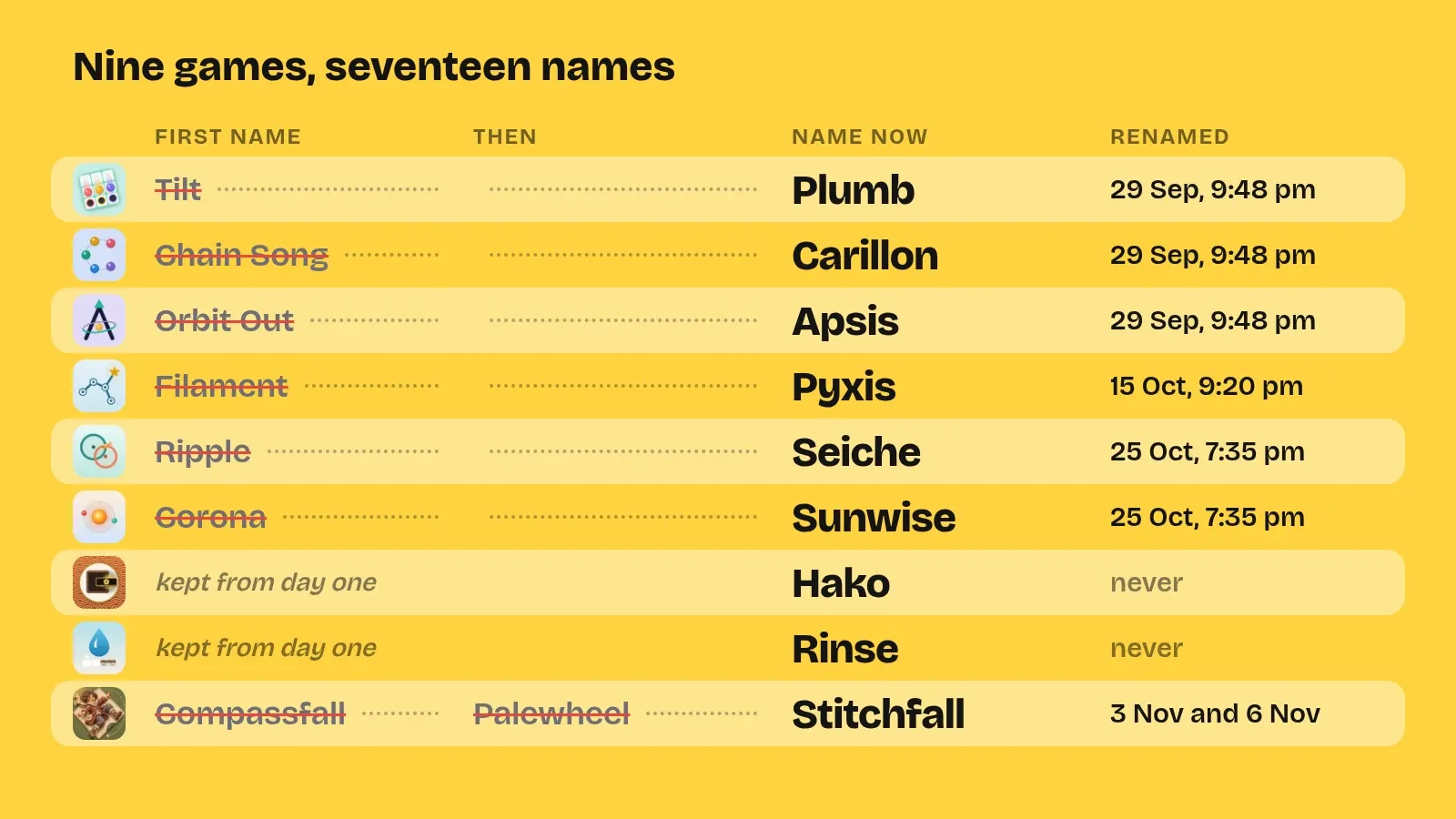
Here is every rename, what was happening when it happened, and the tests I put every name through now.
9:48 pm, three names in one minute
On 29 September I started three small puzzle games, within half an hour of each other. By a little after four, all three played in a web browser. By night they had levels and hints.
They also had names, sort of. Tilt. Chain Song. Orbit Out.
Those were not really names. They were descriptions. Tilt said what you do. Chain Song said what you hear. Orbit Out said where the arrows go. Fine for a folder on my laptop, but not something you would remember a week later, or search for on your phone.
At 9:48 that night, all three got new names, in the same minute. And look at what happened in the forty minutes after that. All three got a new typeface, new title screens, shared menus and everything they needed to be built for Android.
The names came first. That was the moment they stopped being experiments and started becoming apps.
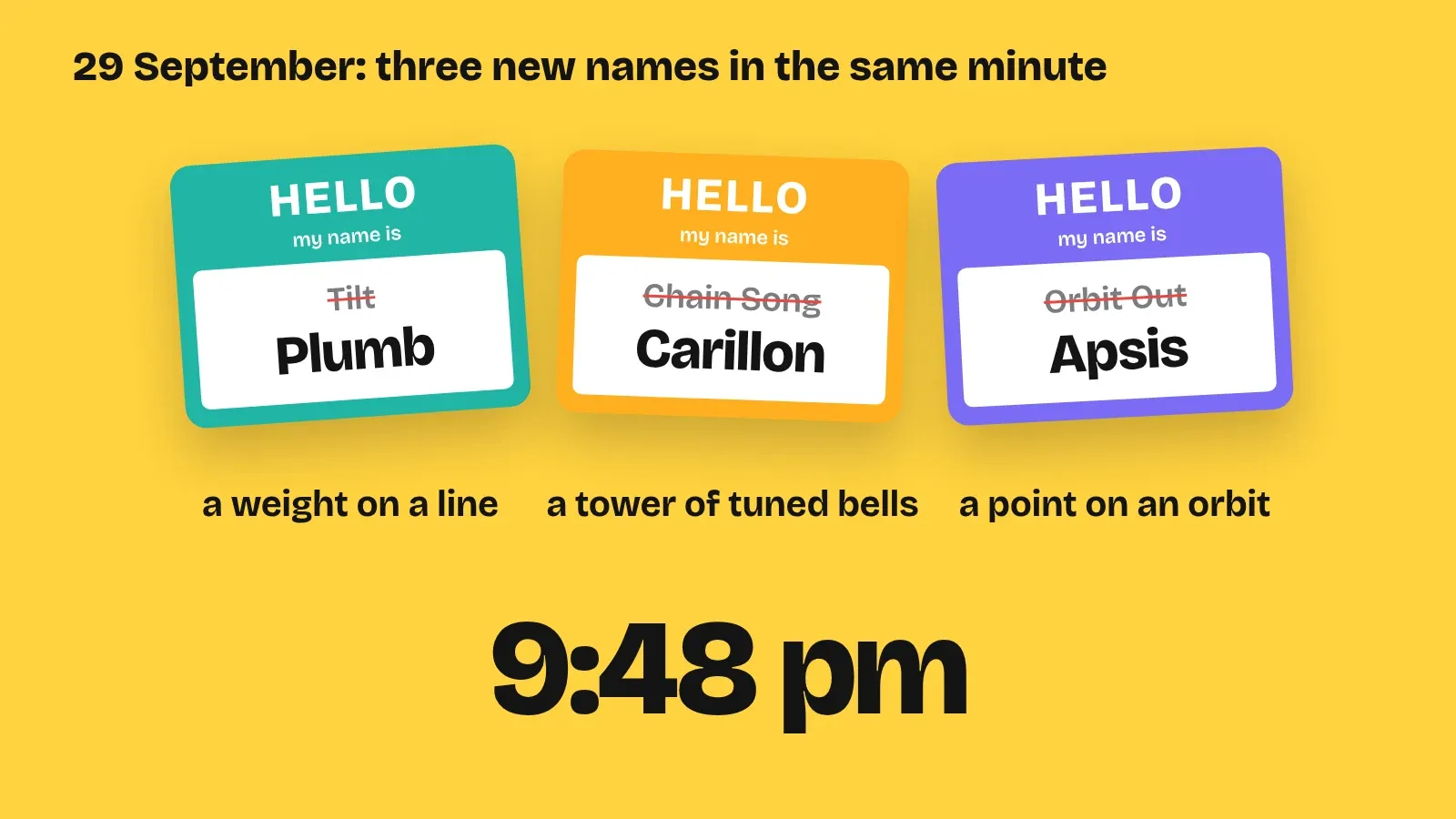
Tilt became Plumb. A plumb is a weight on a line. Let it hang and it points straight down, the way gravity pulls. In Plumb you choose which way down is, and every marble on the board follows. The name is the rule.
Chain Song became Carillon. A carillon is a set of tuned bells, usually hung in a tower and played from a keyboard below. In the game every dot you pop rings a note, so a chain of pops rings out like a run of bells. I wrote about the music in Why every pop is a note.
Orbit Out became Apsis. An apsis is the point of an orbit nearest to, or farthest from, the thing it goes around. Most people have never seen the word, which makes it easy to search for and hard to forget. The whole story is in What is an apsis?
The old names did not go to waste, though. They moved after the colon. On Google Play the games are called “Plumb: Marble Tilt Puzzle”, “Carillon: Chain Pop Puzzle” and “Apsis: Arrow Escape Puzzle”. The name is for remembering. The words after it tell you what you are getting.
The name that was already a game
On the evening of 14 October I made a small game about tangled webs. You pull knots around until no strand crosses another. I called it Filament, a word for a fine thread.
I loved that name. It was short, it was about thread, and it sounded a little like science.
The next morning it moved into its own project, and by that evening I was getting it ready for Google Play. Somewhere in there, the name turned out to be taken.
Filament is a puzzle game from 2020, by a studio called Beard Envy. It is about solving cable puzzles on an abandoned spaceship.
A puzzle game. About cables. Called Filament. You cannot get a clearer no than that.
At 9:20 that night it became Pyxis. Filament lasted about 26 hours.
Pyxis is a small constellation of the southern sky, and its name means a mariner’s compass. A cleared web in the game is a few points joined by straight lines with nothing crossing. That is exactly how a constellation is drawn on a star chart. So the sky was the obvious place to look, and the game even has a look that draws every knot as a small star. I wrote about the stars behind it in A compass in the stars.
The lesson cost me nothing, because I learned it before the store page existed. I will come back to why that matters.
The word that meant something else
On 24 October, at 11:31 at night, I started three new games in the same minute, and a fourth eleven minutes later. The whole timeline is in How I made 9 games in 40 days.
One of the four was a one-thumb game about a star. You swing a ring of planets around it and keep everything the dark throws at it away. In the first version, the star glowed inside a soft haze of light. The game was called Corona.
Corona is a real word for the glow around a star. It is also the word everyone used for COVID.
In 2020 Google Play started turning away apps that used COVID words in their store listing, unless a government or a health body stood behind them. That special rule was retired in 2023. But Play still has a policy against apps that are insensitive to, or cash in on, tragic events. A game called Corona sits right on that line, whatever it is really about.
So it was renamed the next evening, before Google Play ever saw it. It is now Sunwise. Sunwise is an old word for going round the way the sun goes across the sky. And the game is still a star with its planets going round it.
The name that was too small
Another of the four was a fishing logic game. You read the rings on a still pond to work out where each fish is hiding, then cast once to catch it. It was called Ripple.
The next day I tried the first version and found it confusing. There were numbers, shaded water, pebbles and rings that moved. So the same day it was rebuilt around one rule: a fish sits on every ring, never inside one.
When it moved onto our shared puzzle kit and got its proper look, it needed a name of its own. Ripple was too common, and it described one splash. The game is about many rings at once, read together.
So it became Seiche, a slow wave that rocks a whole lake from one shore to the other. It is said like “saysh”. More in Why my pond game is called Seiche.
The other two from that night kept their names.
Hako means “box” in Japanese, and it is a game about Japanese puzzle boxes. I wrote about the real ones in Secret boxes from Hakone.
Rinse is a cleaning puzzle, and it is called Rinse.
Both are one short word, and both are the game. Sometimes the first name is simply right.
Named after a wheel it did not have
Stitchfall holds the record, with three names in four days.
On 2 November at 9:33 at night I started a gravity game called Compassfall. A little pilot restored light to a clockwork station, and every turn changed which way was down. It was warm paper, teal machinery and brass.
By 1:12 that night I had thrown out its look, its menus, its art and its feel. It became Palewheel: a gravity mechanic on a space station, trying to restart a failing orbital engine. The first art for it was too ornate and felt like fantasy, so it turned towards comics and manga instead.
Then, the next morning, I chose something else entirely. A world sewn from cloth. Linen, felt, buttons and thread. Before lunch the rooms were sewn from fabric, and so was the runner.
That afternoon the game’s plan said, word for word: “The temporary title is Palewheel. The game has no wheel in its story or art.”
For three days, my game was named after a wheel it did not have.
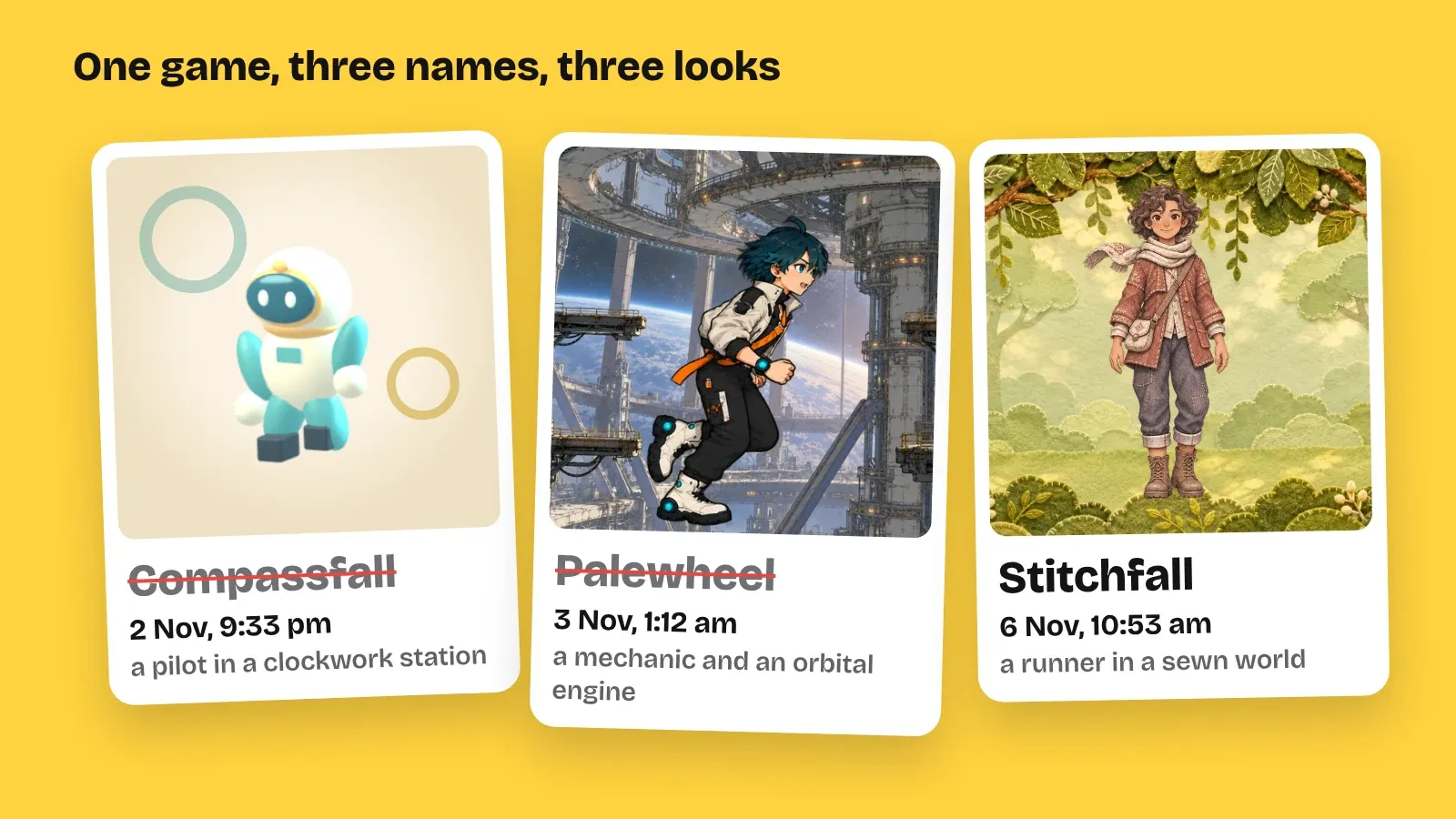
On 6 November it became Stitchfall. It is a sewn world, and every tap makes you fall a new way. The name says both, and as far as I could find, no other game uses it. The full story is in Why Stitchfall.
Even the words after the colon changed once. Until 8 November it was “Stitchfall: Gravity Platformer”. Now it is “Stitchfall: Turn Gravity”, which says what you actually do.
How I check a name now
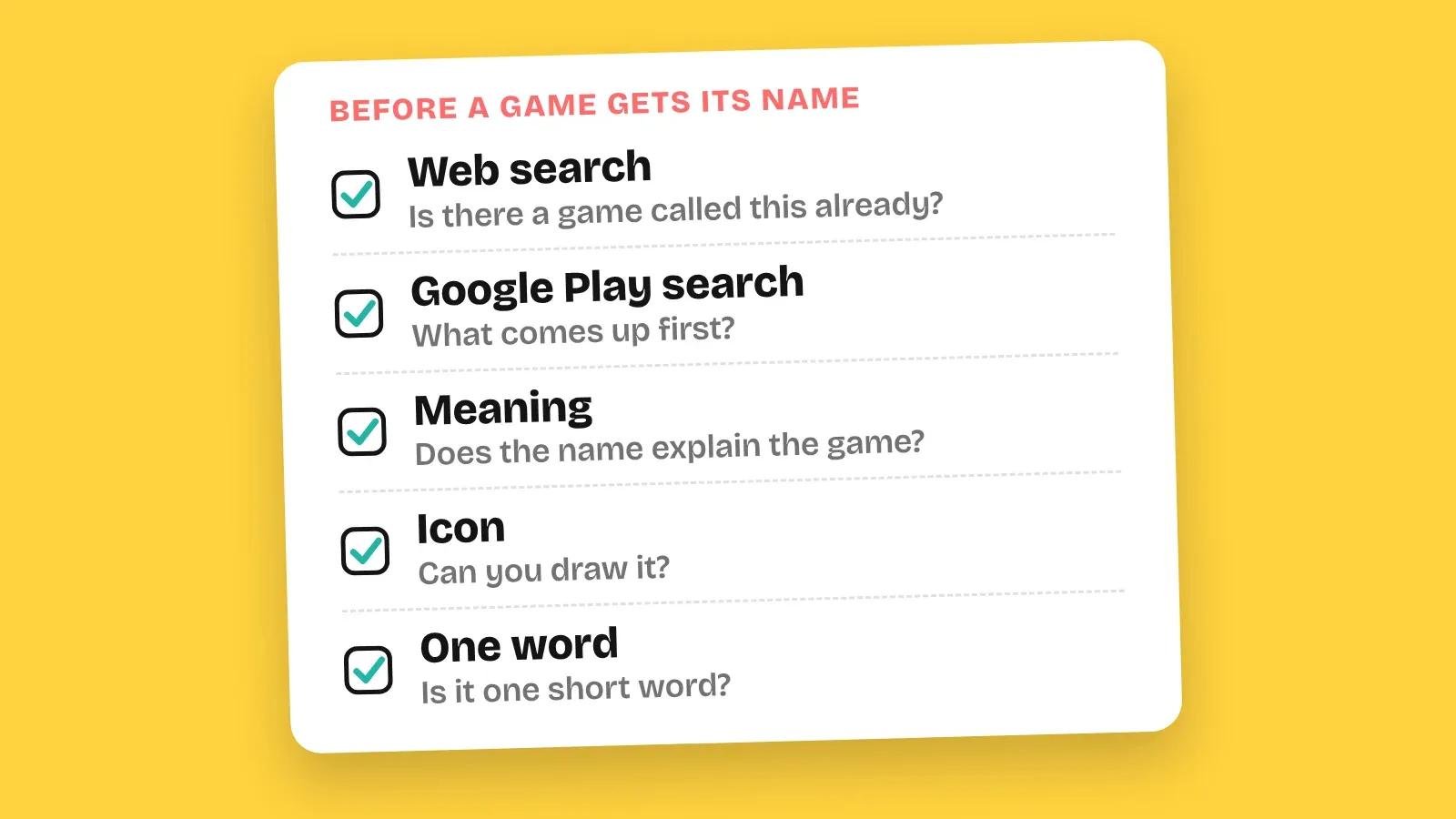
Seven renames taught me more than any naming guide. This is the list every name goes through now, before a game gets a store page.
1. The web search. Search the name with the word “game” after it. If a game already has it, you are done. Filament would have failed this in ten seconds. Then search the word alone and see what it means to everyone else. Corona would have failed that one.
2. The Google Play search. Type the name into the search box on Google Play, on your phone, and look at the first screen. You are checking two things. Is there already a game with that name? And could your game ever come up near the top, or is the word so common that it is buried under everything else that uses it? Ripple was that kind of name.
3. The meaning test. Does explaining the name explain the game? “A plumb is a weight on a line that points down, and in Plumb you choose which way down is.” “A carillon is a tower of bells, and every pop is a note.” If the best I can say is “it is a nice word”, the name fails. Palewheel failed this one the moment the game became cloth. There was no wheel left.
4. The icon test. Can you draw the name? If you can, the icon is half done, and the icon is what people really see on their home screen.
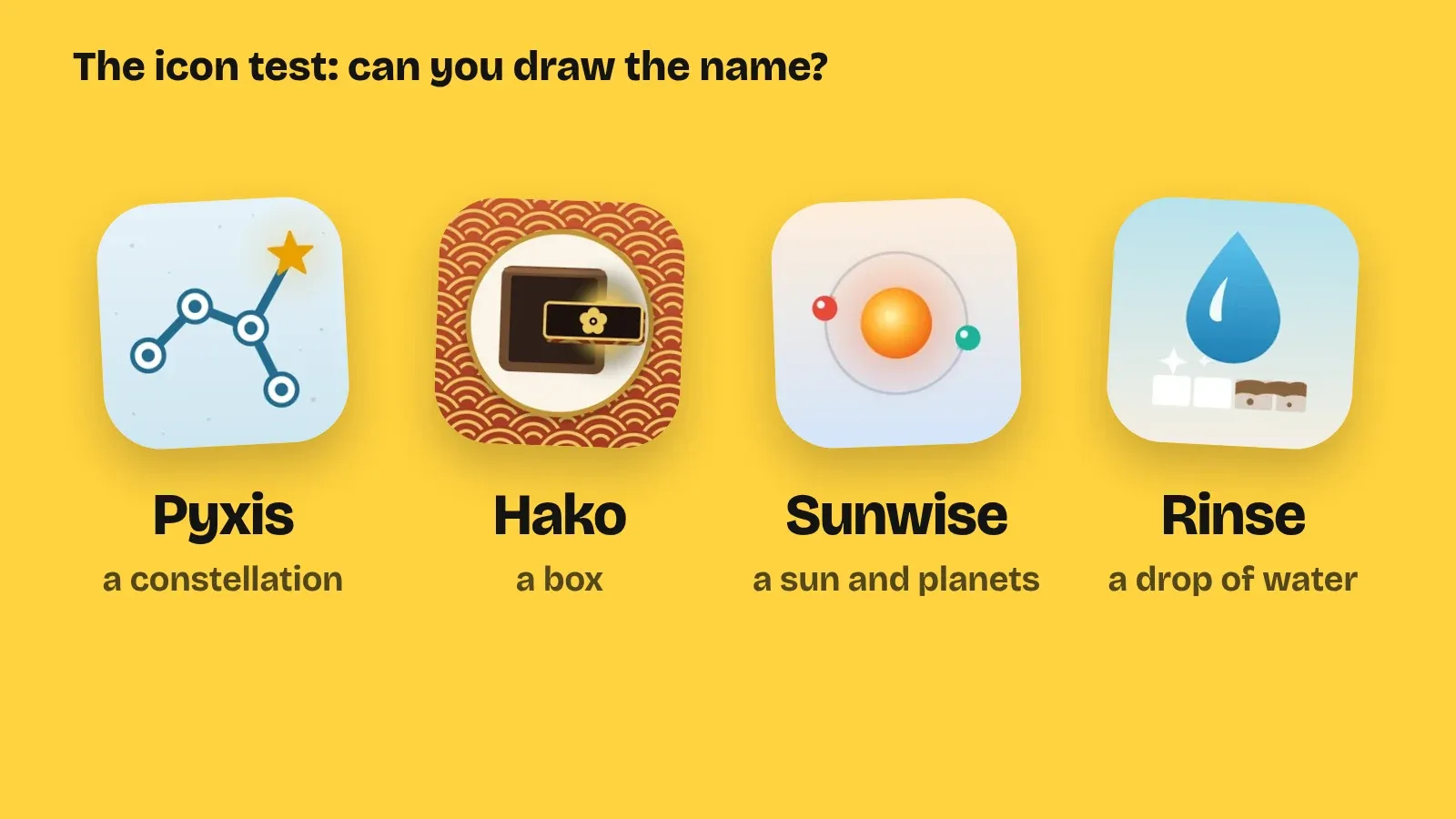
Pyxis is a constellation. Hako is a box. Sunwise is a sun and its planets. Rinse is a drop of water.
5. The one-word test. Every name my games have now is one word. Two of the names they lost, Chain Song and Orbit Out, were two. One word is easier to say, easier to remember and easier to type into a search box.
And three rules that come after the name:
- Say it out loud. If people will not know how to say it, tell them. Seiche is my one exception, and its story starts with how to say it.
- Put plain words after the colon. Google Play gives a game’s name 30 characters. The name is for remembering, and the words after the colon say what the game is.
- Rename before the store page exists. Once a game is on Google Play, the id behind its store page can never change. A late rename would leave the old name hiding inside it forever. Every rename here happened before Google Play saw the game.
The first name has a job too
Tilt, Chain Song, Orbit Out, Filament, Ripple, Corona, Compassfall and Palewheel were not mistakes. Each one got a game started on the day it was started. That is all a first name has to do.
The real name comes once the game knows what it is. For Plumb that took about seven hours. For Stitchfall it took four days and a whole new world.
If you are naming your own game, take the list. And if you want to see where the names ended up, start with Plumb, the one that was called Tilt for one afternoon.