Why Stitchfall: a new name for a sewn world
Stitchfall began as Palewheel, a working title that meant nothing in the game. Here is why it changed, and how the name, the letters and the buttons fit together.
 , 2 min read
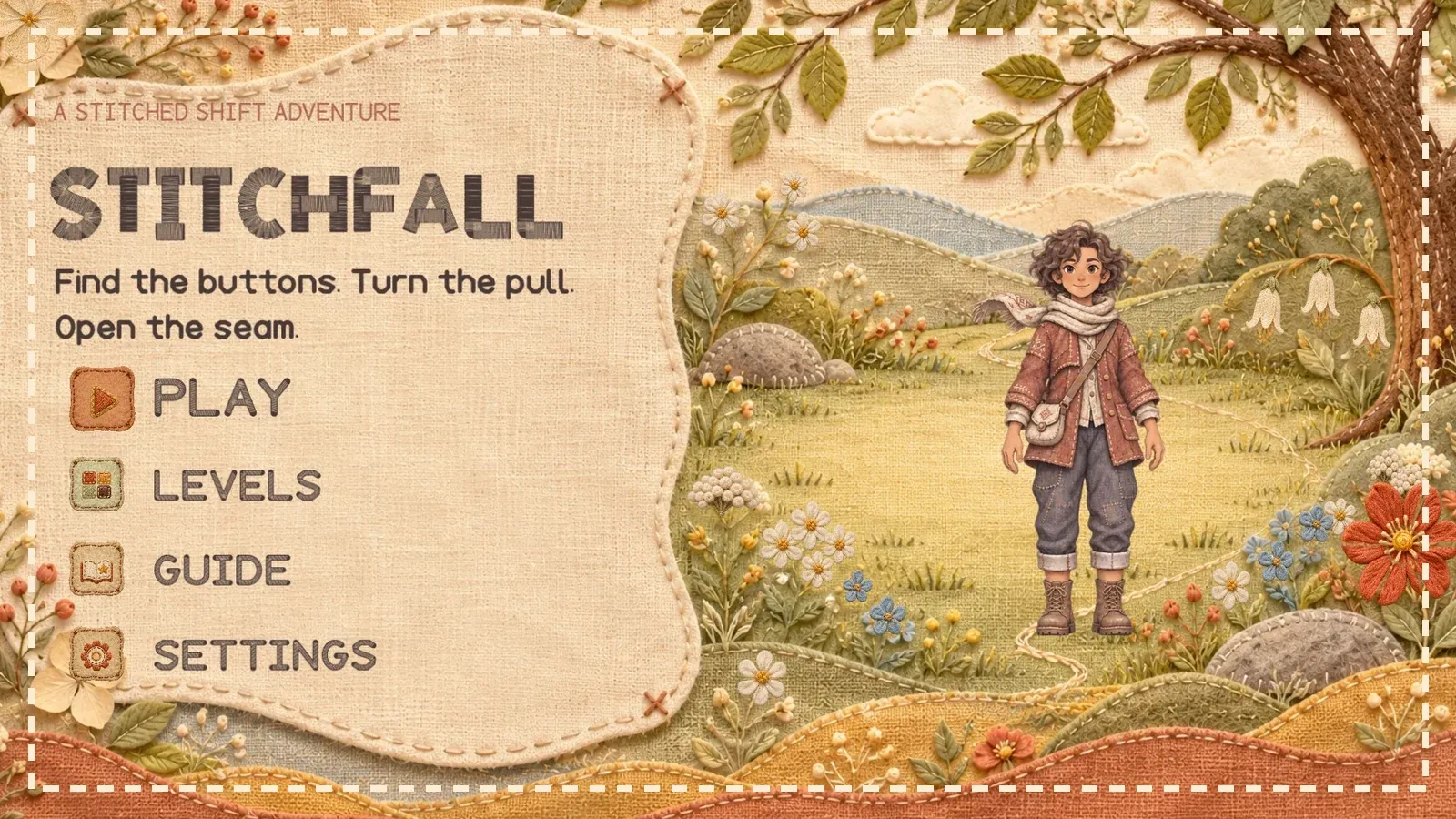
For its first weeks, this game was called Palewheel. It was a working title, picked before the game had a look, and by the time the world turned into linen, felt and thread, the name had nothing left to point at. There is no wheel in the game, and nothing in it is pale.
What the name had to say
The game is two things at once. It is sewn: buttons to collect, seams that open, zippers for doors, a runner in a patchwork coat. And it is about falling: every tap turns gravity, and the whole room becomes a new place to fall into.
Stitchfall says both. It is one word, easy to say, easy to spell, and as far as we could find, no other game uses it.
Letters that are sewn too
The title on the Home screen is set in Darn Display, and the reading text in Darn UI. The menus use Threadline Woven, and the smaller stitched controls Threadline Satin. Both are Chaosmos’s own typefaces, drawn to look embroidered, and both are free to use under the SIL Open Font License. So when the name changed, it changed in the game’s own thread.
Everything is something you would find in a sewing box
Once the world was cloth, the rest followed. The things you collect are buttons, and the meter that counts them is a row of little sewn buttons. A room’s exit is a zipper, which opens when the last button is sewn on. The bridges that come and go with a turn are seams. The checkpoints are flower pins. Even a hit is soft: the runner comes apart into patches and thread, and is sewn back together.
Made for Game Off
Stitchfall is our entry to GitHub’s Game Off 2026, a month-long jam for games whose source is public. Its code is on GitHub, and it keeps growing room by room after the jam. You can play Stitchfall in your browser right now, on a phone held sideways, a tablet or a computer.