 Apsis
What is an apsis? The astronomy behind the name
An apsis is the point of an orbit nearest to or farthest from the body it goes around. Periapsis, apoapsis, perihelion and apogee, and why a puzzle game took the name.
 , updated , 5 min read
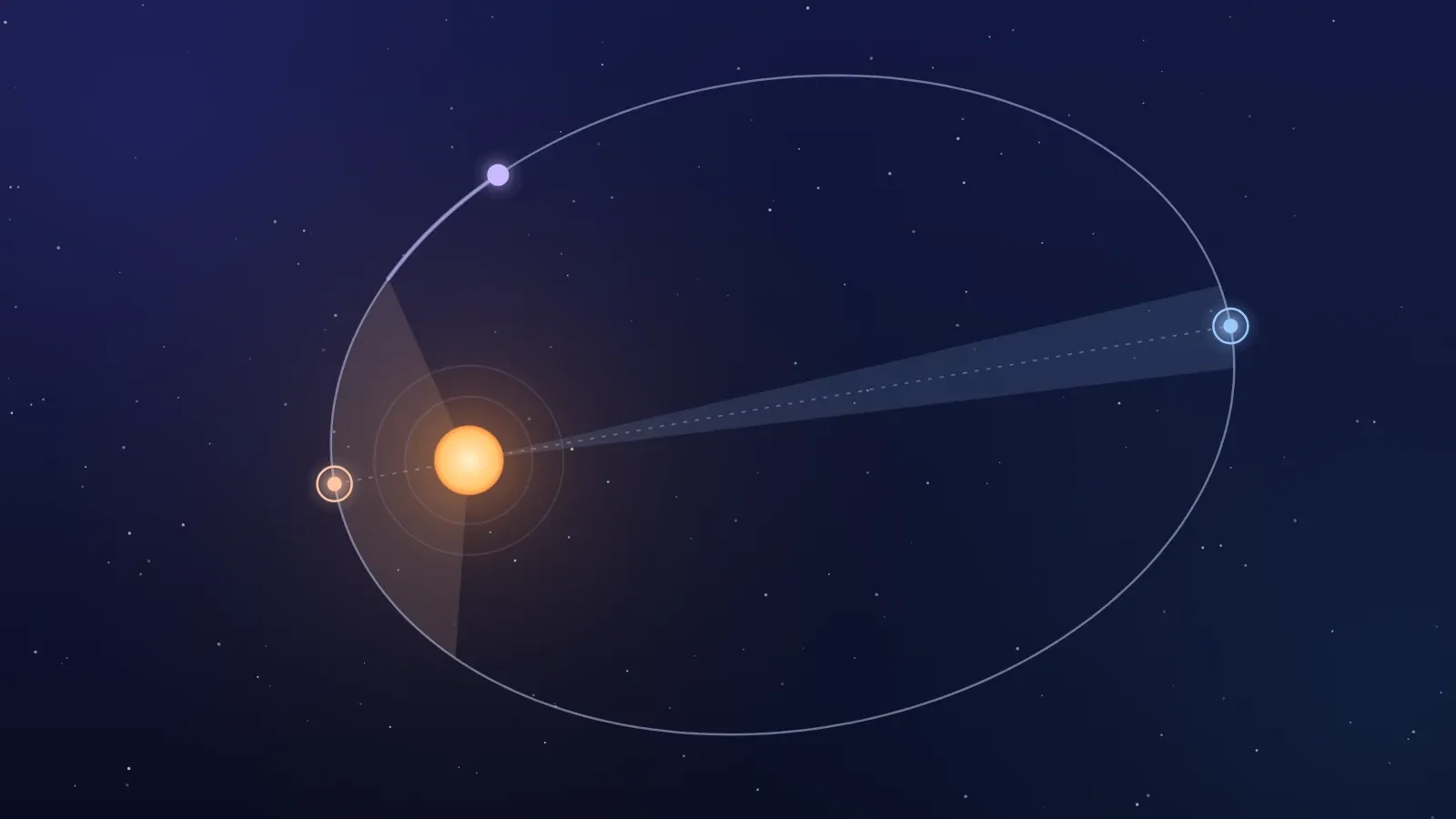
The game started life with the working title Orbit Out. It shipped as Apsis, a real word from astronomy that most people have never met. Here is what it means, the family of words around it, and why it ended up on a puzzle where no orbit has one.
The short answer
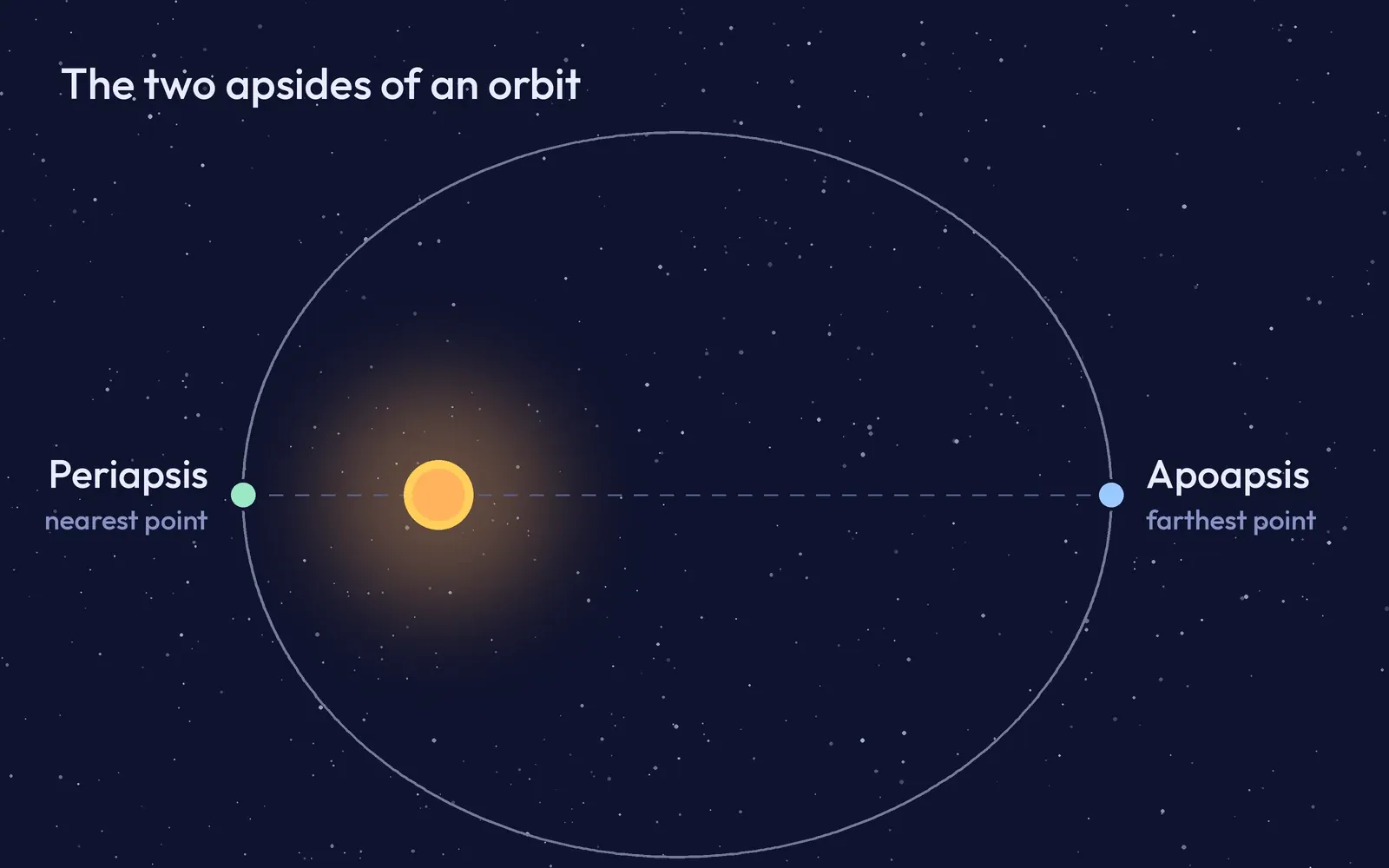
An apsis is a point in an orbit where the orbiting body is either nearest to or farthest from the body it goes around. An elliptical orbit has two of them, and together they are the apsides, said “AP-sih-deez”.
- The nearest point is the periapsis.
- The farthest point is the apoapsis.
The word reached English through Latin from the Greek hapsis, an arch or the rim of a wheel. The prefixes are Greek too: peri means near or around, and apo means away from.
Why an orbit has a near end and a far end
In the early 1600s Johannes Kepler showed that planets move on ellipses, not circles, with the Sun at one focus of the ellipse rather than at its centre. Because the Sun sits off to one side, every such orbit has one end that swings close and one that swings wide.
The straight line through the two apsides runs through the Sun and along the long axis of the ellipse, and astronomers call it the line of apsides. If the ellipse’s long radius is and its eccentricity is , which is 0 for a circle and close to 1 for a long, thin orbit, the two distances are:
Kepler’s second law adds a detail: a planet sweeps out equal areas in equal times, so it moves fastest at periapsis and slowest at apoapsis.
A word for every body
Astronomers often swap the general ending for one that names the body being orbited.
| Orbiting around | Nearest point | Farthest point |
|---|---|---|
| Any body | periapsis | apoapsis |
| The Sun | perihelion | aphelion |
| The Earth | perigee | apogee |
| A star | periastron | apastron |
| The Moon | perilune | apolune |
Two of these have escaped into everyday English. Apogee has come to mean the high point of anything, a career or an empire. And perigee is behind the supermoon: the Moon comes to roughly 363,000 km from Earth at its nearest and goes out to roughly 405,000 km at its farthest, so a full moon near perigee looks a little bigger and brighter than one near apogee.
Our own apsides
Earth’s orbit is only slightly stretched, with an eccentricity of about 0.017. Earth reaches perihelion in early January, about 147 million km from the Sun, and aphelion in early July, about 152 million km away.
That surprises people in the northern hemisphere, because it puts Earth nearest the Sun in the middle of their winter. The seasons come from the tilt of Earth’s axis, not from the apsides.
Apsides that turn
The line of apsides is not fixed. Tugs from other planets make it turn slowly, which is called apsidal precession. Mercury’s is the famous case: most of its slow turn is explained by the pull of the other planets, but a small remainder, about 43 arcseconds a century, stayed a puzzle for decades until Albert Einstein’s general relativity accounted for it in 1915.
Paths with one apsis
Not every path comes back. A body moving fast enough to escape follows an open curve, a parabola or a hyperbola, and that path has a periapsis but no apoapsis, since there is no far end to turn round at. Spacecraft on a flyby of a planet trace exactly that kind of path.
Where the game comes in
Apsis the game is a small planetary system: a warm sun, a few faint rings, and arrows resting on them. The first level has two rings, the next ones three, then four, and from level 61 five.
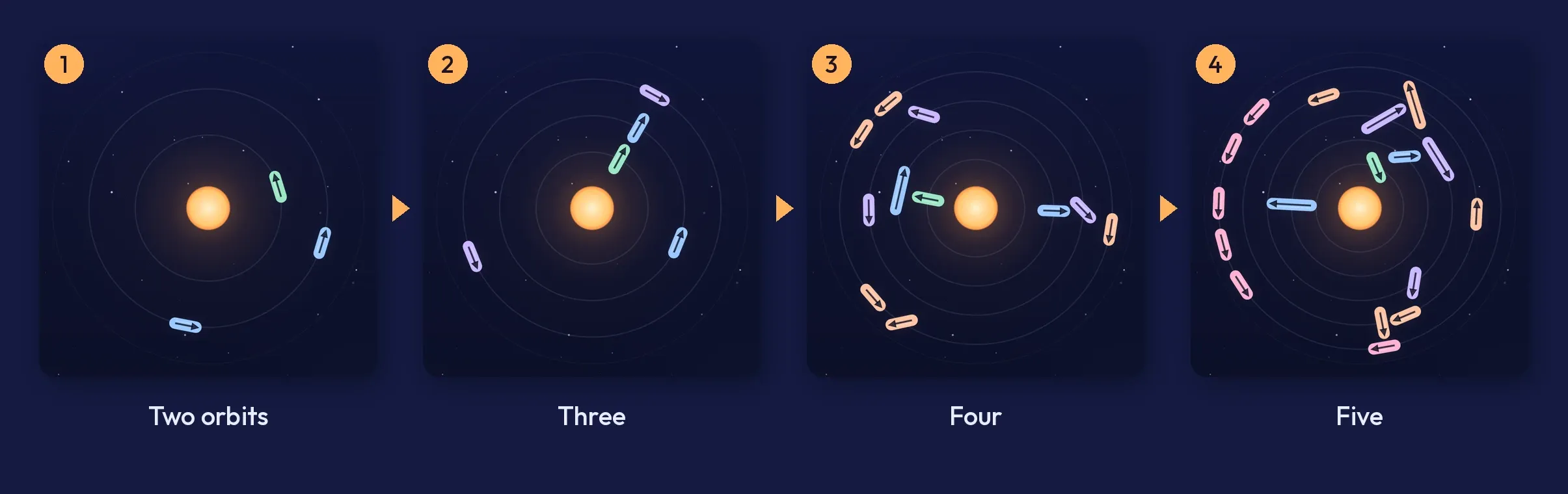
Here is the twist a stickler will spot: every ring in the game is a perfect circle, an ellipse with an eccentricity of zero, so a ring has no nearest or farthest point and no apsides at all.
That suits the game, because its rings are not tracks but where the arrows rest, and a tapped arrow flies off in a straight line. An arrow that points inward and flies past the sun is the plainest open path there is: its line has one point nearest the sun, a periapsis of sorts, and no far end. The game makes sure that point always clears the sun, as Straight lines across circles shows.
Later chapters borrow more from the sky. One has two suns, with two rings round each and one round both, where periastron and apastron would be the words to use. Another has comets, which in the game ride their ring round to a gate before flying out. Real comets are the opposite of a circle: Halley’s Comet has an eccentricity of about 0.97, and swings from inside Venus’s orbit at perihelion to beyond Neptune’s at aphelion.
About the name
The working title, Orbit Out, said plainly what the game is about. Apsis is shorter and stranger: five letters from astronomy that sit well in the game’s light lowercase type. On the title screen the wordmark sets “aps” in ink and “is” in the sun’s warm orange, over the line “Launch every arrow out”. It is also a word most people have never seen, which makes it easy to search for and hard to forget.
To see how it plays, start with Every arrow wants out, or see the game’s page.