 Apsis
Every arrow wants out: the rules of Apsis
Learn Apsis on its first five skies: tap an arrow and it flies straight out if its way is clear, or bounces back and costs one of your three hearts.
 , updated , 5 min read
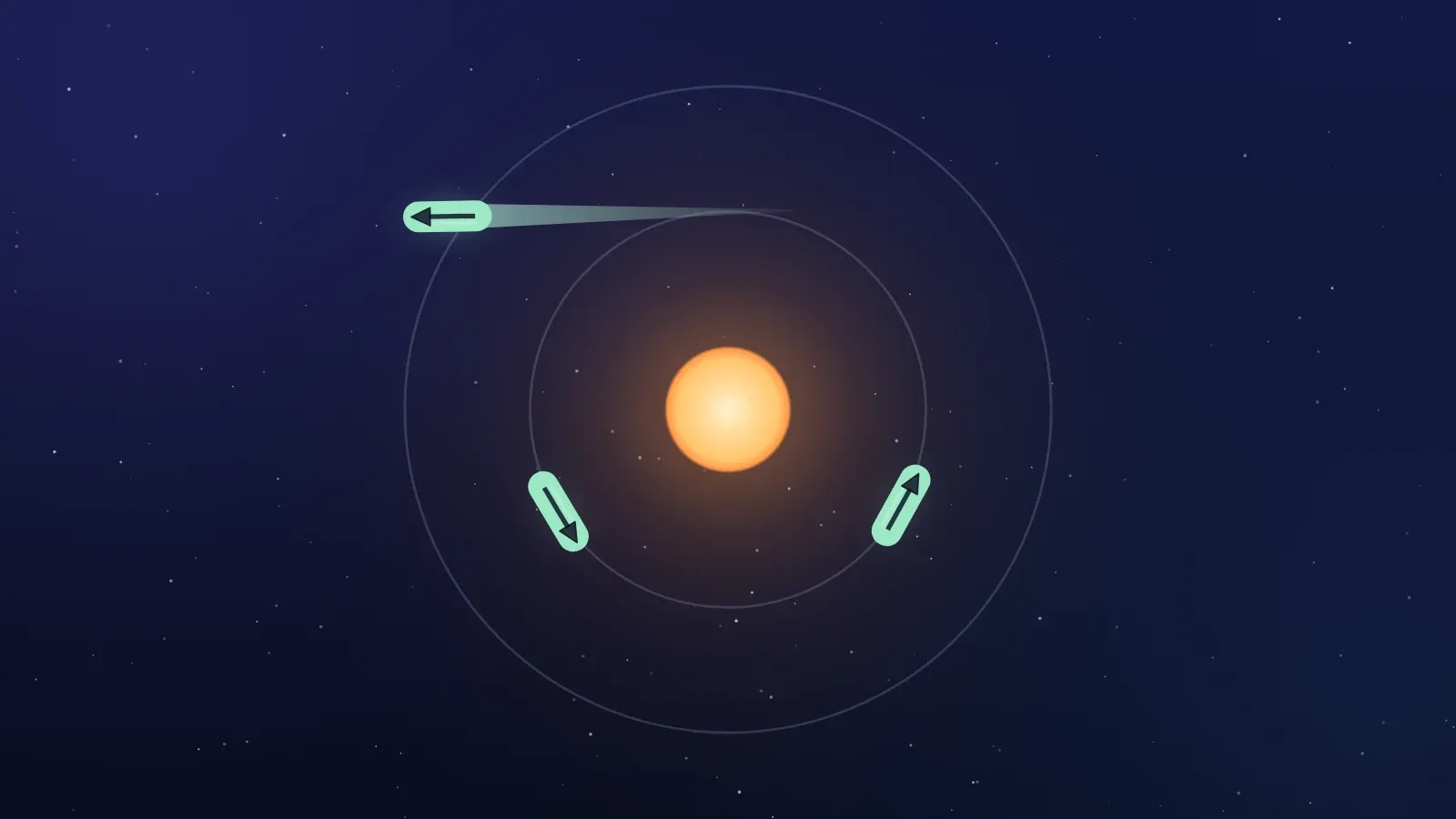
The first sky in Apsis is a sun, two faint rings, and three arrows lying along the inner ring like the blades of a pinwheel. Tap any of them and it leaves. That is the whole game in one move, and the next four skies quietly teach the rest.
Tap, and it flies straight
An arrow flies the way it points, in a straight line from where it rests, and never follows its ring. One question decides what happens next: is anything in the way?
- If the way is clear, the arrow speeds off, fades past the edge of the system and is gone for good.
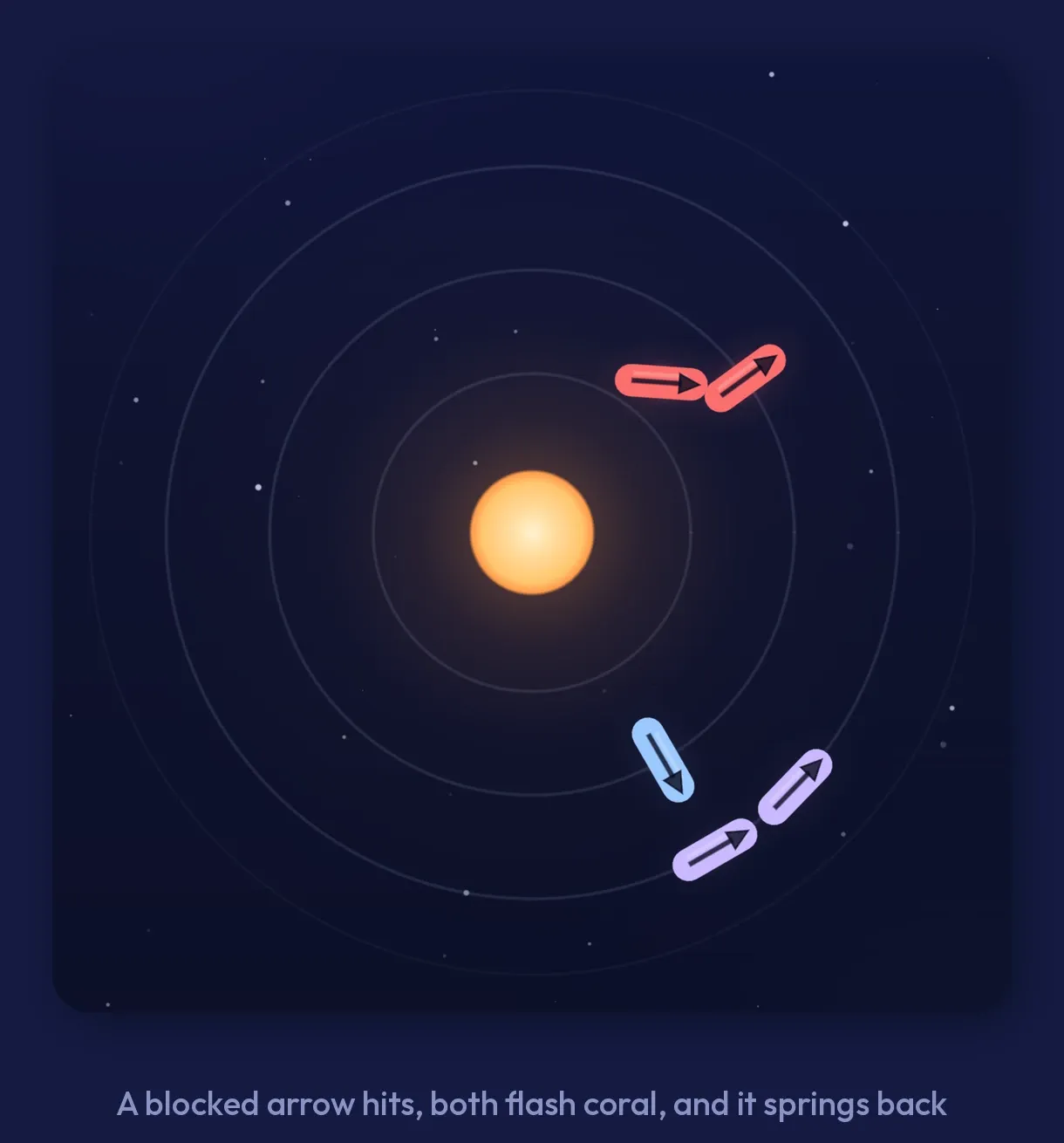
- If another arrow is in the way, the tapped arrow lurches forward to the exact point where it touches, both flash coral, and it springs back home, which costs a heart.
Each arrow that leaves rings a note, and the notes climb as the sky empties. A miss never changes the board: every arrow is where it was, and the puzzle is the same one you had before.
Five skies, five lessons
For each of the first five levels, I had the generator draw a hundred thousand small systems and keep the one that looks best and teaches the most.
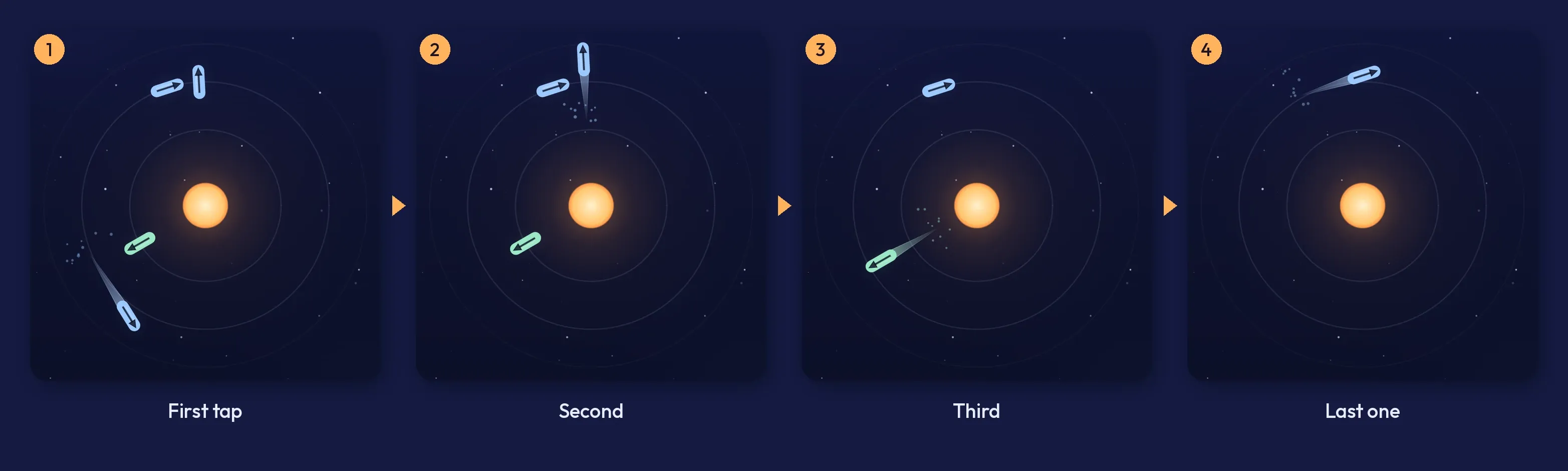
Level 1 is the pinwheel, and all three arrows are free. A short guide walks you through it, pointing at an arrow to tap after every launch.
Level 2 is a stack. Below the sun, one arrow points straight down with a second arrow right in front of it, also pointing down. The inner one cannot leave until the outer one has gone, and the line at the bottom of the screen says why: “Only a clear path gets out”.
Level 3 is a crown. Two arrows lie along the middle ring, both aimed up at one arrow at the top of the outer ring. That top arrow is the only first move, and the line here is “Hold to see where it goes”.
Level 4 is a propeller. Two arrows point straight out to the sides, and each has an arrow lying across its way on the next ring. The arrows pointing out look like the easy ones, and they are the ones that have to wait.
Level 5 makes that a lesson worth keeping. Below the sun, one arrow points straight down, two more along the inner ring head the same way, and all three wait on a single arrow lying sideways on the outer ring. One tap on that sideways arrow frees the other three.
Those five skies hold the whole skill of Apsis: follow each arrow’s line to the rim before you touch it.
Hold to see where it goes
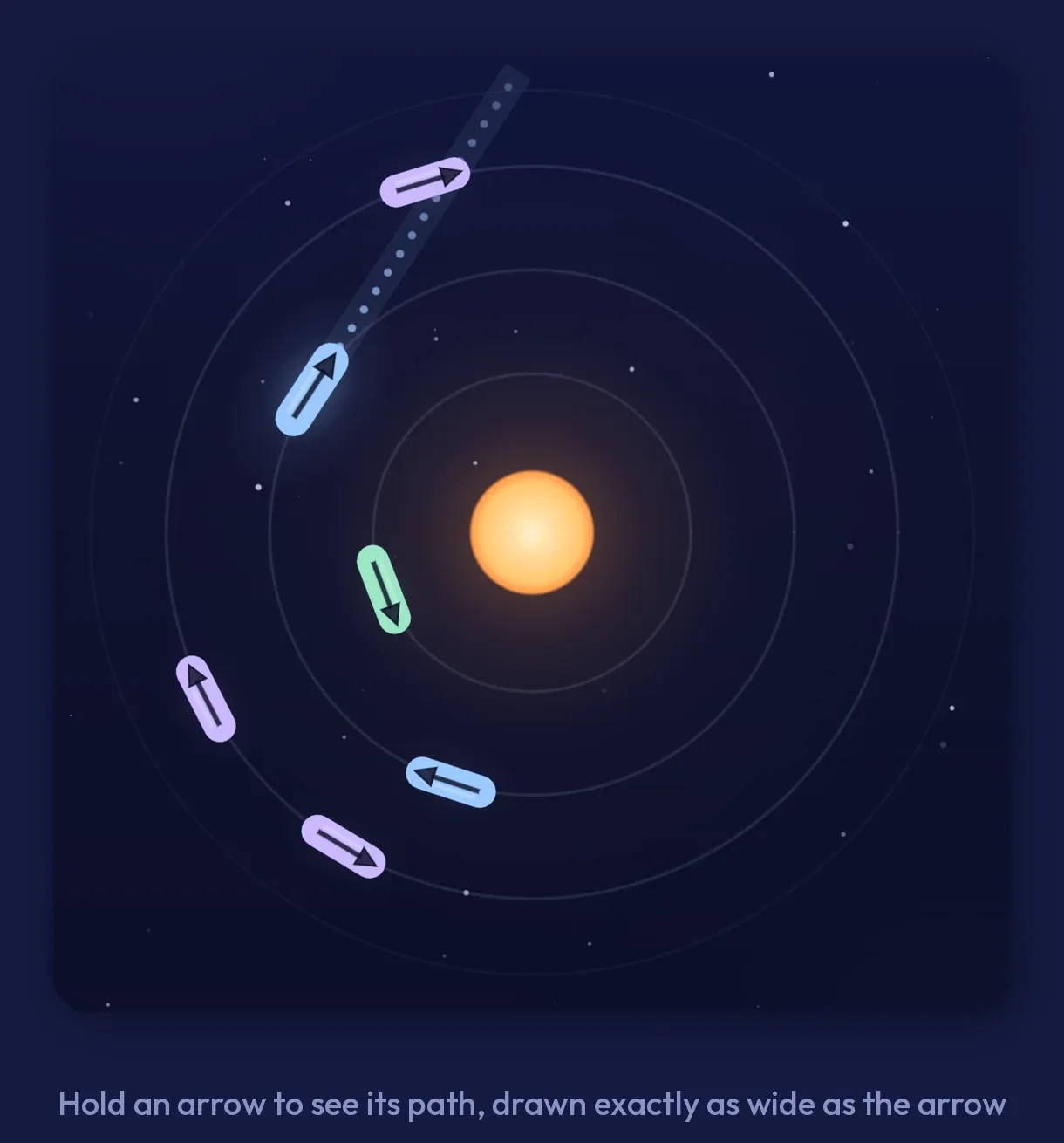
Put a finger on an arrow and keep it there. The arrow lifts, and its path appears as a dotted line over a faint band, all the way out to the rim.
The band is exactly as wide as the arrow. That matters, because an arrow is a pill with real width, and its edge can clip a neighbour that its centre line would pass. If any part of another arrow touches the band, the way is blocked.
A hold also forgives a wrong press. Lift your finger on the arrow and it launches, the same as a tap. Slide onto a neighbour and that one lifts instead, with its own path showing. Slide off into open space and the arrow settles back down, with nothing launched and no heart lost.
Three hearts and no clock
Every level starts with three hearts, and they are the only pressure in the game. There is no timer and no move limit.
When the last arrow leaves, the hearts you kept become your stars. If the third heart goes, the level stops on a sheet that says “Out of hearts”, where you can retry with every arrow back in place, or take one more heart, once, and carry on. How that works is in Hearts, misses and stars.
New arrows, one chapter at a time
Levels come in chapters of twenty. From the second chapter on, a chapter’s first level opens with a card naming what is new and a line at the bottom of the screen, and the rest of the chapter mixes it with what you already know.
In the first chapter, an arrow points straight out from the sun or along its ring, either way. From level 21 some arrows are long, 80 units instead of 44: “Long arrows block more”. From level 41 some point at an angle, halfway between out and along: “Some arrows fly off at an angle”. From level 61 there are five rings, and some angled arrows point inward and fly close past the sun on their way out. No arrow ever points straight at the sun.
After that the chapters bring rules: locks and keys, ghosts that other arrows fly straight through, linked pairs, brittle arrows, heart arrows, numbered arrows, wormholes, mirrors, comets and more. An arrow held back by one of them, say by a key still on the board, rattles where it is when you tap it, shows what it is waiting for, and costs a heart. And every rule keeps the first chapter’s promise: an arrow that is free stays free until you launch it.
When you are stuck
The light bulb at the top right is the hint. It dims the sky around one arrow that can leave right now and draws its way out, choosing the arrow whose launch frees the most others, and it is never wrong.
At the bottom, restart puts every arrow back with three fresh hearts. Beside it is Settings, where How to play brings back the guide from level 1.
Your first sitting
Clear first, and come back for stars later. Hold whenever you are unsure, since a hold costs nothing, and look again after every launch, because the arrow that just left may have been in the way of two others. There is more in Habits that save hearts, and more about the game on its page.