 Apsis
Hearts, misses and stars: how Apsis keeps score
Apsis never counts your taps. It counts misses: how three hearts become stars, what a miss costs, the hearts a level means you to spend, and retrying.
 , updated , 5 min read
Apsis never counts your taps. It counts your misses, and every star you earn is a heart you did not lose. That choice was not a matter of taste: the way the arrows behave left no other score worth keeping.
Why taps cannot be the score
In a lot of puzzle games, fewer moves means more stars. In Apsis every arrow has to leave once, and no order of taps does that in fewer, so every clean clear of a level takes the same number of taps. A tap count would hand every player the same score on every level.
There is no clever order to find either. Whether an arrow is free depends only on which arrows are still on the board, and an arrow leaving only ever clears space. So an arrow that is free now stays free, and if you only ever tap free arrows, you will always clear the sky.
That leaves exactly one kind of mistake: tapping an arrow that cannot go. So that is what the game counts.
What a miss looks like
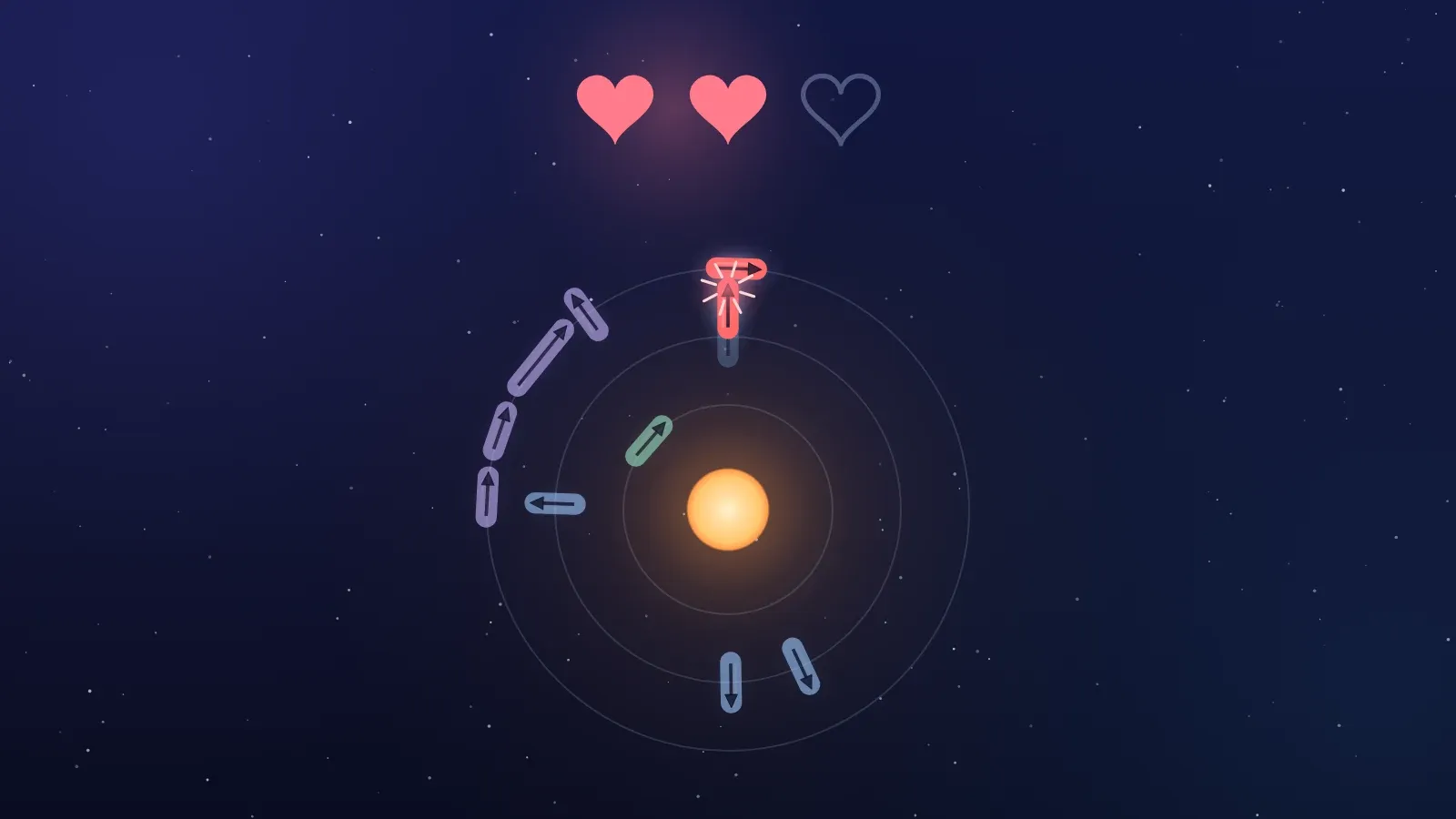
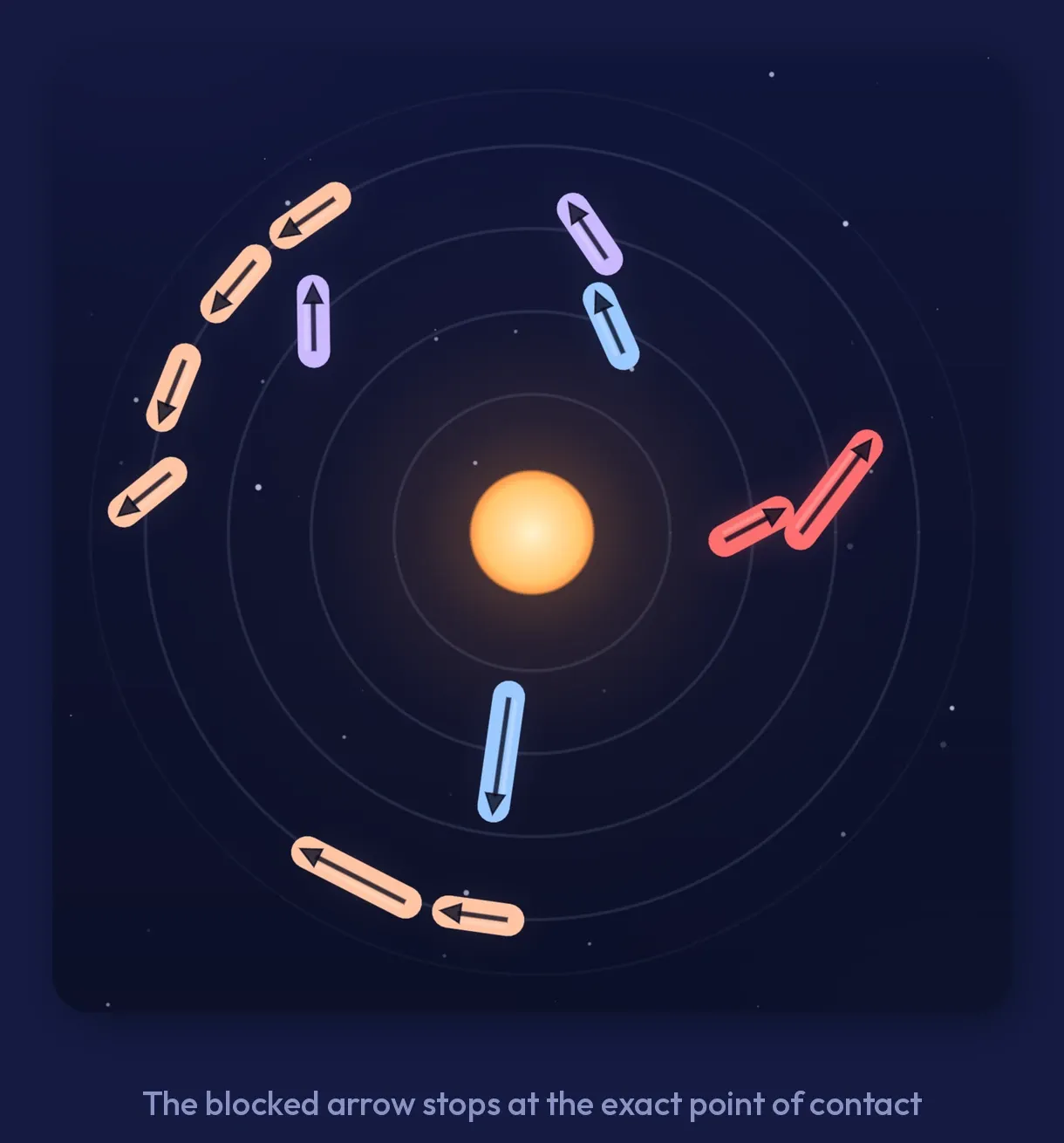
Tap an arrow with something in its way and it lurches forward, stops at the exact point where it touches the other arrow, and both flash coral before it springs home. The heart leaves the row at the moment of contact rather than the moment of the tap, so you see what it hit before you see what it cost.
From the fifth chapter, some arrows wait for a reason other than their path: a key that has not left, a lower number still on the board, a frozen arrow that has not thawed. Tap one of those and it rattles where it is, lifts what it is waiting for so you can see it, and costs a heart in the same way.
Two details keep misses fair. The bounce stops at the true point of contact, so the reason is always on screen. And while an arrow is still bouncing, more taps on it are ignored, so a nervous double tap costs one heart, not two.
The board after a miss is the same puzzle as the board before it. Nothing moved except the heart.
Hearts become stars
Every level starts with three hearts, shown in a row under the level number. Clear it, and the hearts you still have are your stars: three for no misses, two for one, one for two.
The win sheet shows the stars landing one at a time, under a heading that suits them and a line about this particular clear, such as a chapter you have just opened. Below that it says “Not a single miss”, or how many there were, and if you earned fewer than three stars it adds “Clear it without a miss for three stars”. Next level is the big button, with Watch, Again and Levels under it. Watch replays your clear at speed, and above the sheet there is a card of the win to share or save.
Hearts a level means you to spend
Two chapters bend the rule on purpose.
In the brittle arrows chapter, every sky jams at some point: no arrow is free, and the way through is to hit a brittle arrow on purpose. The bounce breaks it and costs a heart. The game counts that heart as kept, so a clear with no other miss still earns three stars. Breaking one the level did not need costs a star like any other miss.
In the heart arrows chapter, launching a heart arrow wins back a lost heart, and the star that goes with it. A heart arrow launched while you still have all three hearts wins nothing, so it is worth keeping one back until you have missed.
Out of hearts
When the third heart goes, a sheet rises a moment later over the board, which is still exactly as you left it. It says “Out of hearts”, and under it, “Retry puts every arrow back”.
The big button offers one more heart, once per try. It comes after a short video, and it is free for a Supporter. Take it and you play on from exactly where you stopped. A clear after that earns one star, since the level was really lost, and you can always come back for more.
Retry puts every arrow back with three fresh hearts, and the stars you already earned on that level stay.
Stars that stay
Your best result on each level is kept, so replaying can only ever raise it. The level grid shows the stars on every tile, and the title screen shows your total.
Any clear, even a one-star one, opens the next level. A chapter’s first level also opens once you have cleared 14 of the 20 levels in the chapter before it, so one stubborn level never walls you in. On Google Play, a level key or a short video opens any one level too.
A routine for clean runs
Three stars is about attention, not speed. Before any tap, follow each arrow’s line to the rim, and start with the ones that have nothing in front of them. When in doubt, hold: the band shows the arrow’s full width, and sliding off into open space cancels without a cost. Tap only what you are sure of, since a free arrow stays free and there is never a reason to gamble. After every launch, look again, because the arrow that just left may have been holding back two others.
And when you would otherwise guess, ask for a hint instead. A hint never costs a heart or a star, and a hinted tap never costs a star either, as Why the Apsis hint is never wrong explains. For more on reading a sky, see Habits that save hearts.