 Seiche
Why my pond game is called Seiche
A seiche is one slow wave that rocks a whole lake. How that word became the name of a calm ring puzzle, why its rings are square, and why the board has no numbers.
 , 6 min read
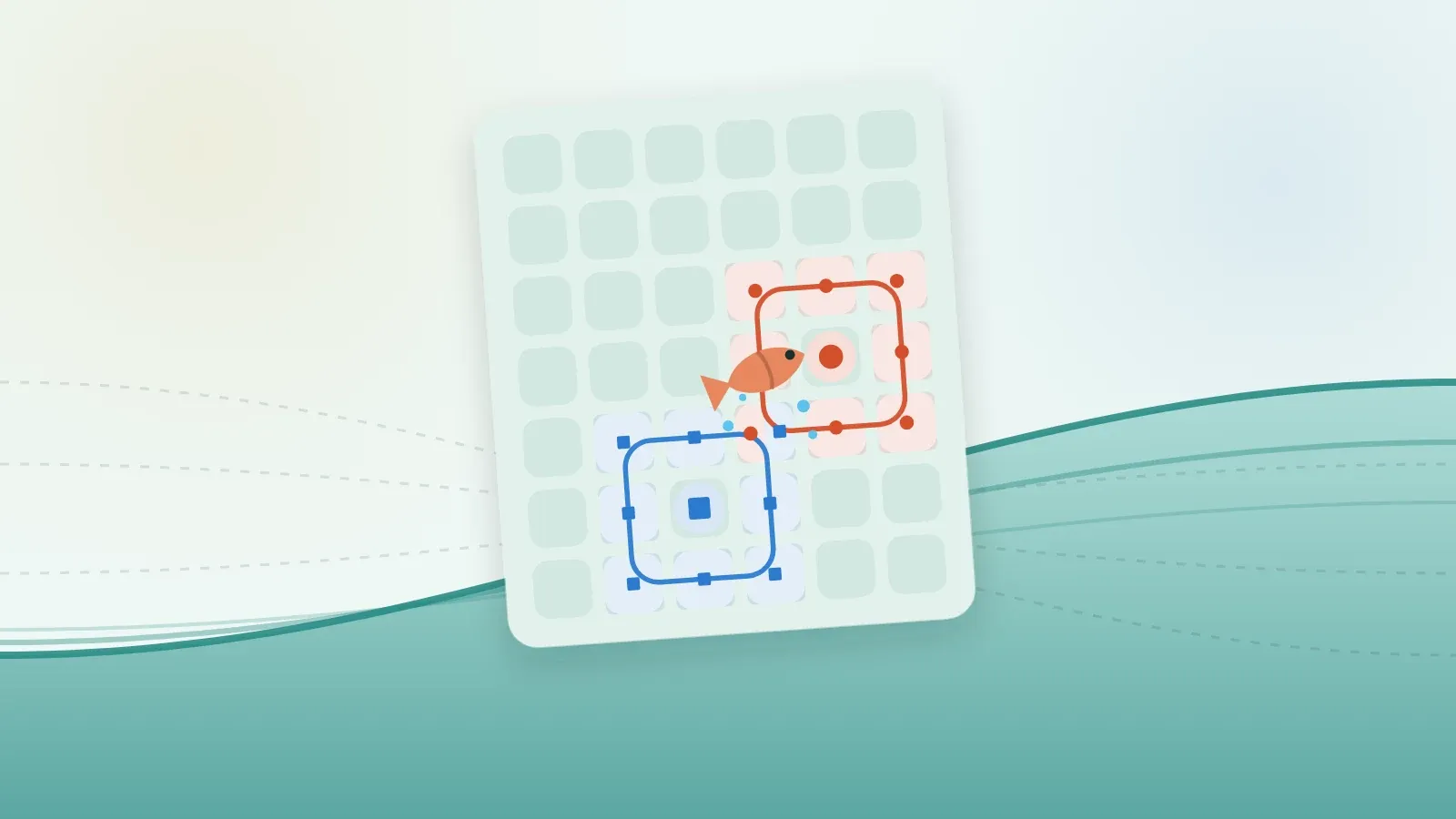
If you are wondering how to say it, let me start there. Seiche is said like “saysh”, one syllable, rhymes with “fresh” if you squint. It is a real word, and I did not make it up.
A wave you cannot see
A seiche is a slow wave that rocks a whole lake from one shore to the other. Wind pushes the water to one end, or the air pressure changes, and when it lets go the water swings back. Then it swings again, and again, like tea in a cup you just put down on the table. On a big lake one swing can take many minutes, so you never see it as a wave. You only see that the water at one end is a little higher than before, and later a little lower.
The word comes from Lake Geneva, where people noticed the water at the shore rising and falling for no clear reason, long ago. A scientist there studied it properly in the 1800s, and the local name stuck.
I liked it the first time I read it. A lake that moves as one thing. Nobody looking at one corner of the water can tell you what is happening. You have to look at the whole surface together.
That is exactly how I want people to play this game.
From Ripple to Seiche
The first version of this game had a much plainer name: Ripple. It was a small prototype, a few ponds and the rule, nothing else. The rule has not changed since then.
Every ripple on the pond draws a ring. Every ring touches exactly one fish. Nothing hides inside a ring. Find where the rings say a fish must be, cast there, and the fish jumps out.
The guide on the rules of Seiche walks through it on the first ponds, so I will not repeat all of it here.
When the game moved onto our shared puzzle kit and got its proper look, I wanted a name that was its own. “Ripple” was too common, and it described one splash. The game is not about one splash. It is about many rings across one pond, and you only understand a ring once you see all the others with it. One pond, read as a whole. So Seiche.
Why the rings are square
This is the next question almost anyone has after the name. A ring on water should be round, no?
In the game, a ring is every tile at the same distance from its ripple, and that distance is counted like a king moves in chess. One step in any direction, diagonals included, counts as one. So the tiles one step away make a square around the ripple, the tiles two steps away make a bigger square, and so on. The game draws each one as a rounded square through the middle of its tiles.
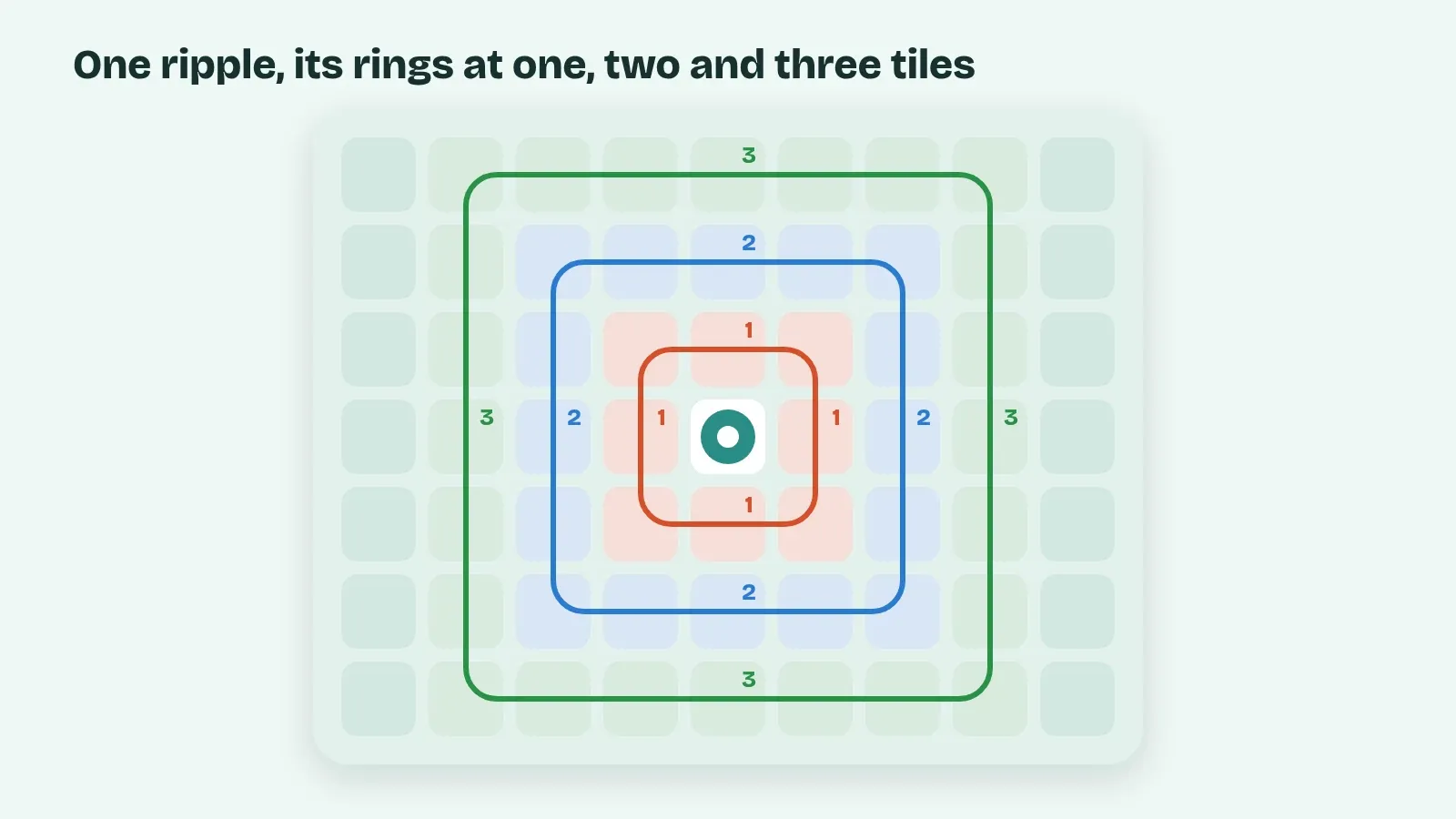
Round rings sound nicer, of course. On a grid of tiles, a round ring cuts through tiles at odd angles, and you can never be sure if a tile is “on” it or just touched by it. A square ring runs along whole rows and whole columns. Your eye can follow it tile by tile and there is no doubt.
There is one more good thing. The water inside a square ring is a neat block of whole tiles. And the rule says nothing hides inside a ring, so that whole block is safe to ignore. With round rings, the inside would have been a fuzzy shape and the rule would be harder to trust.
So the rings are square because square is honest on a grid. They still have soft corners, so they look like water and not like a spreadsheet.
No numbers on the board
Seiche looks a bit like Minesweeper if you only glance at it. A grid, hidden things, and you must work out where they are. But I made one firm choice early: there are no numbers on the board.
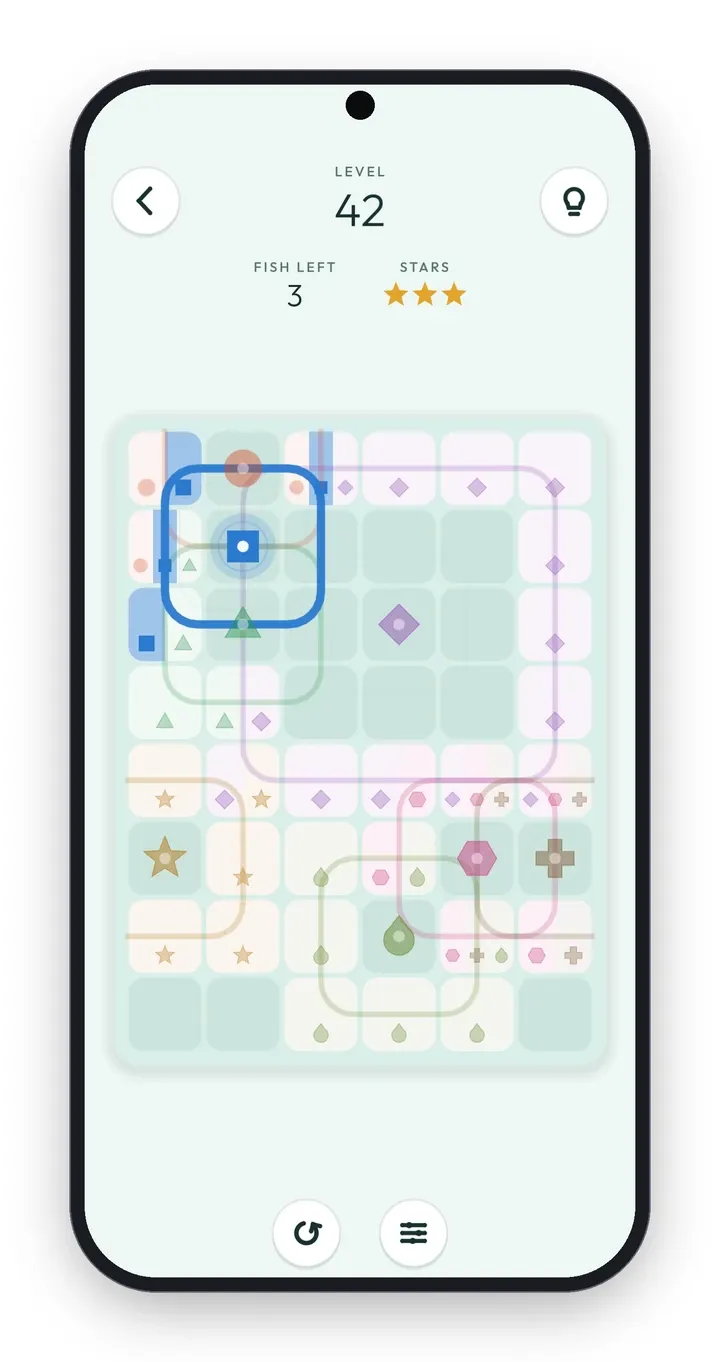
In Minesweeper you add up counts in your head. In Seiche you look at shapes. Each ring has its own colour and its own mark: a circle, a square, a triangle, a diamond, a star, a hexagon, a plus or a drop. The mark sits on the ripple and on every open tile the ring crosses. A tile on two rings is split into two bands, one for each.
So you can always tell which rings pass over a tile, even if you cannot tell two colours apart. That part was important to me. I never want a puzzle to depend on colour alone.
Tap a ripple and its ring is picked out on its own. Its tiles brighten and every other ring dims. Tap it again to let go. It helps a lot on the bigger ponds, when four rings pass over the same corner.
Calm water
Here is where the lake idea comes back.
Any water where no fish could be is drawn calm. The water inside a ring is calm. Water that no ring touches is calm. And once a ring has its fish, the rest of that ring goes calm too, because a ring only ever has one fish.
So the pond gets quieter with every catch. When you catch a fish, a little bright bead runs round each ring it was on, from the fish outwards in both directions, and every tile it passes settles down. The rings still waiting keep a faint wave running out inside them, so you can see at a glance which ones still need a fish.
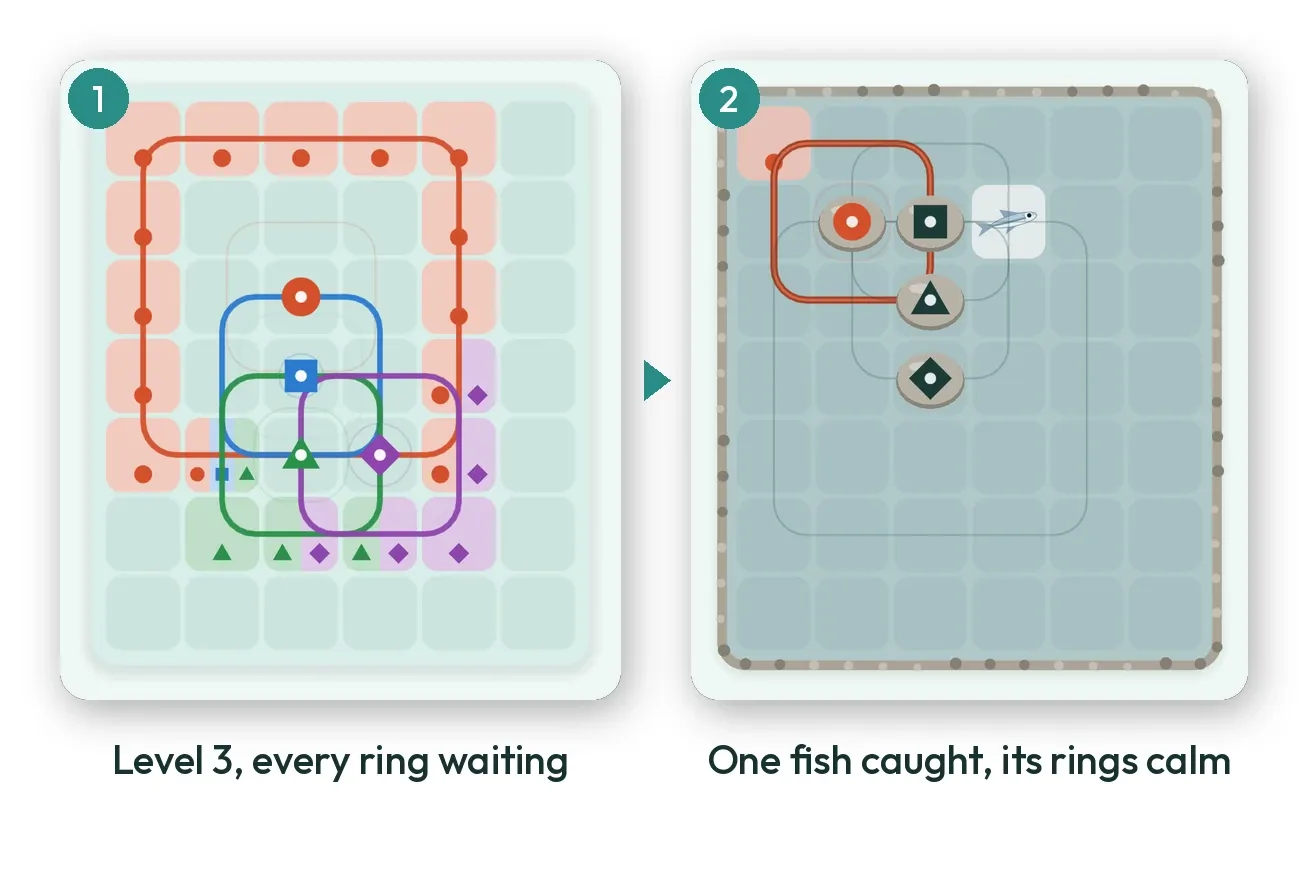
If you tap calm water, nothing bad happens. The tile flashes and tells you why it is calm, in one line, like “Nothing hides inside a ring.” or “That ring already has its fish.” I made that free on purpose. A puzzle should explain itself when you ask.
The last fish
I saved the best moment for the last fish in every pond, and this is the one place the name shows itself.
When you cast on the last fish, time slows down for a moment. One wave starts at that fish and crosses the whole pond, edge to edge. Every ring left dissolves as it passes. Then the water goes still and glassy, and the result comes up.
That wave is my little seiche. After all the small rings, one slow wave moves the whole pond at once. If you play with sound on, listen for it.
A calm game, on purpose
The name also sets the mood, and I wanted the mood to be calm.
There are no timers on the ponds. There are no lives. A wrong cast is a soft plop, it marks the tile as empty, and it costs a star and nothing else. There is no undo, because a miss shows you something true, and taking it back would make guessing free. Restart is always there if you want all three stars back.
And the pond never ends early. You can always finish it.
I think this is why the word fits so well. A seiche is not a storm. It is a lake quietly finding its level again. That is what I want a pond in this game to feel like: messy for a second, and then, catch by catch, still.
There is more on how every pond is made so it can be read, and on the places the ponds are in. Seiche is one of four new games we are getting ready at Chaosmos, and there are more after these.