 Seiche
Ponds you can read: how every Seiche pond is made
Every Seiche pond has one answer you can read without a guess. How the ponds are built, what a what-if is, where the hint comes from and why ponds only get harder.
 , 8 min read
The one promise I care about most in Seiche is this: you never have to guess. Every pond has exactly one answer, and a careful person can find it from what the board shows. That sounds simple when I write it in one line. Making it true for every single pond took most of the work on this game.
So this post is about how a pond is made, and how I know it is fair. No answers to any level here, don’t worry.
One answer is not enough
The first thing a pond needs is exactly one way for the fish to be placed.
You know four things when you look at a pond. Every ring has exactly one fish on it. Nothing hides inside a ring. Fish only sit on the rings. And the game tells you how many fish there are.
A program in the game counts every way of placing the fish that fits those four facts. It does not try tiles one by one, which would be slow. It picks the ring with the fewest possible tiles left, tries each of those tiles as the fish, and follows each choice to the end. If it finds one layout, good. The moment it finds a second, it stops, because a pond with two answers is already a bad pond.
But here is the thing I learnt quickly. A pond with one answer can still be horrible to play.
The counting program is happy to check every case in a big tree of what-ifs, deeper than any person would go. A pond can have one answer that only that tree can see. For a person it would feel like a guess, and a guess is exactly what I promised you would never need.
So there is a reader too
Every pond is also played by a second program, which I call the reader. The reader is only allowed to think the way a person does.
It knows four plain rules:
- A ring with its fish. Once a ring has its fish, the rest of its tiles are empty.
- One tile left. If a ring still waiting has only one open tile, its fish is there.
- Counting. If no fish are left, every open tile is empty. If there are as many open tiles as fish left, every one of them is a fish.
- The last fish. With one fish left, it must sit on every ring still waiting, so it is where they all meet.
Level 1 is the fourth rule and nothing else: two rings, one fish, one tile where they meet.
When those four rules stop finding anything, the reader is allowed one more kind of step. It picks a tile and asks, what if? Suppose a fish is here. Follow the four rules and see what happens. If some ring ends up with no open tile left, or with two fish, or there are more fish than the pond holds, then the supposing was wrong, and that tile is empty. It also asks the other way: suppose there is no fish here. If that breaks the pond, there must be a fish.
That is a what-if. It is the hardest kind of thinking in Seiche, and it is still only one step deep. The reader never supposes something and then supposes again inside it. If it cannot clear a pond with these steps, that pond does not go in the game.
The hint is the reader’s next step
Because of the reader, the hint was easy to make honest.
When you tap the light bulb, the reader looks at your pond as it is right now: the fish you have caught, the calm water, even your misses, since a miss tells you that tile is empty. It runs its rules and stops at the first fish it can prove. That fish is your hint, and the rule that proved it becomes the one line shown above the pond.
There are only four lines it can say:
- “This ring has one open tile left, so its fish is there.”
- “One fish left: it sits where every ring still waiting meets.”
- “There are as many open tiles left as fish, so each holds one.”
- “If this tile were empty, the rings could not each get their one fish.”
A little dragonfly carries the hint from the button to the tile, which is my favourite small detail in the game.
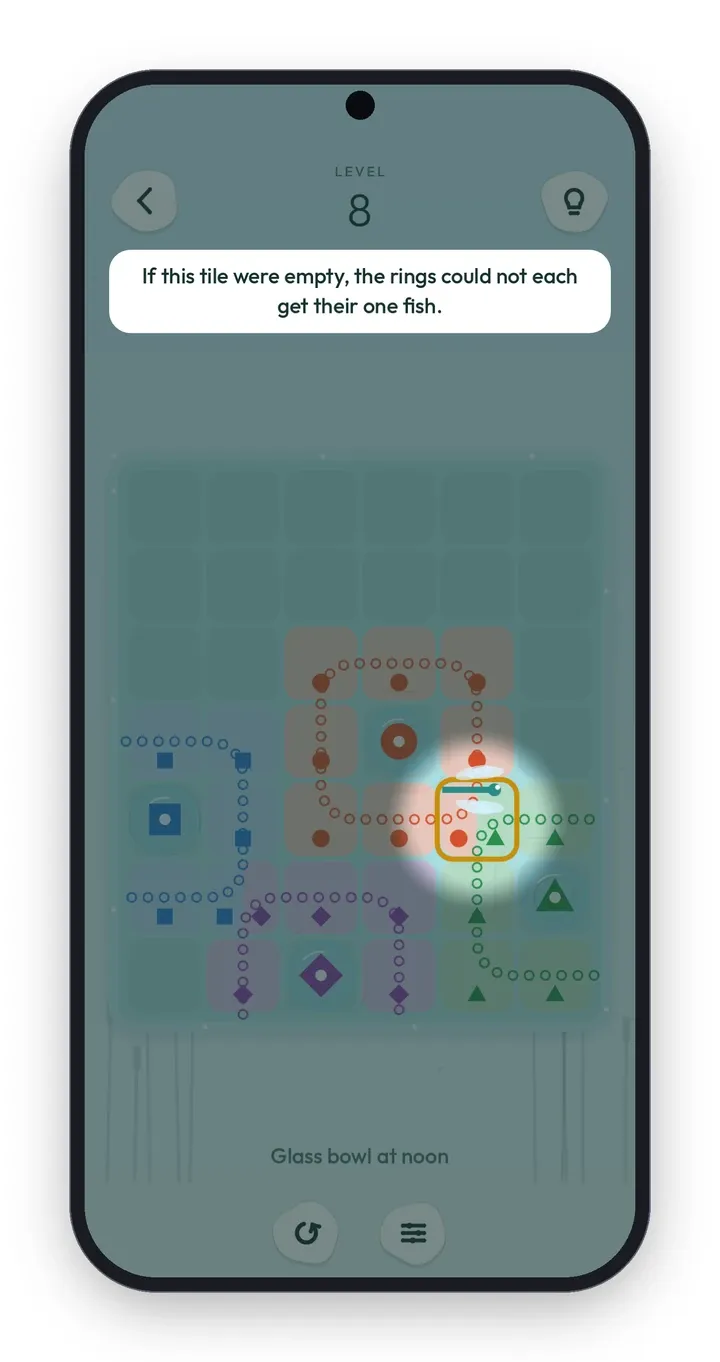
So a hint is never a fish you could not have found yourself. It is the next thing a careful look would show. Read the line once and you can often find the fish after it on your own.
How a pond is built
Now the building part. No pond is drawn by hand, me included.
- Hide the fish. The program places the fish at least two tiles apart, so two catches never share a splash.
- Find every ripple that could be. A tile can hold a ripple only if its ring, drawn out to the nearest fish, touches no other fish. Most of the ring also has to be on the pond, at least 60 percent, so it still looks like a ring and not a corner of one. On the first three ponds the rings must be whole.
- Put them all on, then take them away. Every possible ripple goes on the pond at once. Then, in a random order, each one is taken off if the pond stays fair without it. Fair means one answer, and the reader can find it.
- Keep the smallest. That taking-away is done in a few different orders, and the version with the fewest rings wins.
So every ring left on a pond is needed. Take any one away and the pond either gets a second answer or stops being readable. I like that a lot. Nothing on the board is decoration.
A pond also has at most eight rings. Beyond that, a phone screen starts to look like a tangle of wool, and reading stops being fun.
Teaching ponds have one more check
The first three ponds teach one line each, under the pond. Level 2 teaches “Nothing hides inside a ring.” Level 3 teaches “Each ring has exactly one fish.”
For those, the counting program runs again with that one rule switched off. If the pond still has one answer without the rule, it is not teaching the rule, and it is thrown out. So when the game tells you something on level 2, that pond really needs it.
Why ponds only get harder
Each pond gets a difficulty score from four things:
Fish count the most, because each one is one more thing to find. Rings come next, since each is more to read. A round of what-ifs counts double, because it is a harder kind of thinking. And hidden fish are the ones the four plain rules cannot find before the first what-if. A pond that hands you three fish at once is kinder than one that gives you nothing, so every fish still hidden at the start adds one.
Then the program chooses the ponds in order so that the score never drops from one level to the next. Not inside a chapter, and not at the start of a new chapter either. A new chapter brings a new place and maybe a new pond shape, but never an easier pond than the one you just did. And every chapter ends harder than it starts.
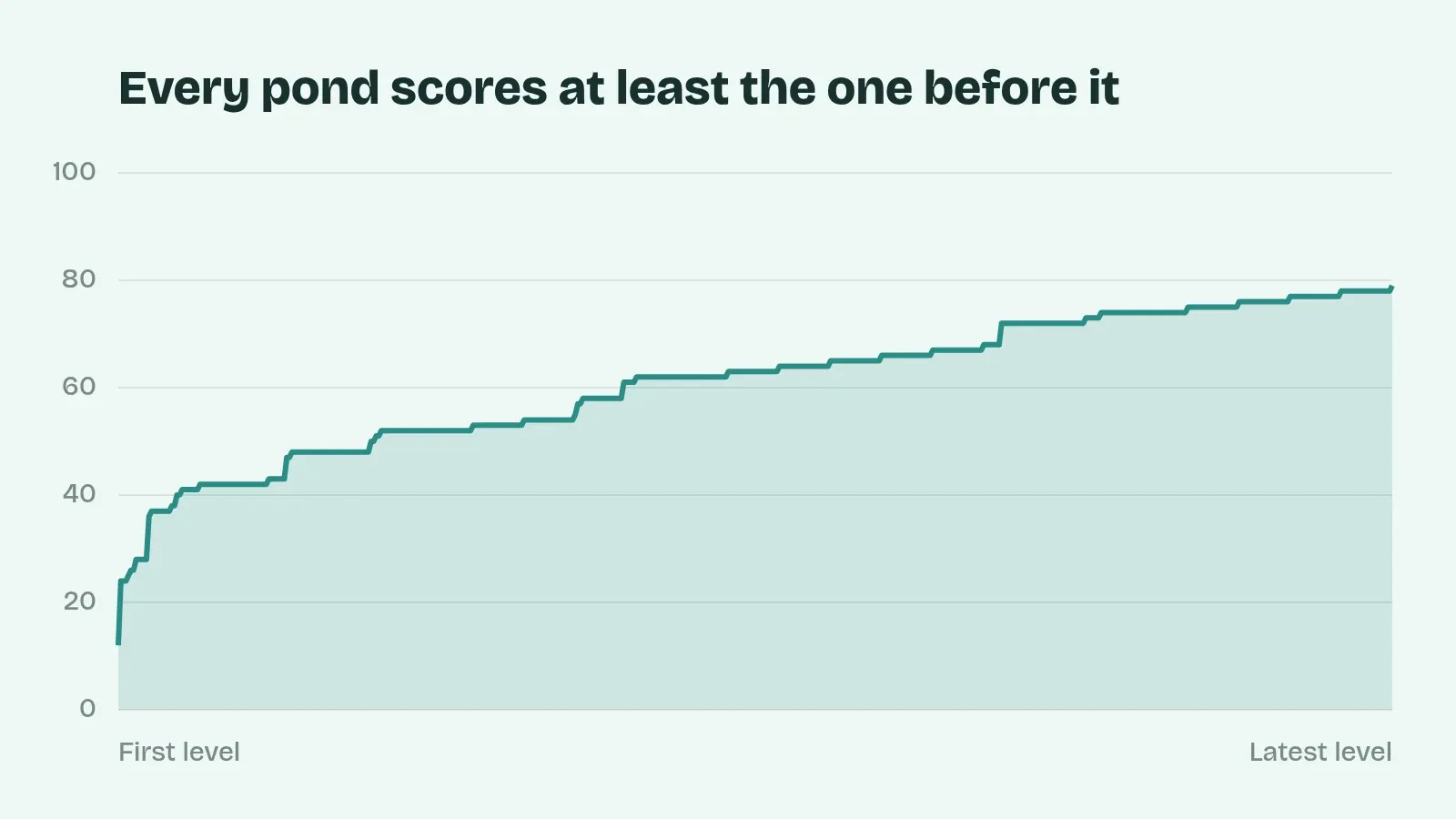
The steps are small, and that is a real limit of the idea. There is one rule and at most eight rings, so there is not much room to climb. Most later ponds use all eight rings and need one what-if, a few need two or three. The climb comes from more fish, more what-ifs, and fewer free fish at the start.
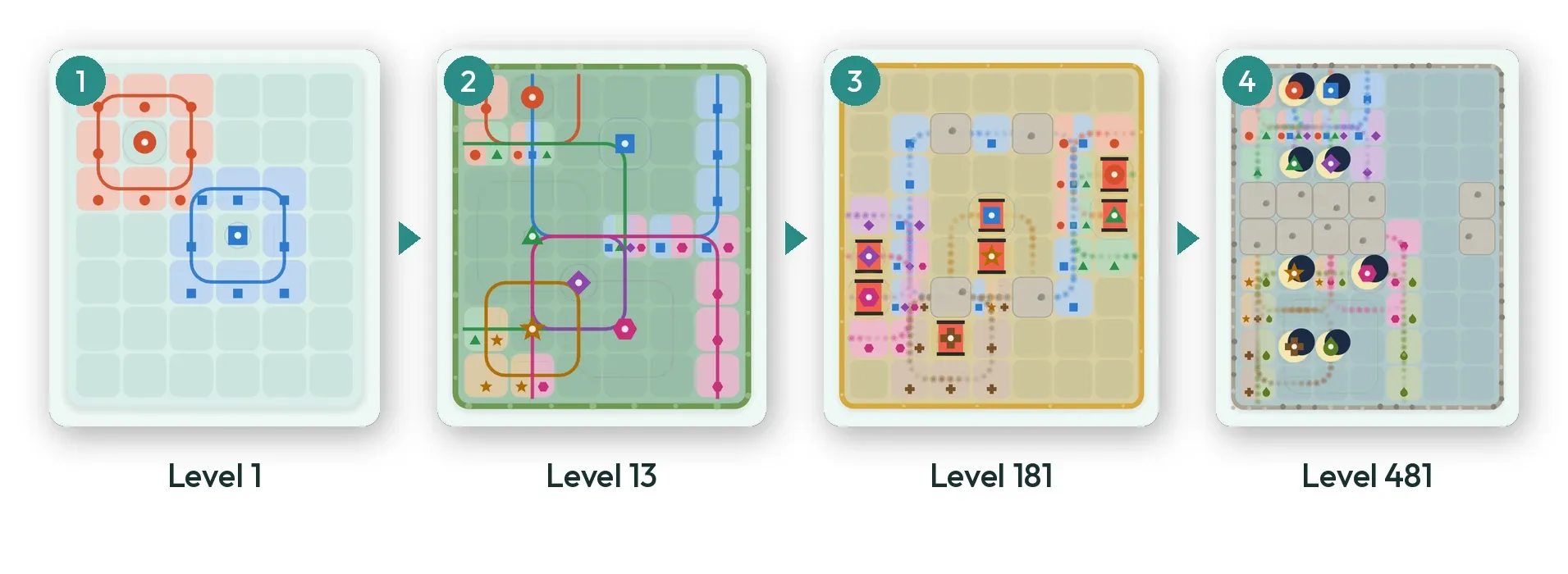
The bank helped more than I expected
Six fish in eight rings was the hardest kind of pond to make. Every ring holds one fish, so six fish need six rings just to stand on. That leaves only two rings to make the answer unique, and the calm insides of the rings have to do the rest. On a plain rectangle of water, about one try in twenty found such a pond, and slowly.
Then I gave the ponds shapes. Some tiles become bank: stepping stones, a bay, an island in the middle, an L, two pools joined by a channel. No fish swims on the bank and no ripple sits there. The rule does not change at all. But the bank takes away tiles that a ring would otherwise have to rule out, and suddenly six-fish ponds came much more easily.
So the later chapters all have shapes, and it is not just for looks. The shape is what makes those ponds possible.
No two ponds alike
One last check. Two ponds count as too alike if, under a mirror or a half turn, they have the same fish, or share most of their fish and ripples. A pond like that is skipped, and the daily pond skips any day that looks like a level. Every pond is checked again whenever the game changes, so a change can never quietly break one.
That is the whole machine. A counter that wants one answer, a reader that thinks like you, and a ladder that only goes up. If you ever find a pond that feels like a guess, please tell me on the support page. I would really like to see it.