 Sunwise
Bosses and skies: where Sunwise takes you
Every Sunwise chapter brings one new thing to keep off your star, its own sky and a named boss at the end. Meet Old Grey, The Lighthouse and the rest.
 , 7 min read
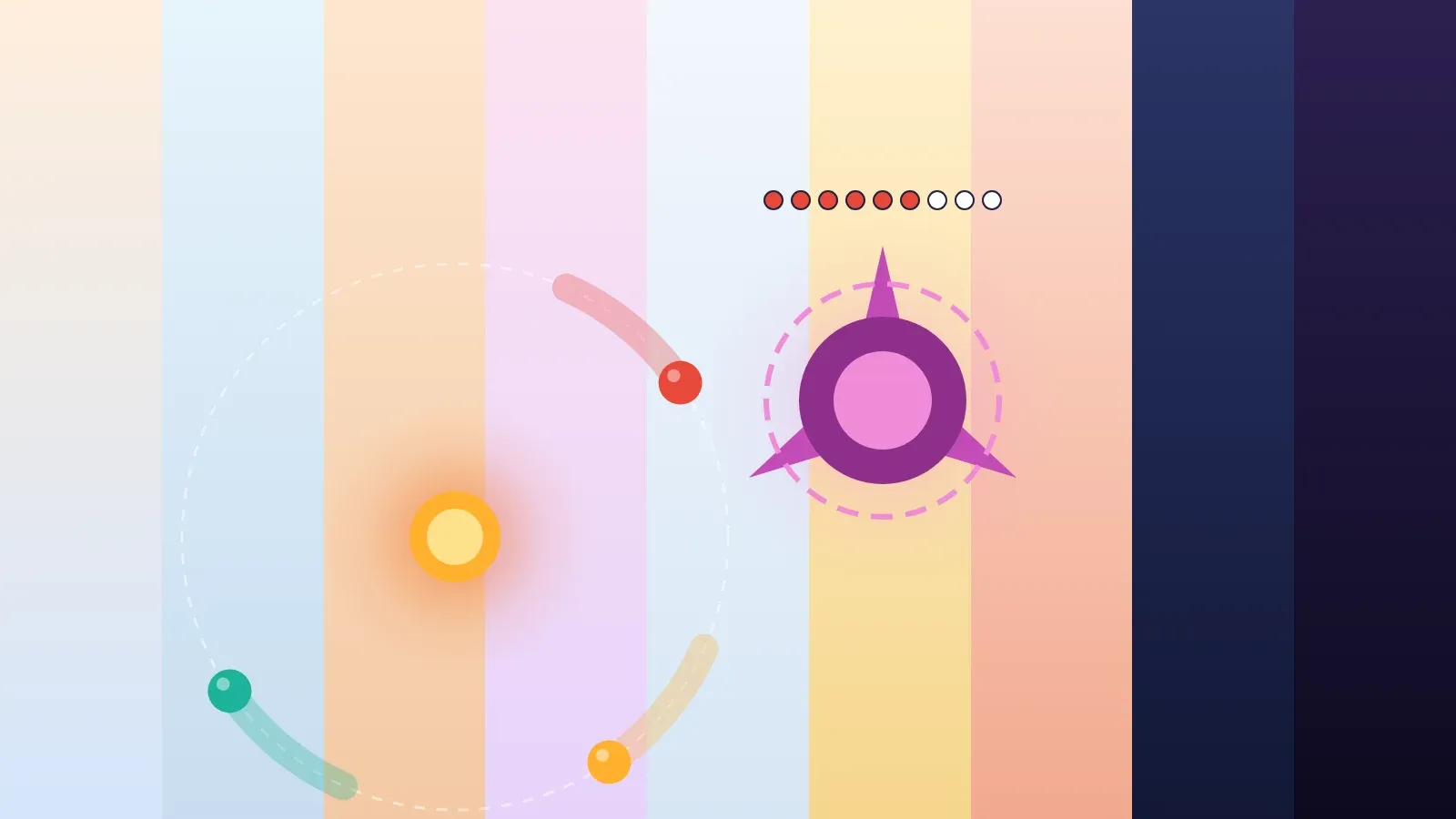
In Sunwise you are a small star, and your planets keep the sky off you. The control never changes: hold anywhere, and your thumb sets how wide the planets swing. I wrote about the maths of that in orbits made simple.
But a game can’t live on one control alone. It needs places to go and things to meet. So this post is about the journey: the hazards, the bosses at the end of every chapter, and the skies.
One new thing at a time
Every chapter brings at most one new thing, and its first stage sends that thing early and alone, with one line on the screen saying what it wants.
The first chapter, First light, is only rocks. “Hold anywhere. Your thumb sets how wide the planets swing.”
Then the hazards arrive, one chapter each:
- Comets come fast, with their path drawn as a warning first. “Pull in to block them.”
- Pulsars stop out of reach and shoot at your star. “Swing wide to reach them.”
- Swarms are a ring of small darts closing in from every side. “Pull in tight as it lands.”
- Boulders take several hits and burst into rocks.
- Iron rocks take two hits. “Keep them on your ring.”
- Drifters circle in slowly. “Meet them where they cross your ring.”
- Splitters burst into little swarmlings that fall back at the star. “Catch the pieces as they fall back.”
Each one reads by its shape as well as its colour. A comet is a bright head with a tail. A pulsar is a magenta core with three spikes. A drifter is a spinning lime square. You should be able to tell what is coming from the edge of your eye.
After that, no new hazards arrive. Instead, each chapter brings a twist that stays for the rest of the game. The Hard sky chapter makes boulders, pulsars and bosses take one more hit. Meteor storm sends rocks in packs. Quickening makes everything fly a little faster. Scorch makes hits on your star burn more. Long night takes away the quiet moments between waves. And the last chapter, Supernova, simply says: “The whole sky at once. You have met all of it.”
A boss at the end of every chapter
The last stage of every chapter ends on a boss.
Bosses come in three kinds. A giant is a rock as big as your star, slow and stubborn. A titan is a huge rock that bursts into boulders when it breaks. A magnetar is a big pulsar that parks out wide and fires twice as often.
But every boss also has its own name and its own line, and I had a lot of fun with these:
- Old Grey: “Old Grey is slow and stubborn. Keep hitting it.”
- Frostback: “Frostback rolls in behind the comets.”
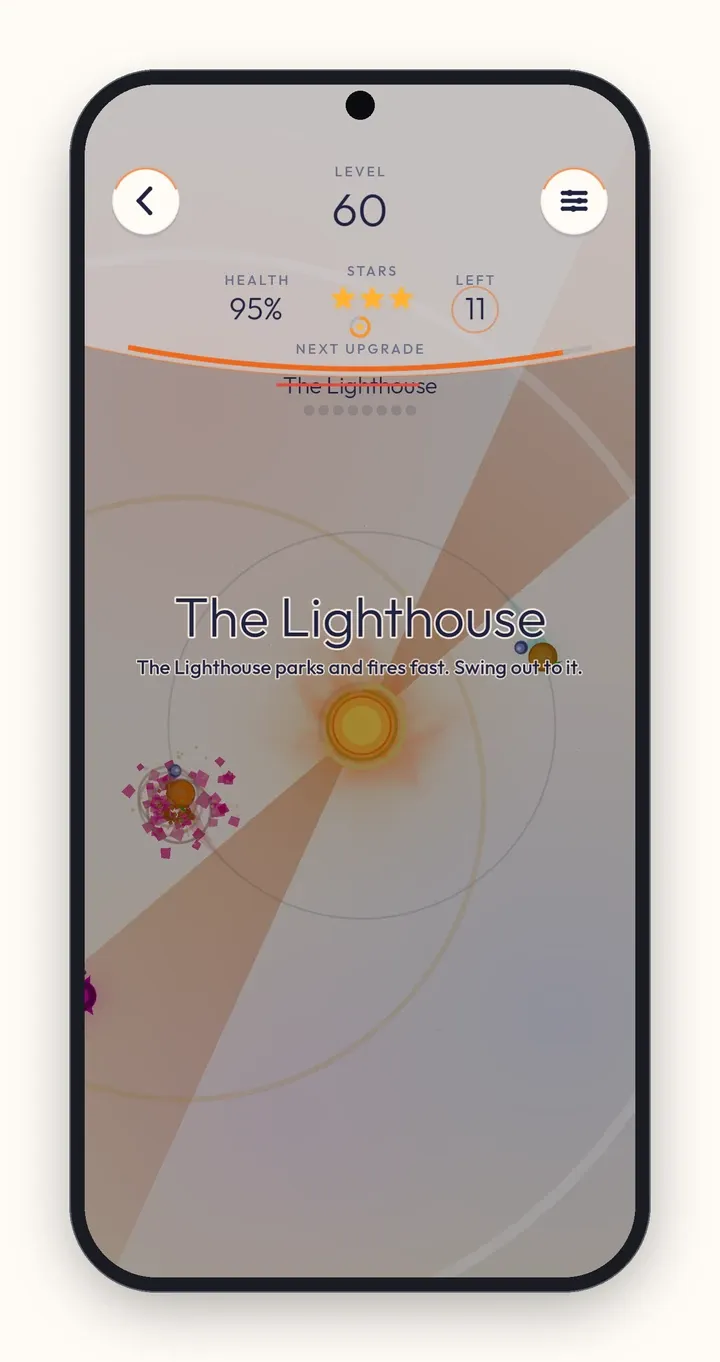
- The Lighthouse: “The Lighthouse parks and fires fast. Swing out to it.”
- The Hive Queen: “The Hive Queen fires while her swarms close in.”
- The Piñata: “The Piñata bursts into boulders when it breaks.”
- The DJ: “The DJ drops bolts on the beat.”
- The Sprinter: “The Sprinter gets there first. Go out early.”
- Glacier: “Glacier is slow, cold and huge.”
- The Leviathan: “The Leviathan rises from the deep. It takes a lot of hits.”
- The Umbra: “The Umbra blots out the sun. Break it early.”
Near the end you meet two at once. The Twins come from both sides at once, and at the very end, The Nova Pair: “Two of the biggest, together.”
When a boss arrives, the sky dims for a moment and its name rises in big letters with its line under it. It comes in with a bar of pips, one for each hit it can take. When you break it, the frame holds for a beat, a white ring sweeps out from it, its pieces scatter as sparks, and its name at the top is struck through.
Some bosses also leave something behind. Old Grey gives you cookie rocks. Frostback gives you donut planets. The Lighthouse gives you a lighthouse for your star. A few later bosses give planets like Jupiter and an eyeball, which is exactly as silly as it sounds.
A sky for every chapter
Every chapter also has its own sky. First light is a dawn sky, peach fading to pale blue. Comets are frost. Pulsars are a beacon, warm orange with beams sweeping across. Swarms are a meadow with fireflies. Then canyon, forge, lagoon, candy, a bazaar with lanterns, steel, storm, a disco for the Pulsar field, snow, honey, rust, a whirl, glass, twin suns, the abyss, embers, midnight, an eclipse, the void, and a nova at the end.
Inside a chapter there are four settings, and you see each one at different times of day: sunrise, full sun, sunset, an eclipse and starlight. So every stage is its own scene. “Pebble belt at sunrise.” “Comet festival at sunset.” “Hard frost in full sun.” The boss’s stage gets a scene of its own.
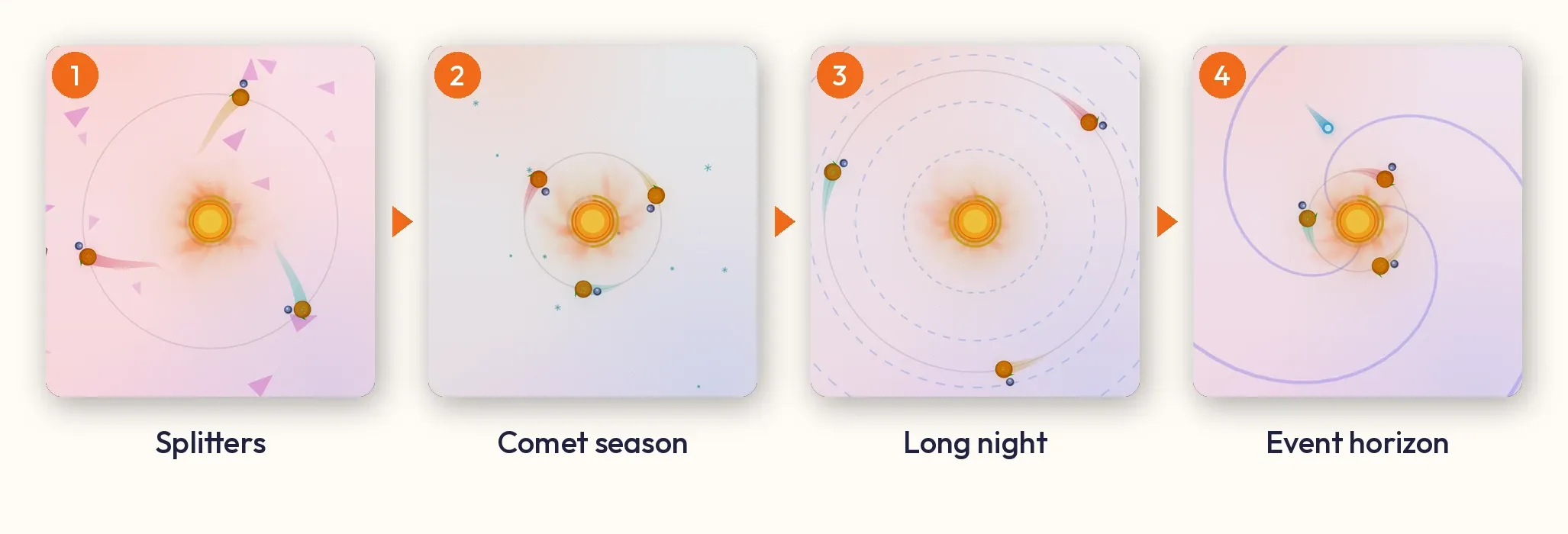
The backdrop is always faint. Hazards must read first, always. A beautiful sky that hides a comet is a bad sky.
How the stages only get harder
I have the same rule in every Chaosmos game: difficulty never drops from one level to the next, chapter starts included. For a puzzle, that is easy to measure, because a solver can count the fewest moves. Sunwise is not a puzzle like that. So how do you know one stage is harder than another?
My first idea was to let robots play every stage and measure how much health they lost. There are four robot pilots, each acting a little late the way a person does, from 0.15 to 0.45 seconds. They pull in for fast things, swing out to parked pulsars, and pick upgrades by their own taste.
It turned out a single stage’s loss is mostly luck. Whether a comet meets a planet or slips between two is partly about where the planets happen to be. Playing the same stage just one frame later could change a robot’s loss from 12 to 7, or from 4 to nothing. So the loss could never put stages in order.
Instead, each stage is ordered by what it sends: every hazard weighted by how much it costs the stage to send it, per second, made tougher and faster and more hurtful by the chapter’s twists. I call it the stage’s demand. It is exact, and the program that makes the stages makes sure it never drops.
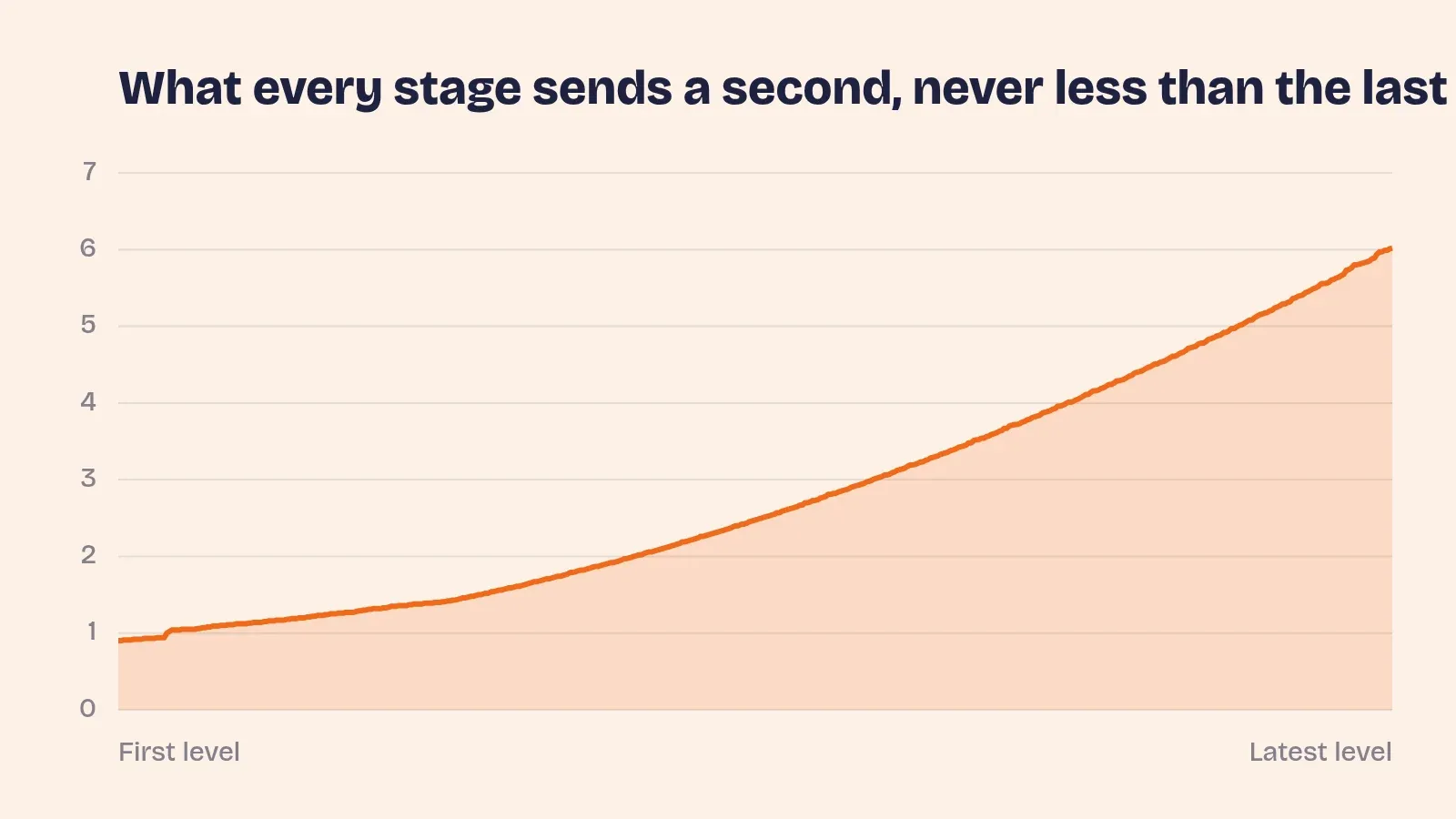
The robots still have two jobs. The best of them must win every single stage, which proves it can be won. And their average loss has to rise across the game, from each fifth of it to the next, which tells me the demand means what it should.
The robots taught me one thing I did not expect. Chapters full of rocks and iron cost them almost nothing, because a robot watches every side of the sky at once. A person can’t. So those chapters are probably harder for you than the robots say, and that is something I will watch for when testers play.
Every stage starts small
One last thing that surprised me. Every stage starts from two planets with no upgrades, even late in the game. So a late stage can’t open at full strength, or you would be gone in seconds. In the very first try at late stages, every robot burned out within half a minute.
Now every stage opens gently and builds: a trickle that gets faster, waves with a short lull before each one, and the stage’s biggest moment near the end. The late stages are hard because of how far they climb, not because they start hard.
That is the journey. One new thing at a time, a boss to end each chapter, and a sky that keeps changing. And when the campaign is not enough, there is Endless, and the fight for a best score.