 Sunwise
Endless in Sunwise: how long can you keep the star burning?
Sunwise's Endless is one sky that never clears. How the score works, chains up to x5, bosses on a clock, twists, fruit, and why speed is what finally beats you.
 , 6 min read
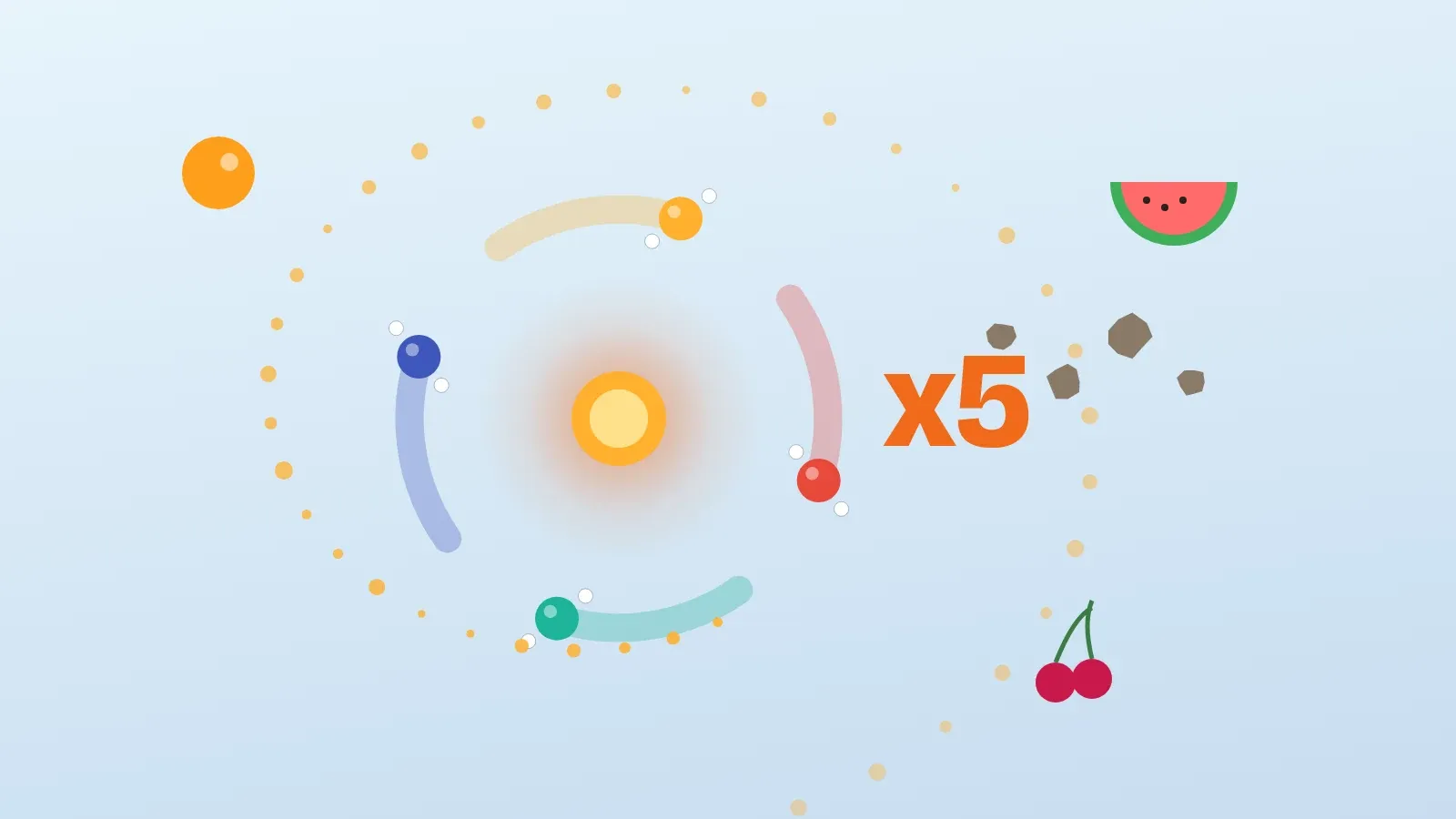
The campaign in Sunwise has an end. Every stage is a fixed sky, and when the last hazard is smashed, you win.
Endless is the other way round. The sky never clears. The only question is how long you can keep your star burning, and how many points you collect on the way.
It opens once you clear level 3, as a second button under Play on the title screen, with your best score written under it. Everything you wear in the campaign, you wear in Endless too.
One run
An Endless run starts the same way every time: your star, two planets, an empty sky. Then things start coming, and they never stop.
Smashed hazards drop light, light fills the upgrade bar, and you pick an upgrade from three, exactly like in the campaign. But here the upgrades keep coming for as long as you last. By the late game you can have six planets with three moons each, a second ring turning the other way, burning trails, a pulse from the star. It looks amazing. It is also not enough, eventually.
The run ends when your star’s health is gone.
The score
The score has three parts.
Smashes. Every hazard you smash scores what it costs the sky to send it. A rock is worth 10. A comet is 24. A pulsar is 40. A boss is 200.
Chains. Smashes close together, within a second of each other, build a chain, and the chain multiplies every smash in it:
| Smashes in a row | Each smash is worth |
|---|---|
| 1 or 2 | its points |
| 3 | double |
| 5 | three times |
| 8 | four times |
| 12 | five times |
Each step needs a longer run than the one before, on purpose. If x5 came easily, every busy moment would hit it and it would stop meaning anything. At x5, your ring is really sweeping. And each smash in a chain plays a note higher, so a good sweep sounds like a rising run.
A hit on your star breaks the chain. That is the real cost of a hit in Endless: not just health, but your multiplier.
Surviving. You get one point for every second you stay alive. It is small, but it means a careful run still climbs.
Fruit and health kits
Two things drift through the sky that are not hazards at all.
Fruit. Every few seconds, a cherry, an orange, some grapes or a slice of melon drifts across the sky. It never hurts your star. Catch it with a planet for 50 points, and it keeps your chain alive. Catch three of the same fruit in a row, and you get a bonus of 500. So sometimes you are swinging wide for a melon slice in the middle of a meteor shower, which is exactly the kind of bad decision I wanted the game to tempt you into.
Health kits. About once a minute or so, a green rock with a white cross drifts in slowly. Smash it and your star heals 15 percent. It drifts slowly on purpose, so it is a choice: swing out for it, or keep the ring tight and safe.
Bosses, on a clock
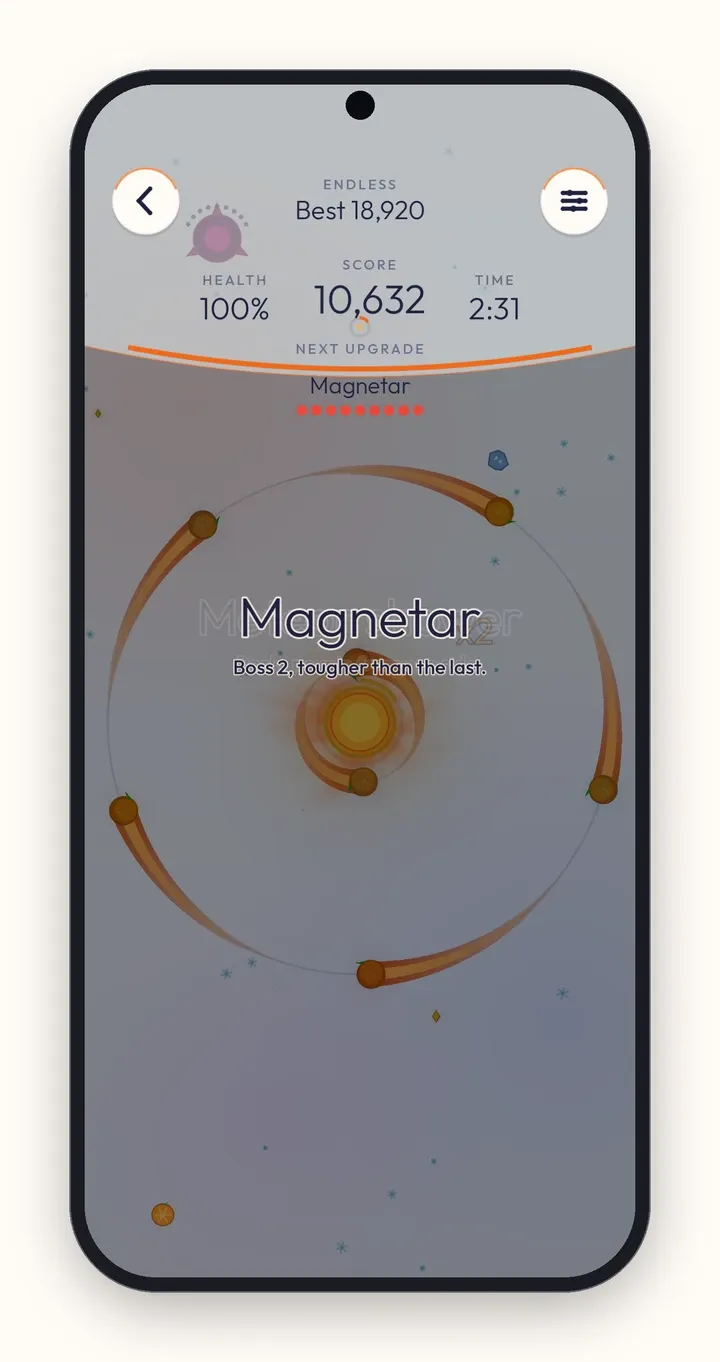
The first boss comes one minute in. Then the gaps get shorter: a minute and a half, then 80 seconds, then 70, and after that a boss every minute. They come in turn: a giant, a magnetar, a titan, then pairs from opposite sides, a giant with a magnetar, a titan with a magnetar. Each boss takes one more hit than the one before it. And the normal waves keep coming between them.
Twists
Every two minutes a twist arrives for 30 seconds, named on screen as it starts:
- Meteor shower: rocks pour in from one side.
- Comet rain: most of the rocks are comets now.
- Golden sky: everything smashed drops twice the light.
- Swarm night: rings of swarms close in, one after another.
- Heavy sky: slower, and the big ones take a hit more.
- Calm: ten quiet seconds, then a double wave.
Calm is my favourite. Ten seconds of nothing feels lovely, until you remember what comes after it.
There were two more twists in the first draft, Eclipse and Reverse spin. Eclipse darkened the sky, and Reverse spin turned the planets the other way. I left both out. One hides the sky and the other changes the one rule, and Sunwise should never do either.
The sky travels too
As the run goes on, the sky moves through the campaign’s places. A new sky every minute and a half, with its time of day passing as well, and the rocks taking on each place’s look. The change fades over a few seconds so play never breaks. How far you got is part of how the run is remembered: the end screen names the sky you reached.
Why speed is what beats you
This was the hardest part to get right, and the most interesting.
In a campaign stage, you only reach five to eight upgrades. In Endless you keep levelling, and a fully grown build is a wall: six planets, moons, trails, all spinning round the star.
My first version made the sky a little busier and a little faster every minute. Four percent more hazards a minute, two percent faster. I let the robot pilots play it, and every one of them, even the slowest, was still alive after fifteen minutes with almost no damage. The ring had become a wall, and more rocks against a wall changes nothing.
So I thought about what actually beats a wall. Speed. A planet sweeps a bit of the ring in the time a hazard takes to cross it. If the hazard is fast enough, it crosses before the next planet comes round.
So now the number of hazards grows steadily, but their speed grows 10 percent a minute, up to more than three times as fast, and how much a hit hurts grows too. With that, the robots last from about two minutes, the slowest of them, to over eleven, the keenest. A person who reads the sky well should land somewhere in between, and I am very curious where.
Each minute also brings one more kind of hazard into the mix, in the same order as the campaign. So the first minute is rocks and comets, and the late game is everything at once.
The end of a run
When your star burns out, the score counts up. If it is your best, it says so, “New best!”, and shows your old best. Then your time, your longest chain and the sky you reached.
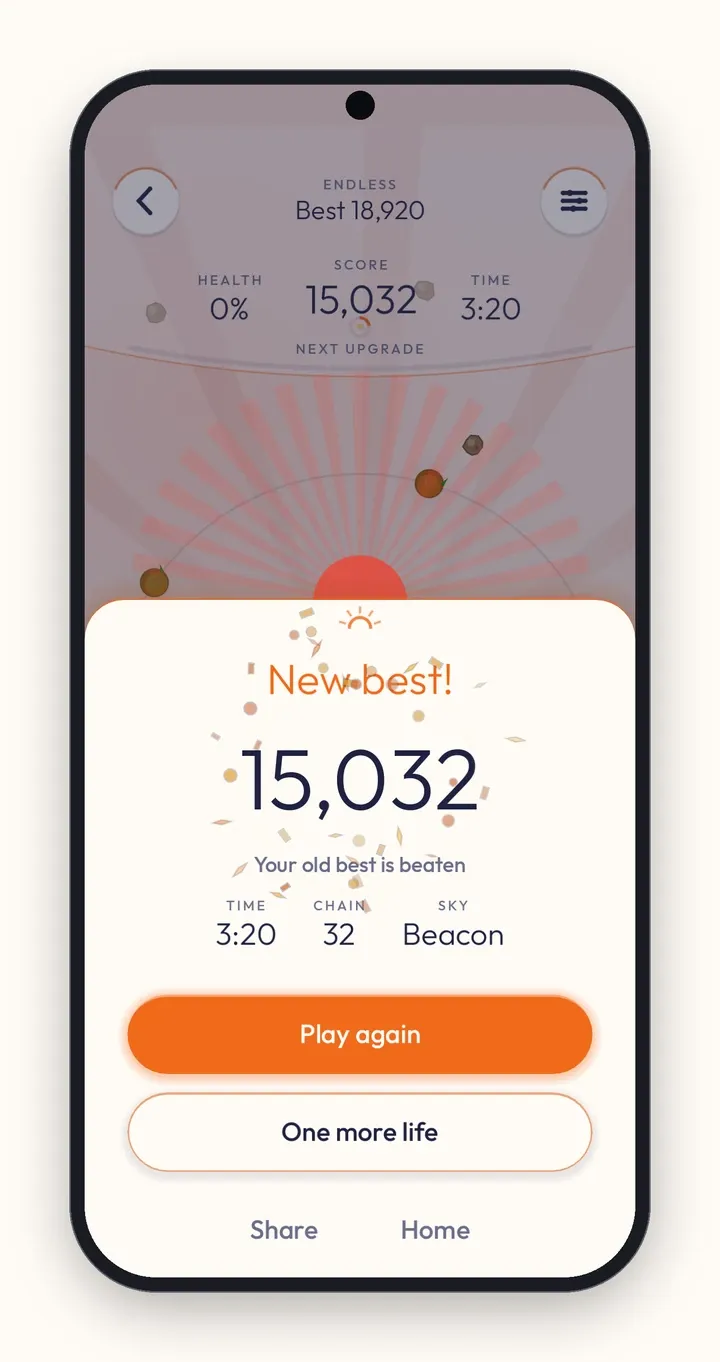
Play again is the big button. One more life is offered once a run, which in the Android app comes from a short video you choose to watch, or free with the Supporter pack. And you can share the run as a card with your score, your time, your chain, the sky and a code to get the game.
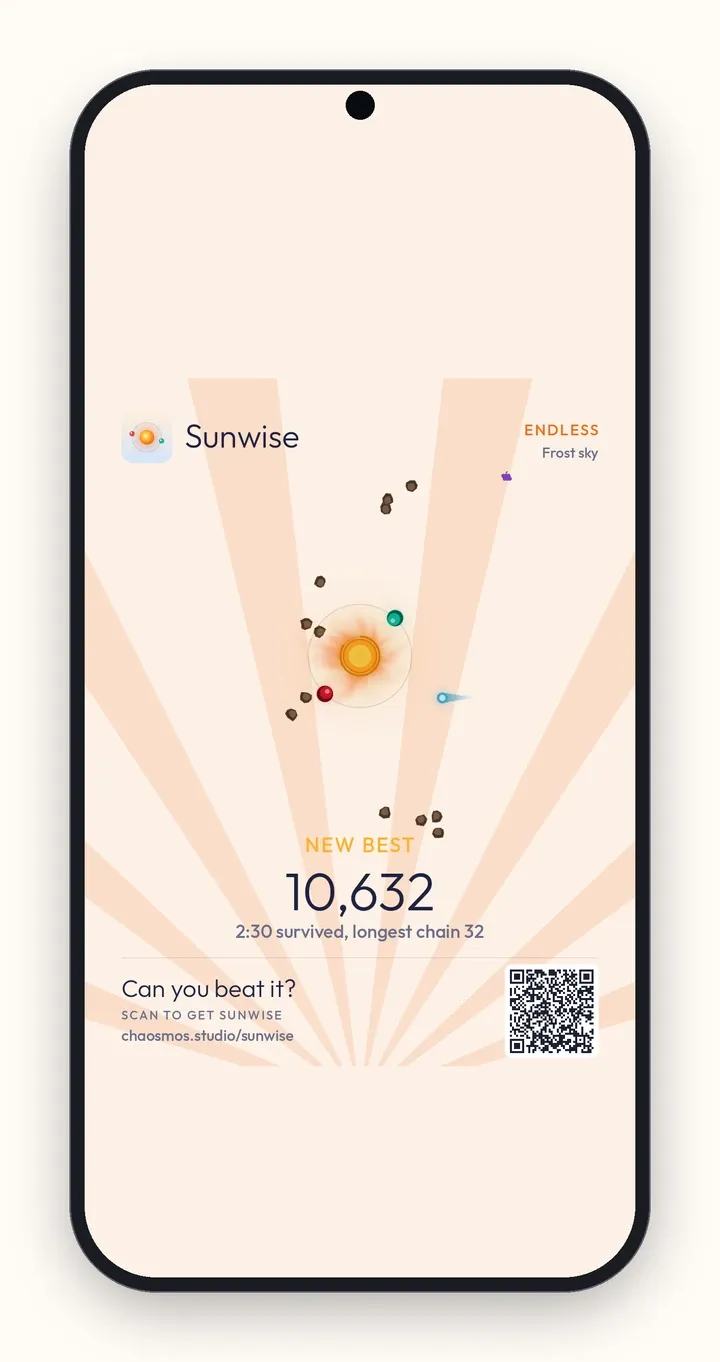
That card says “Can you beat it?”, and honestly that is the whole point of Endless. The campaign is you against the sky. Endless is you against your best, and your friends against theirs.
If you post your score somewhere, tell me. I really want to see how far people get. And if you are still learning the swing, orbits made simple is the post that explains it.