
Seven beginner tips for Carillon: reach, sources and decoys
Seven practical tips for new Carillon players: hold before you tap, read the reach circles, find the dot nothing reaches, and see through the showy decoys.

On this page
Carillon’s rules fit in one sentence: tap a dot, and its ring pops every dot it reaches. Getting good at it is about reading. These seven habits are the ones that make the biggest difference in the first hour. If you have not played yet, start with how to play.
1. Hold before every tap
Holding a dot is free. Its reach sweeps out as a bright circle, and every dot its ring would touch is outlined. Lift on the same dot to tap, or slide off to cancel.
It is tempting to tap the first dot that looks good. Don’t. On any level past the first few, hold three or four dots before you commit. Nothing is lost by looking, and the spare tap is worth more saved than spent.
2. Read the faint circles
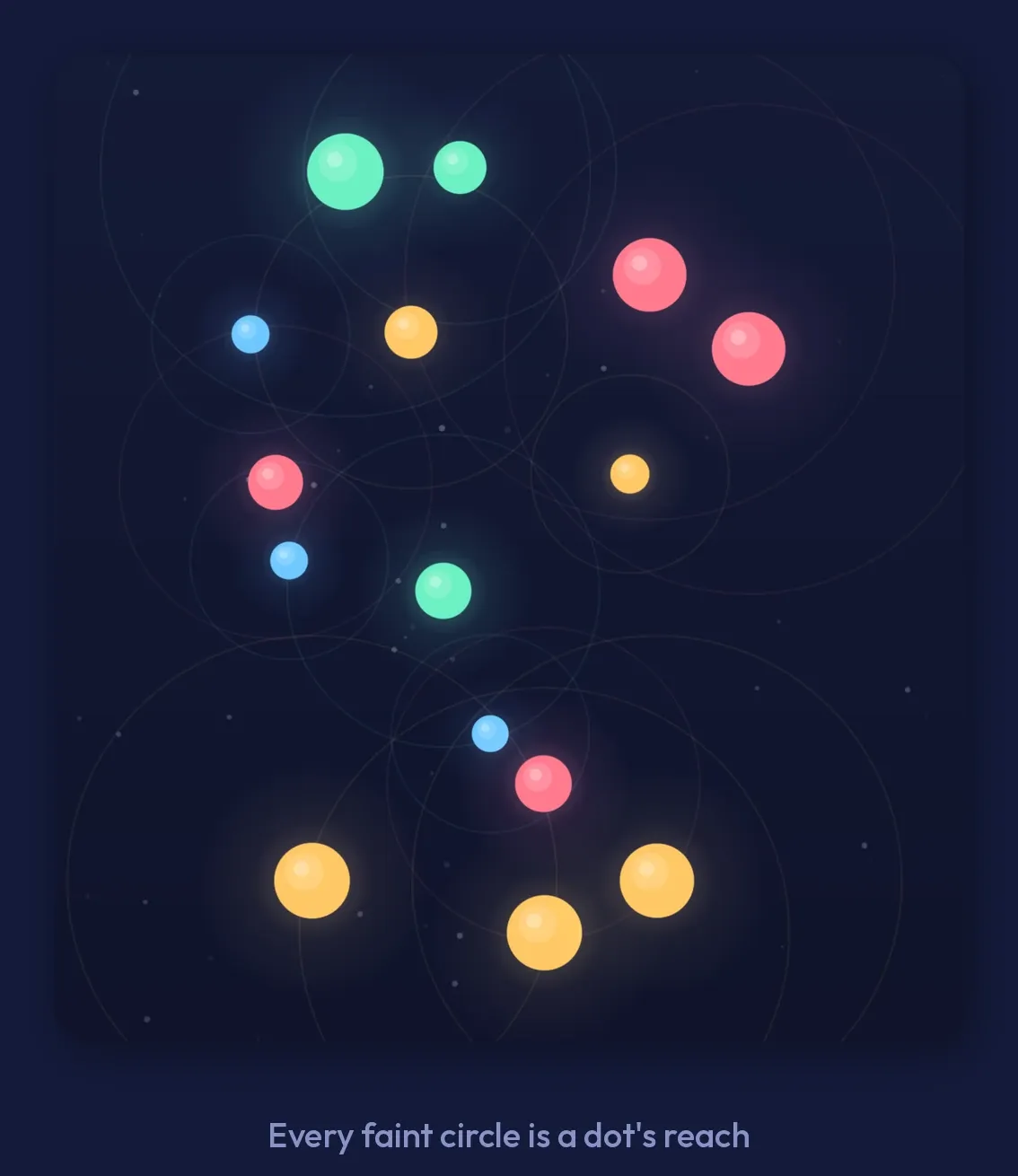
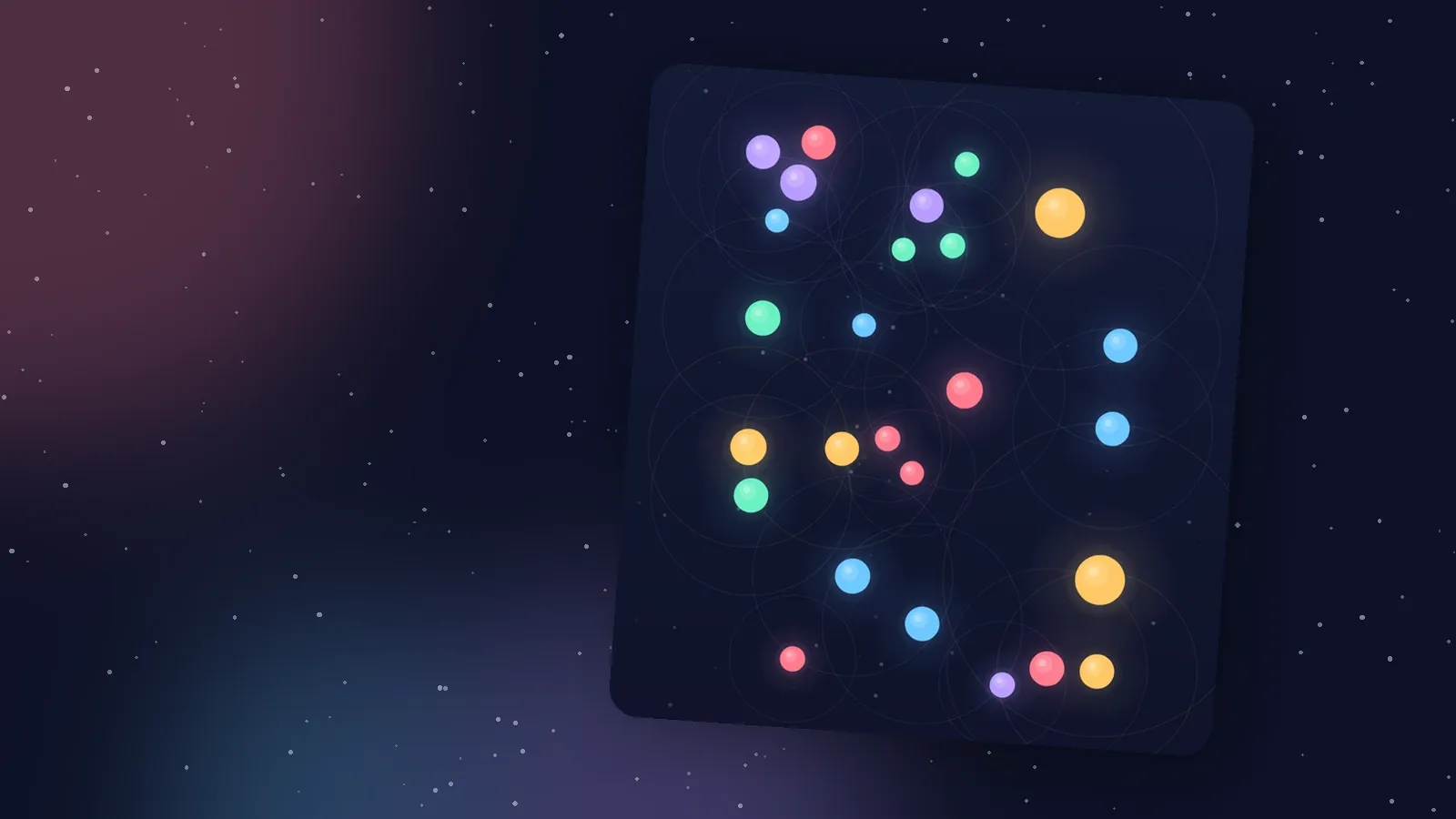
Every dot wears a faint circle: its reach, the furthest its ring will grow. A dot pops if its edge falls inside another dot’s circle when that dot pops. The game keeps every edge clearly inside or clearly outside a circle, with a gap of at least ten units either way, so you never have to guess whether a ring “just” touches.
Remember that reach is one way. A big dot’s circle can cover a small dot whose own circle stops well short of the big one. So “these two are close” is not the same as “these two pop each other”.
3. Find the dot that nothing reaches
This is the big one. A dot whose edge sits inside no other dot’s circle can only ever be popped by tapping it. The game calls nothing by name, but this dot is the start of a chain, and a level has one such start for every tap it needs.
To check a candidate, turn the question around: hold its neighbours, one by one. If the candidate never appears in their outlines, nothing reaches it. On level 30, try holding the big dots and then their neighbours: the three winning dots are the ones whose outlines never appear when you hold anything else.
Sometimes the start is a pair or a small group of dots that reach each other but that nothing outside can reach. Any dot of that group works.
4. Don’t trust the showy dot
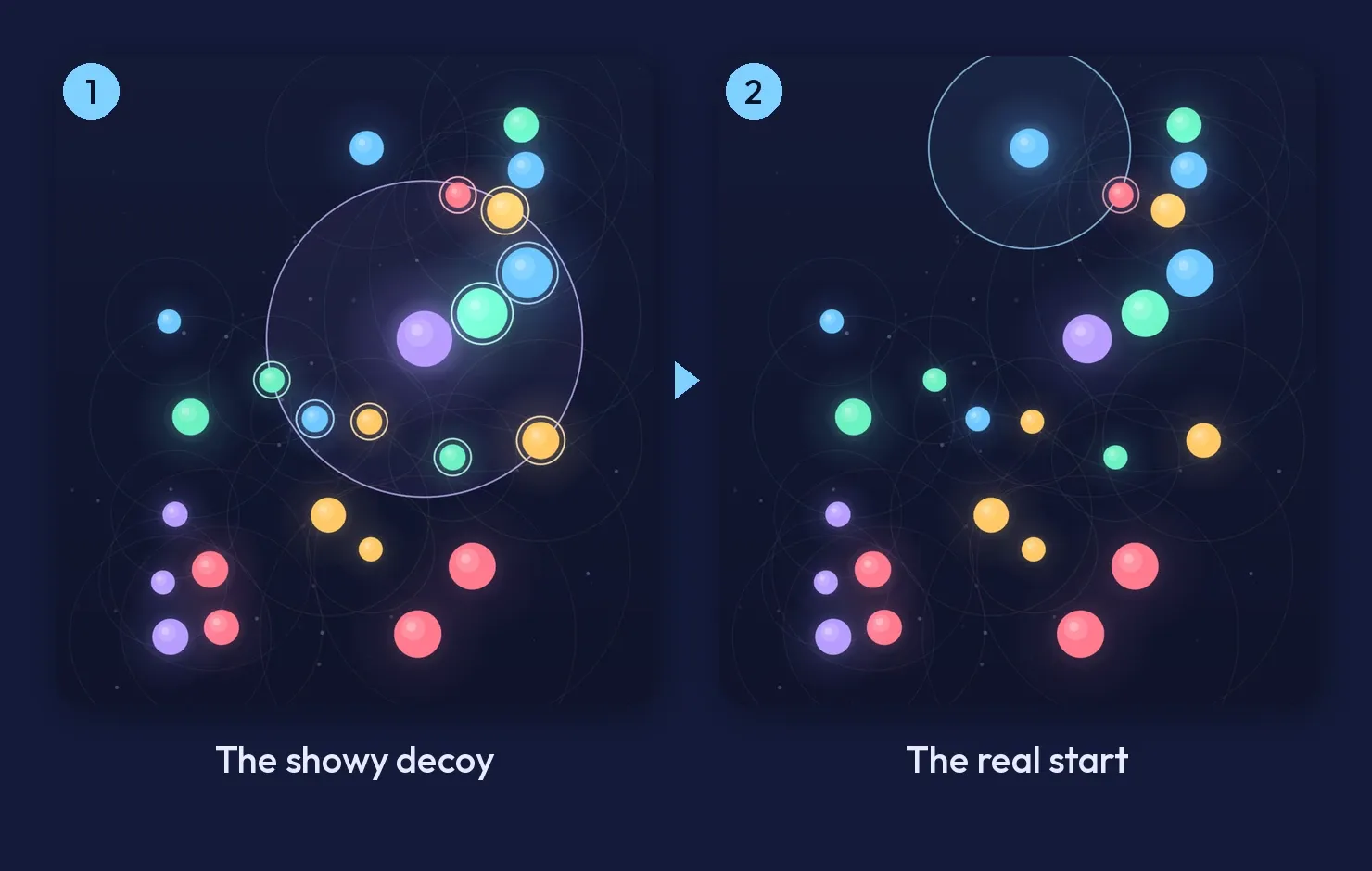
The dot whose hold lights up the most is often a decoy. It pops a lot of dots, but some other ring can reach it, so it is not where a chain starts. Tap it, and the true start is still sitting there, waiting for another tap.
Later levels are full of them. On level 83, fifteen dots light up at least as many neighbours as the best of its winning dots, and none of them wins.
5. Follow the chain past the outline
The outline shows only what one ring touches directly. Every outlined dot then sends out its own ring, and those rings pop more. So a dot with a modest outline can still clear the whole field, through a relay of rings.
When you hold a candidate, glance at the circles of the outlined dots and follow them outward. By the later levels, a winning chain typically relays through three or four rings before its last pop.
6. When a level needs more taps, look far away
From level 4 every field needs at least two taps, and the count climbs to five by the late levels. Each tap starts its own chain, so you need to find each start. The level generator places those starts well apart, at least a third of the field’s height from each other, so once you find one, look on the far side of the field for the next.
A good order: find all the starts first by holding, then tap them. Wait for each chain to finish before the next tap; the next tap only counts once the last chain has settled.
7. Spend the spare to learn, and retry freely
Every level allows one tap more than it needs. If a field has you stumped, spending that spare on a question (“what does this one really do?”) costs you a star, never the level. A tap outside the chain starts pops some dots but leaves every start in place, so a clear is still possible.
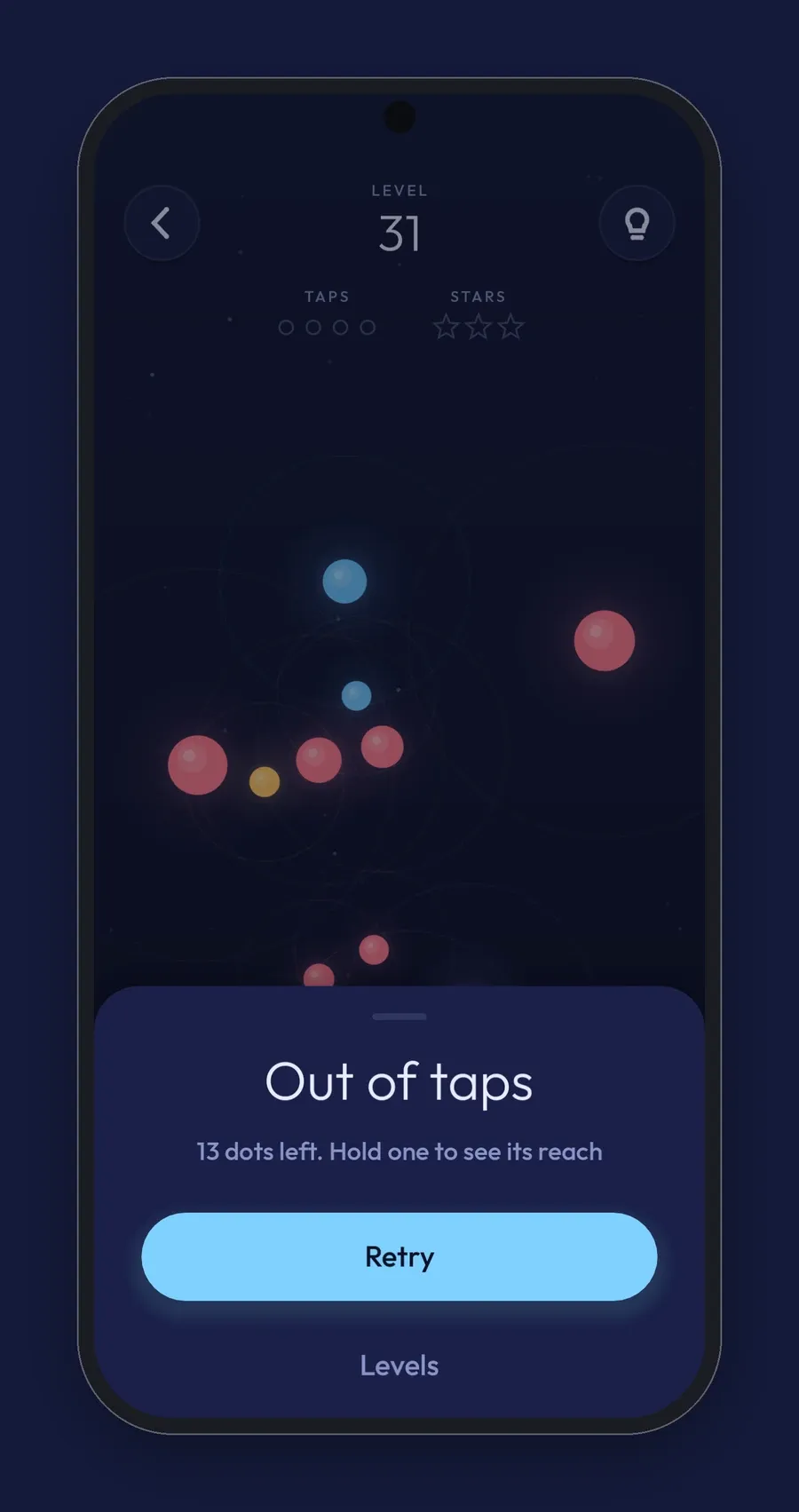
If you do run out, the fail sheet tells you how many dots are left. Those dots hold the chains you missed. Retry puts the field back in one tap, and now you know something you did not before.
Bonus: when to use the hint
If you have held every dot and still cannot see it, the light bulb shows the best next tap, and asking costs no tap and no star. It even works after a wasted tap. Here is exactly what it shows.
When you are ready to go for three stars on everything, the guide to stars and the spare tap has a method that works on any level.
Written by

Shravan Goswami
Game designer and developer
Claude Opus 5.5
AI co-developer
Comments
Sign in with GitHub to leave a comment or a question.