
How to get three stars in Carillon, and what the spare tap is for
How Carillon scores a level, why every level gives you one spare tap, and a simple method for finding the three-star read, with a worked two-tap example.

On this page
Every Carillon level can be cleared in some fewest number of taps. A computer has worked that number out for every level, and it is what the stars are measured against. This post explains the scoring, why there is always one tap to spare, and how to find the three-star read.
How stars are scored
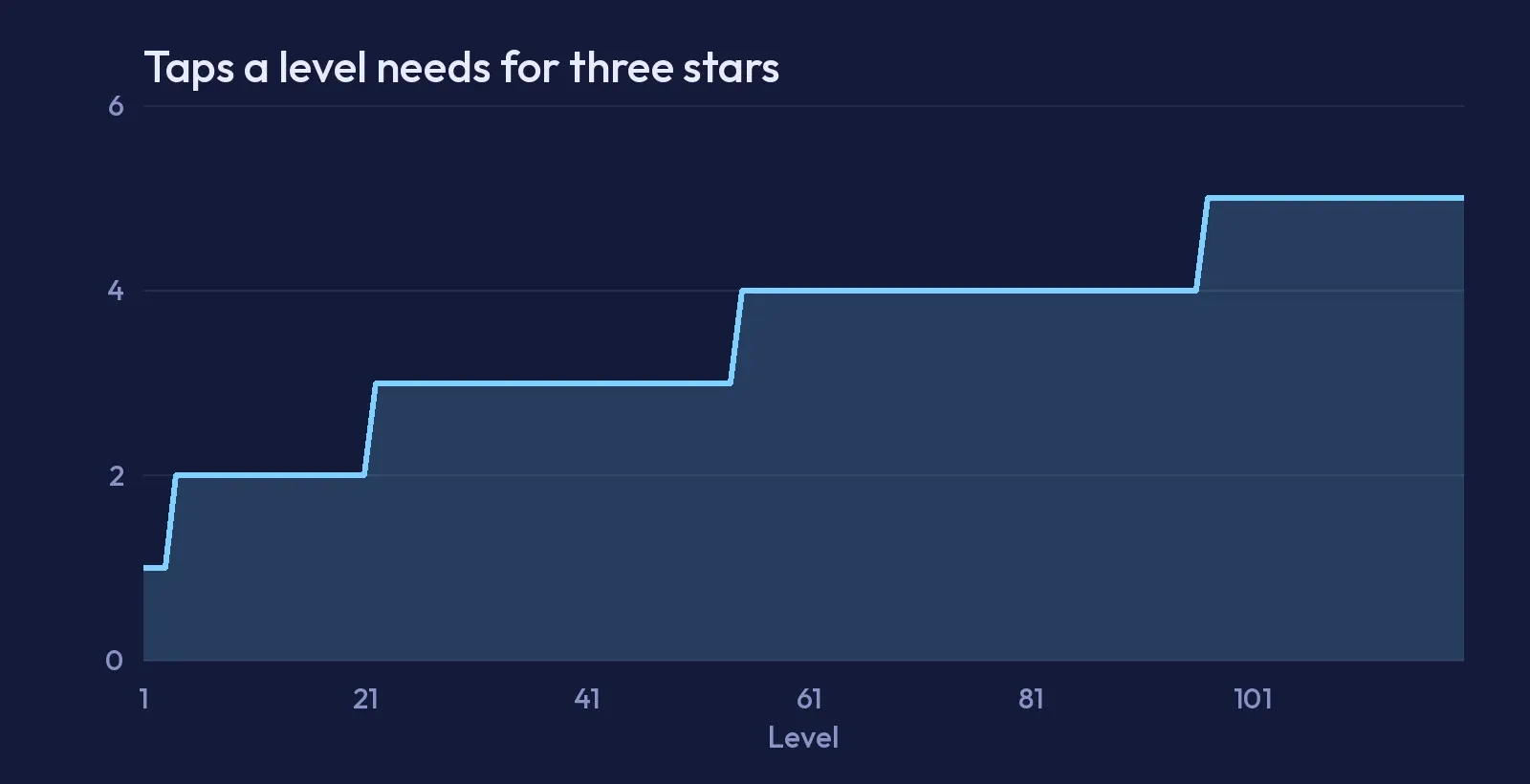
A level allows the fewest taps that clear it, plus one. That extra tap is the spare.
- Clear the field in the fewest taps: three stars.
- Clear it using the spare as well: two stars.
- Run out of taps with dots still on the field: no stars, and a Retry button.
There is no one-star clear. Past the spare, the taps are simply gone, and a retry costs you one tap on the button. Your best result on each level is kept, so you can always come back and improve it.
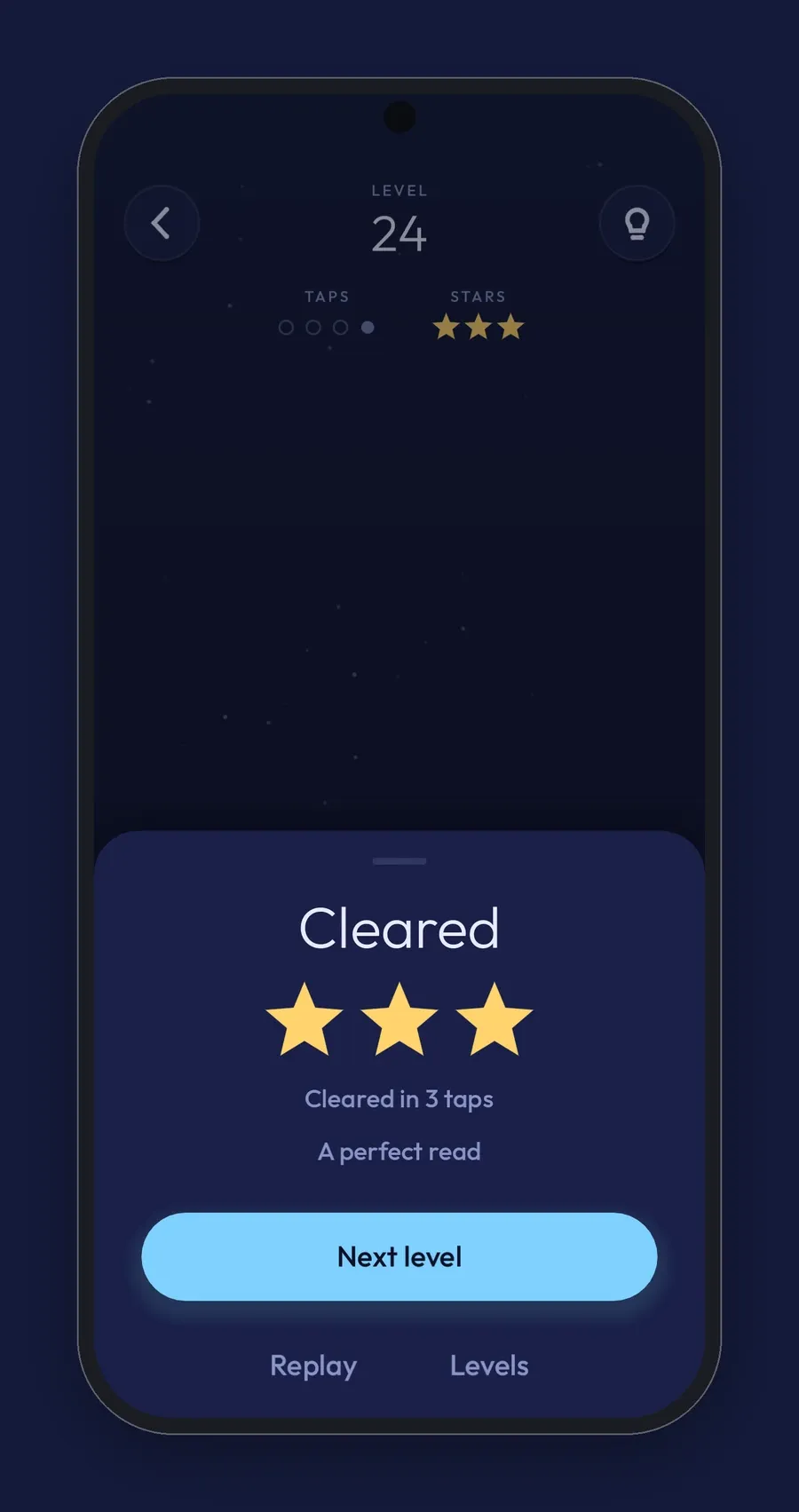
The result sheet tells you how you did: “Cleared in 2 taps”, say, and then either how many taps would have earned three stars or, the first time you earn them, “A perfect read”.
Reading the pips and the star readout
At the top of the play screen are two readouts. Taps is a row of pips: bright for the taps that keep three stars, dim for the spare, hollow once spent. Stars shows what a clear on your next tap would score: three while a three-star tap is left, two once only the spare remains. You see the cost of the spare when it happens, not at the end.
The game never uses the word “par” on screen. The pips say it instead: a level with two bright pips needs two chains.
Why three stars means “you read it”
Here is the idea that makes Carillon work. Some dots on a field are sources: a dot, or a small group of dots that reach each other, that no other ring on the field can reach. A source can only ever be popped by tapping it, because nothing else will get there.
That gives two facts:
- Every source needs a tap of its own. So the fewest taps is simply the number of sources.
- One tap in each source is enough. Every other dot sits downstream of some source, so tapping each source once pops the whole field, in any order.
So a three-star clear means you tapped a source every time. Any tap outside a source is wasted: it pops some dots, but the sources are all still there, waiting. That is also why a wasted tap never ruins a level. With the spare in hand, you can still tap every source and clear it. Chain reactions as graphs has the maths behind this.
A method for any level
- Count the bright pips. That is how many sources the field has.
- Hold the least covered dots first. A source is a dot no other ring touches, so start with the dots that few faint circles pass over.
- Check it the other way round. Hold its neighbours. If none of their outlines ever includes your candidate, nothing reaches it: it is a source.
- Look far away for the next one. The chains start well apart on the field, so once you have one source, the next is usually on the other side.
- Tap the sources, one chain at a time. Wait for each chain to finish; the next tap only counts once it has.
A worked example: level 4
Level 4 is the first level that needs two taps, and the screen says so: “Two taps this time”. It has eight dots and three pips: two bright ones for three stars, and one dim spare.
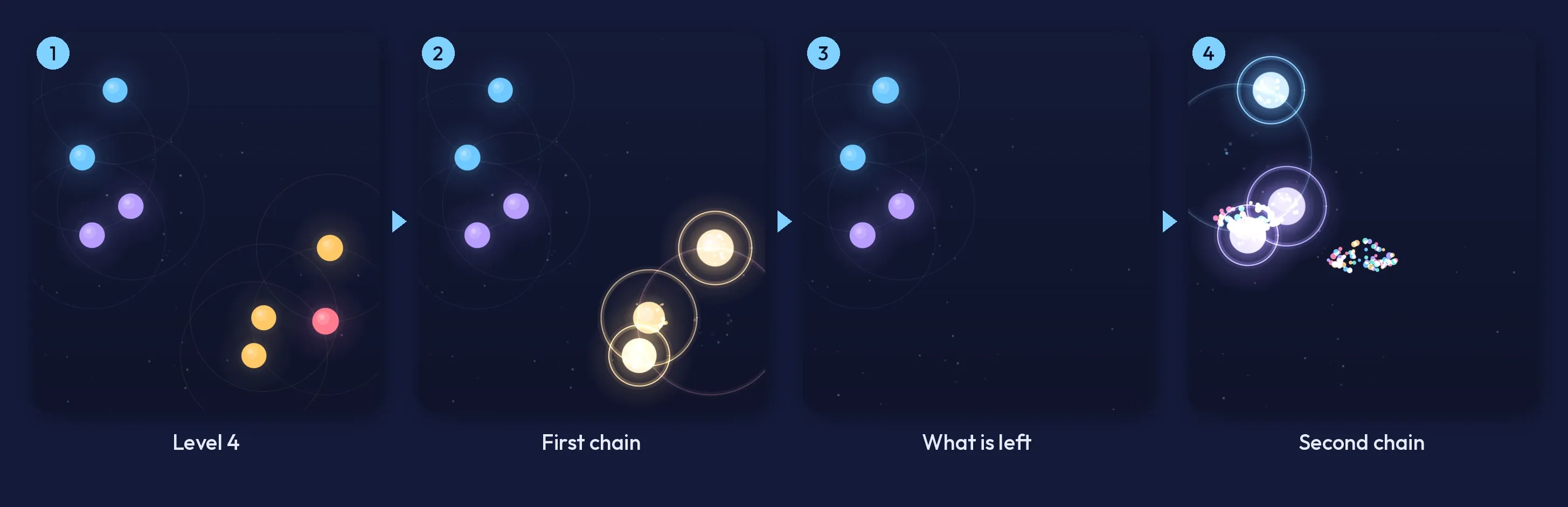
The eight dots sit in two groups, one on each side, and no ring reaches across. Inside a group every dot pops the others, so each group is one source and any of its dots starts its chain. The first tap sweeps one side. What is left is a smaller field with exactly one source in it, and the second tap clears it. Two chains, two taps, three stars.
From level 5 on, the sources hide among dots that do not win, and the method above is how you find them.
What the spare tap is for
The first tap on a new field is often a question: “what does this one actually do?” Holding answers most of those questions for free, but not every one. The spare tap is there so a question never costs you the level.
Use it to experiment, then come back for three stars once you know the field. Or use it on the hardest levels, where two stars is a fine result the first time round.
If you are stuck
The hint always shows the best next tap from the field as it is now, even after a wasted tap, and asking for it costs no tap and no star. Here is how it works. If it says “No clear from here”, more taps have gone outside the sources than the spare allows, and Restart brings every dot back.
For the reading itself, the beginner tips cover decoys, one-way reach and more.
Written by

Shravan Goswami
Game designer and developer
Claude Opus 5.5
AI co-developer



Comments
Sign in with GitHub to leave a comment or a question.