 Carillon
One tap, a whole chain: how a Carillon field works
Learn Carillon by following one chain across the first field: a ring pops every dot it reaches, every pop rings a note, and reading the field is the whole game.
 , updated , 6 min read

The first field in Carillon is nine dots in an arch. You can learn almost the whole game by watching what one tap does to it, so that is where I want to start.
Follow one chain
Tap the dot at the left foot of the arch. It pops, and a ring grows out of it. When the ring reaches the next dot along, that dot pops too and sends out a ring of its own. That ring finds the dot after it, and the chain walks up one side of the arch and down the other.
Every pop is a note. On that first arch the chain climbs C, D, E, G, A and comes back down to C, about a quarter of a second between notes, nine notes in a little over two seconds. You tapped once, and the field did the rest.
That is Carillon. Every level is a field of dots, and you clear it by starting chains. The puzzle is working out where to start them.
What a ring touches
Every dot wears a faint circle around it. That circle is its reach, the furthest its ring will grow. A ring grows from the dot’s centre out to that circle, and any dot whose edge it touches pops at that moment and sends out a ring of its own.
The rings are exact circles, and they all grow at the same speed. So a chain plays out the same way every time you tap the same dot. There is no luck in it, only reading.
Hold to read, lift to tap
You never have to guess what a dot will do. Put a finger on it and keep it there. Its reach sweeps out as a bright circle, and every dot its ring would touch gets an outline.
Lift your finger on the same dot and it taps. Slide off it and nothing happens, so looking costs nothing, as often as you like. A mouse works the same way in a browser.
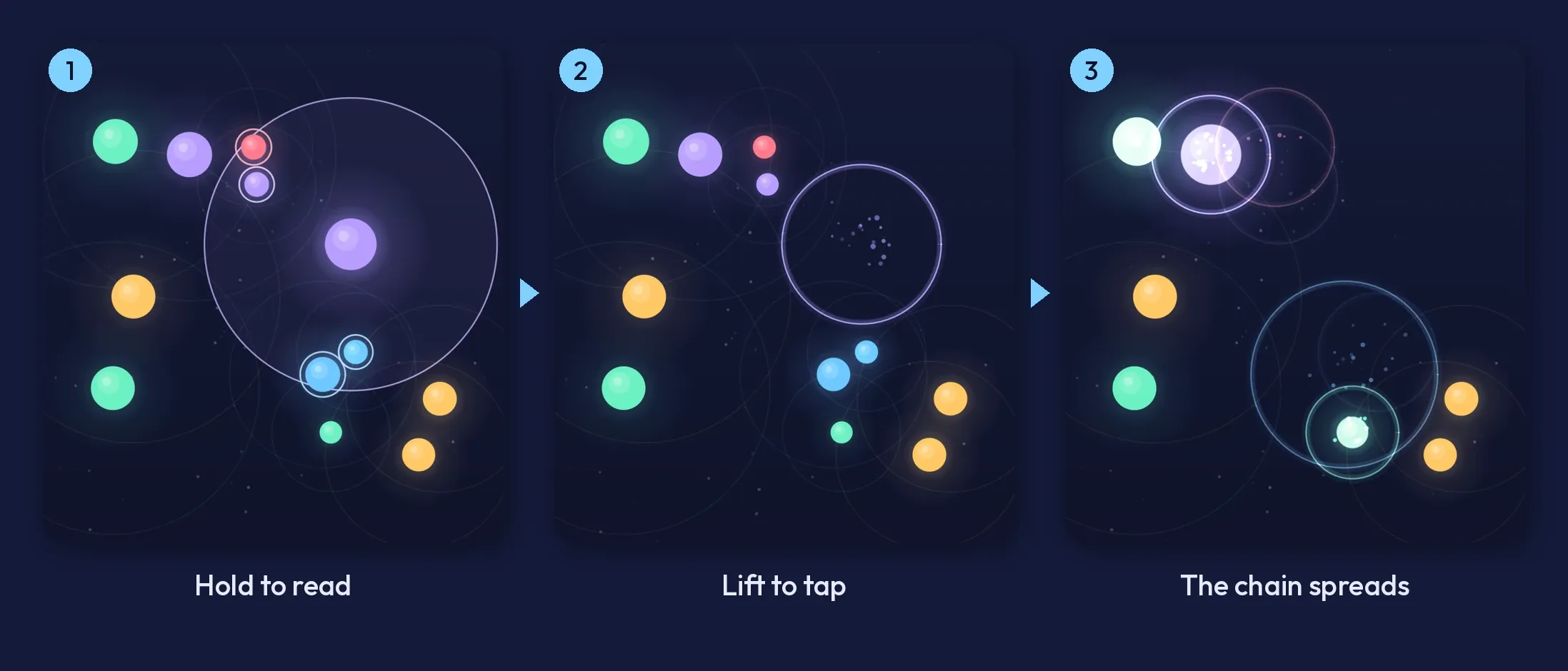
The outline shows only what that one ring touches. Each outlined dot then sends out its own ring when it pops. To see a whole chain, follow their circles outward, one ring at a time.
Big dots, small dots
The arch is all one size, but it does not stay that way for long. Level 3 brings the first big dots, and level 5 the first small ones, each with a line at the foot of the screen to say so.
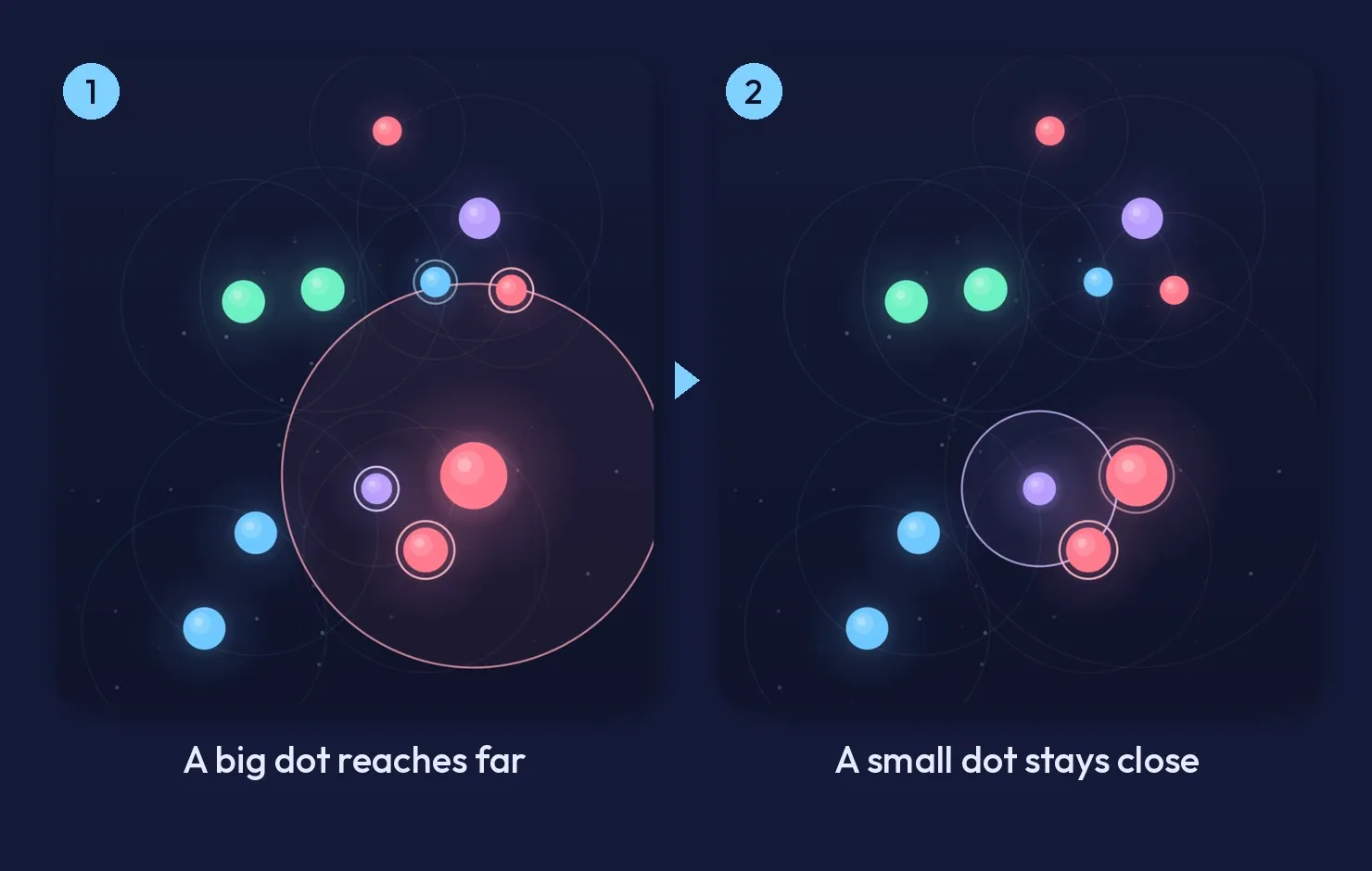
Size sets reach. A small dot reaches only the dots right beside it, a normal dot a little further, and a big dot about two and a half times as far as a small one.
Reach is also one way. A big dot’s ring can cover a small dot whose own ring stops well short of the big one. So two dots sitting close together do not always pop each other, and that one fact is behind most of what makes a field hard.
When one chain is not enough
Level 2 has ten dots in two curves, one inside the other, and no ring reaches from one curve to the other. Any dot clears its own curve, but the other curve is still waiting, and it needs a tap of its own. The line at the bottom says so: “Two taps this time. Hold a dot to see its reach”.
The early chapters all work that way. A field needs as many taps as it has chains that nothing else can start, and each start is a dot no other ring reaches, or a pair of dots that reach only each other.
The count climbs as you go: three taps from level 14, four from level 29, five from level 59 and six from level 201. Finding every start is what reading a field is about.
Taps, stars and the goal
Every level has a goal, the fewest taps that clear it, worked out by a solver before the level ships. You get one tap more than that. Clear the field in the goal for three stars, or with the spare as well for two. Run out and the level offers Retry, plus one more tap once a try, and a clear on that tap is worth one star.
The pips at the top count your taps, bright for the ones that keep three stars and quieter for the spare, and the stars beside them show the most you can still earn. After a clear, the sheet sums it up in words like “Cleared in 2 taps, goal 2”. While a chain is still spreading the field takes no new tap, so there is never a rush. What the spare tap is for has the rest of the scoring.
Chapters and their rules
Levels come in chapters of twenty, one page each on the Levels screen. The first four chapters teach what you have read here: chains, pairs, decoys and, at last, five chains on the biggest fields.
From chapter 5, every chapter brings a rule, and a card names it as the chapter opens. Heavy bells only ring once two rings have struck them. An hour bell rings by itself after its number of taps. The gold home note must ring on your last tap. A horn rings only the way it faces. There are many more, and holding a dot still shows what its ring would do, with the rule taken into account.
A level opens once you solve the one before it. The next chapter also opens once you have solved 14 of a chapter’s 20, so one stubborn level never walls you in.
When you are stuck
Tap the light bulb at the top right. The screen dims except for one dot, its reach sweeps out as if you were holding it, and the dots its ring will pop are outlined. It is the best next tap from the field as it stands, so it still helps after a tap that went nowhere. The best next tap explains how it picks.
Restart, at the bottom, brings every dot back at any time.
With a keyboard, R restarts, H asks for the hint, Enter goes on to the next level and Esc goes back.
Where to start
Play the first few levels with sound on. Hold a few dots before every tap, and don’t chase three stars on your first pass. Clear first, then come back for the perfect read.
Carillon’s own page has the rest. If the notes are what keep you, why every pop is a note is about how they work.