How to find your game's first audience
Start with what someone enjoys doing, then find creators and communities that share that interest. Make a focused game-marketing brief with this practical guide.
 , 5 min read

“People who play games” is too wide an audience for a small post. It does not tell me which moment to show, who to approach, or why someone would stop scrolling.
“People who enjoy watching marbles roll into place” gives me somewhere to start. There is an action to show and a reason to watch it. There are also people already making videos about that kind of movement.
That is the approach I would use for a small game’s first campaign. Find one thing someone might enjoy, show it clearly, and make the next step easy to find. Then check whether those people actually want to play.
Begin with an action and an interest
A genre helps someone place a game. An action helps them imagine playing it.
For Plumb, the action is tilting a board so every marble rolls together. Someone might enjoy the motion, the puzzle of lining things up, or finding what one tilt changes. Those are related interests, but each suggests a different first clip.
For Carillon, a chain of musical pops could interest someone who likes chain reactions or small sound-making toys. For Pyxis, pulling a knot and watching a tangled picture become clear gives another starting point.
These are audience hypotheses. The fact that someone likes marble videos does not establish that they will install a marble puzzle. The campaign has to help us find out.
What Unpacking found in ordinary objects
Victoria Tran’s firsthand account of working on Unpacking separates the game’s genre appeal from its theme appeal. Organizing belongings, recognising familiar objects and seeing a task completed gave its videos specific things to connect with.
She reports about 120,000 TikTok followers in five months, with one video about toilet-paper placement reaching 1.3 million views in a week. She also describes the game arriving with an existing audience and other promotion already underway. Unpacking’s Cozy TikTok Strategy
The useful part for me is how concrete the content was. It gave someone an ordinary preference to recognise in the game. I would borrow the process of finding that connection, rather than expect the same numbers from another game or platform.
The relevant creator may make something else
GameInfluencer’s Nono Crossing case study describes a mobile puzzle campaign using five TikTok creators across lifestyle, entertainment, DIY and crafts, and gaming. The agency reports 1.17 million views, with creator videos supported by seven days of Spark Ads. Nono Crossing campaign
That is a useful example of looking beyond gaming accounts. It is also a paid campaign report. The page does not provide completed-install totals or spending that would let us calculate acquisition cost. Its view count is evidence of reported reach, not a forecast for a free creator approach.
For my own shortlist, I would look at recent relevant posts before follower count. Does the person already enjoy the action I want to show? Do their viewers ask about trying similar things? Can someone in their audience use the platform where my game is available?
A smaller relevant account can be worth approaching. So can a larger one. Neither size settles the question without the content, audience and proposed work.
Make a brief before approaching anyone
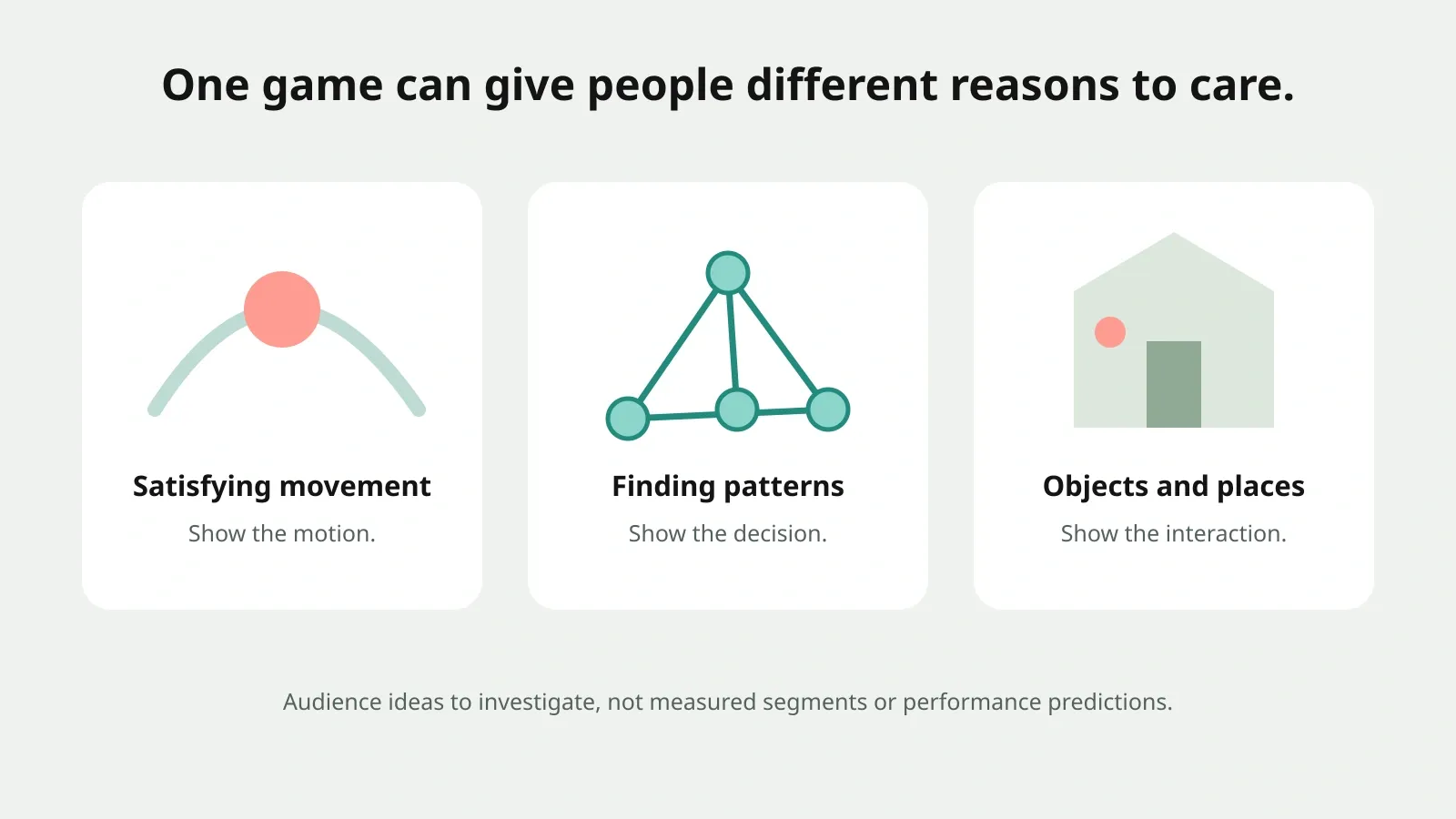
Choose an appeal below to assemble a starting brief. The suggestions are editorial examples, not audience research or a prediction of reach. Use the result as a note to refine after looking at actual creators.
Choose one reason to care.
Start with an interest. Find a moment that shows it.
- People to investigate
- Creators who show marble motion, sorting or tactile objects.
- A moment to show
- One input moves several pieces. Keep the actual game visible.
- A useful question
- Do viewers visit the game page after seeing the movement?
Your starting brief
Select and copy this note, then refine it for your game.
The brief needs a moment, a destination and a question you can answer afterward. For example: will a clip showing all the marbles moving together bring interested people to the game’s page? That is narrower and more useful than asking whether the studio can become popular.
Give a creator something specific to consider
I would send a short personal note that mentions a relevant video of theirs, describes one game, and explains why I thought it might fit. The press kit should make the artwork, gameplay and current availability easy to check. An independent review should leave room for the creator’s actual opinion.
For paid work, ask what the quote includes. A finished video file and a post to an audience are different deliverables. Revisions, reuse on your own channels and permission to run an advertisement with the video are separate questions too. Settle the scope before paying for production.
For a community, read its rules and take part in a way that fits the place. Reddit’s spam guidance specifically asks businesses to consider posting frequency and each community’s additional rules. Reddit’s spam guidance
Check the next step on the actual phone
Open the post placement, follow the link, and check the destination as a new visitor would. Does the page show the same activity? Is it clear whether the game is available to everyone or needs early-access steps? Can the visitor find its name and the right download button?
The link placement itself matters. YouTube says URLs in Shorts comments and descriptions are not clickable, while channel profile links are. A pasted address under a Short therefore needs a different route from a normal clickable link. YouTube’s link guide
Use a consistent campaign label where the destination supports it. Keep a note of the post, date, audience, destination and what you changed. If you compare two clips, keep enough of the rest similar that the difference is worth investigating.
Count the people who take the next step
Keep the stages separate: video views, page visits, store-button clicks, completed acquisitions and people who return to play. Each answers a different question.
Google Play’s current documentation distinguishes store-listing button clicks from completed acquisitions. The latter remain available in the growth overview, statistics and downloadable reports. Google Play’s measurement definitions
Small results can still be useful if their limits are clear. Someone may see a video and search for the game later, leaving no neat campaign label. Organic posts also reach different groups at different times. Treat one successful post as something to repeat and investigate, rather than proof that its opening caused every install.
There is more on interpreting those gaps in measuring interest beyond views.
Begin with one game and one reason to care
Pick one game. Choose two plausible audience angles and make a small set of clips around them. Give each angle a relevant destination and the same useful next action.
Then read the results alongside the content. A video people enjoy watching may still need a clearer connection to playing. A modest post that brings people who return may be worth making again.
That is the first audience I want to find: people who recognise something they enjoy, try the game, and choose to come back.
If rolling every marble together sounds like your kind of decision, start with Plumb.