How to plan your first useful game playtest
Plan a focused game playtest, write neutral tasks and turn observations into decisions. Includes a sample session plan and a guide to interpreting feedback.
 , 4 min read
Your first playtest can start with one playable section and one question. For example: can someone who has never seen the game find the goal and recover after a mistake? That is specific enough to observe and useful enough to guide a change.
Riot describes playtesting as trying in-development content and identifying what works, what is confusing and what needs reconsideration. The same broad purpose is useful for a small project, even when you do not have a dedicated research team. Riot’s playtesting introduction
The session plan below is a practical recommendation for an early qualitative test. It is intended to help you understand behaviour, rather than estimate a population-wide success rate.
Choose a question that can change the game
“Is it fun?” is a reasonable thing to care about, but it gives you little guidance about what to watch. Try a narrower question that relates to the current uncertainty:
- Can a new player identify the next action without being told?
- Does the feedback make a failed attempt understandable?
- Can someone find and use restart when they want another try?
- Does the intended control work comfortably on the target device?
Pick one as the primary question. You can record other issues, but give the session a clear purpose. If the control is still changing, spending the whole session asking about the final economy is unlikely to settle the immediate decision.
Choose participants who fit the question. For a first-time introduction, use someone unfamiliar with your game. For a specialist strategy mechanic, note how much experience the participant has with similar games. Keep those differences in your notes so you do not treat every reaction as interchangeable.
Write a task without giving the answer
Consider a hypothetical room in which a switch opens an exit. “Tap the blue switch, then walk through the door” explains the solution before the test begins. “Try to leave this room” gives the participant a goal while allowing you to observe how they interpret the scene.
Before play begins, explain that you are evaluating the game and that they can stop. Ask permission before recording their screen or voice. Make sure the version opens reliably and that the intended device and controls are available.
During the attempt, leave room for the participant to act. If you help, record when and what you said. An attempt completed after a hint tells you something different from one completed independently. If they become stuck or uncomfortable, help or end the task rather than treating silence as a rule you must enforce.
Separate observation from interpretation
Here is an illustrative note, not a report from a real session:
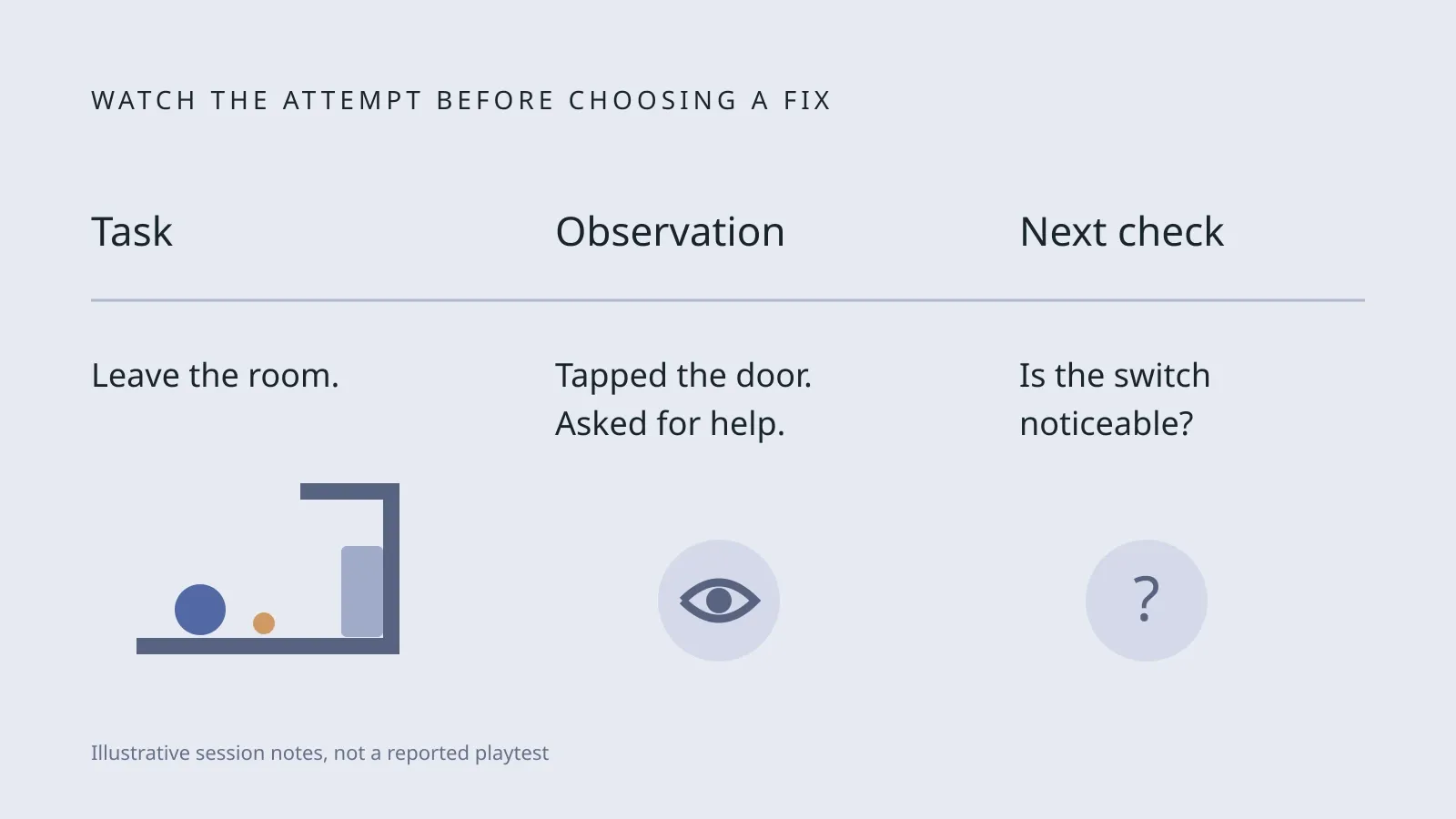
| Kind of note | Example |
|---|---|
| Observation | The player tapped the exit three times, then asked what to do. |
| Player’s explanation | They expected the door to open when touched. |
| Interpretation to investigate | The switch may be less noticeable than the exit. |
| Candidate change | Make the switch’s interactive state clearer, then repeat the task with a new participant. |
This separation helps you keep alternative explanations available. Perhaps the switch was hard to see. Perhaps the player saw it but did not understand the connection. Perhaps the input failed. Watch the attempt and ask a neutral follow-up before deciding which explanation to act on.
Useful follow-ups include “What did you expect to happen there?” and “What were you trying to do?” Avoid asking whether they agree with your preferred fix. After the task, you can ask about their overall experience as well as the specific moments you observed.
What should you do with the feedback?
The player succeeded, but said it was confusing
Review the route they took and ask which moment felt uncertain. Completion and clarity are different observations. Look for guessing, repeated attempts or an explanation that differs from the game’s actual rule.
The player failed, but wants another attempt
Check whether they understand why the attempt failed and what they plan to change. A failed attempt can still support a deliberate decision. Investigate the quality of that understanding before reducing difficulty.
Two players suggested opposite changes
Return to the problem each person experienced. Compare their expectations and familiarity, then test a small change against the original question. You do not have to combine every requested feature.
A short session plan you can reuse
- Write the question and the version being tested.
- Explain the session and obtain any recording permission.
- Give a neutral goal and observe the attempt.
- Ask about specific moments, expectations and the overall experience.
- Separate observed problems from possible fixes.
- Choose one change and check it in a later session.
For a Steam project that needs broader access, Steam Playtest provides a separate app ID and lets developers manage participation without mixing its playtime, reviews and wishlists with the main game. Valve also explains that Steam Playtest is not confidential, so it is a distribution choice to consider carefully for unreleased material. Steam Playtest documentation
A handful of early sessions can give you concrete examples of confusion and recovery. Keep the conclusion proportional to what you observed. Record who played, what they did, where you helped and which question remains open.