 Plumb
Why four directions go so deep: the maths of tilting
Plumb has only four moves, yet its longest levels take over twenty tilts. How moving every marble at once grows a vast tree of sequences that folds into few positions.
 , updated , 3 min read
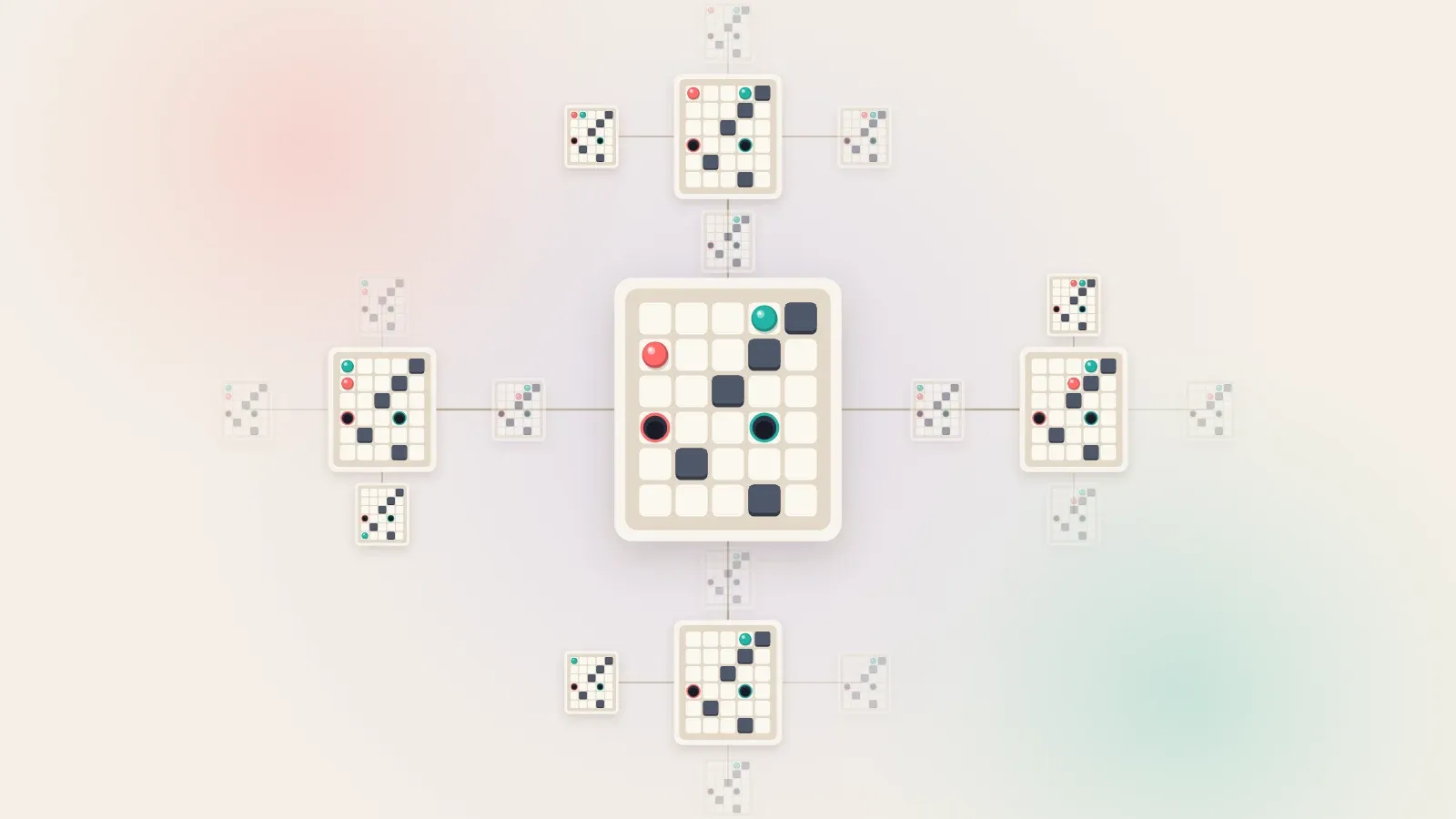
Plumb gives you four moves: up, down, left and right. That sounds like a game that should run out of ideas quickly. It does not, because of the one rule that sets Plumb apart: every marble moves at once.
A tree with four branches
From any board you can tilt four ways, and each of those boards can be tilted four ways again.
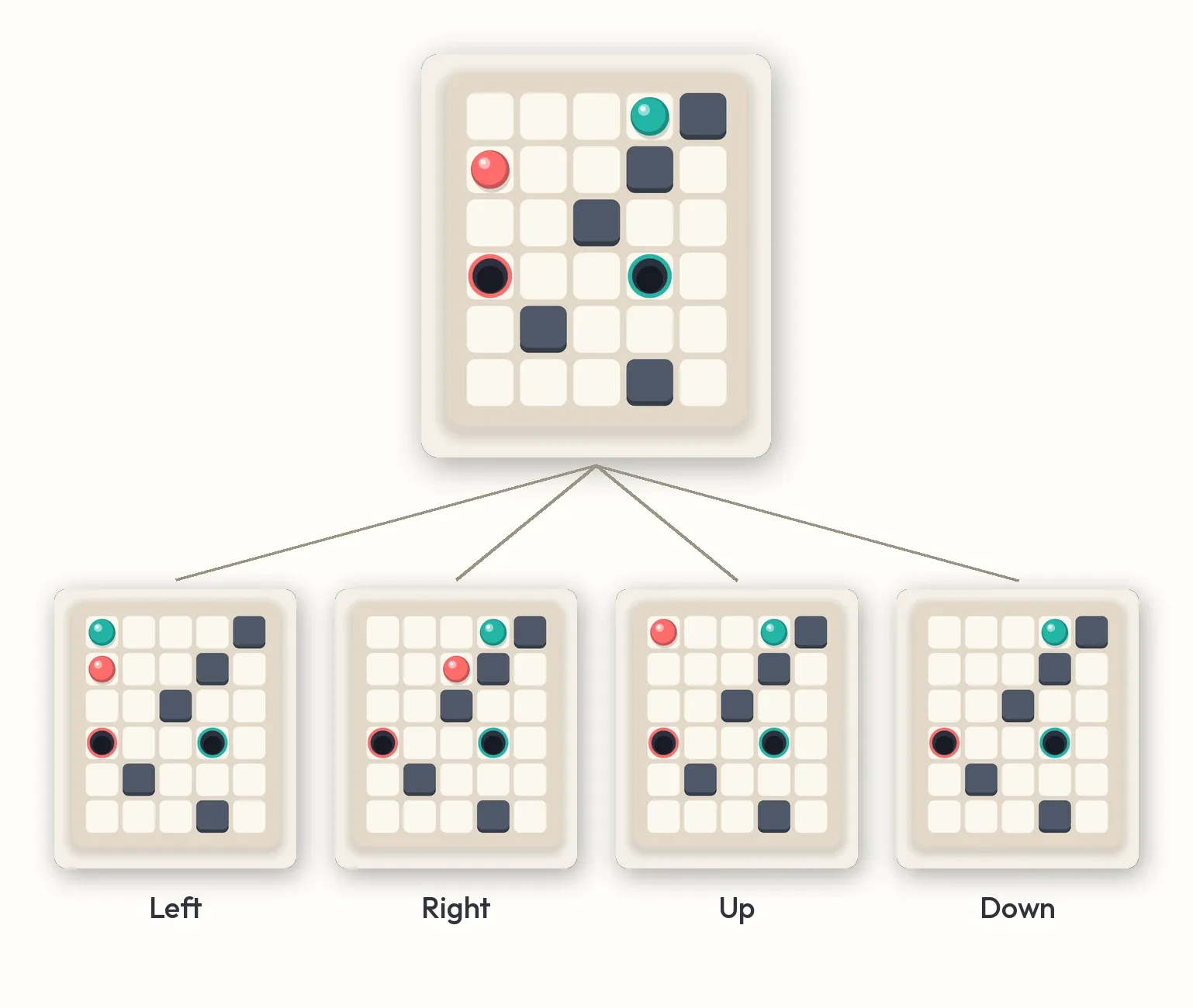
So there are sequences of tilts. Ten tilts already give of them. The longest goals in Plumb today are 21 tilts, and is more than four trillion.
Most of the tree is the same few boards
Luckily, most of those sequences are not different at all. A tilt can move nothing, as a tilt right or down does to the teal marble in the tree above. Two different orders often reach the same board. And a marble that drops home never comes back, so a board can only lose marbles.
There is a deeper reason too: on a plain board, after any tilt, every marble rests against something in the direction of that tilt, a wall, the edge or another marble. That leaves very few places a marble can be. Level 20, the board in the tree, has only 15 positions in its whole world, counting the start and the empty board at the end. Level 80 can reach 1,058 positions in all, against sequences of the eight tilts its goal needs.
Searching positions, not sequences
So Plumb’s solver thinks in positions, which only have to record where the marbles are, since walls, holes and pits never move. It explores breadth first: every position one tilt from the start, then every position two tilts away, never visiting one twice. The first time it meets a cleared board, it has found a shortest route, and that length is the level’s goal. The same search, run from wherever you are, is what the hint shows you.
Why moving everything makes it hard
If a swipe moved one marble, you could solve a board one marble at a time. Because a swipe moves all of them, moves interfere: parking one marble drags the others along, and the best routes make every tilt useful to several marbles at once. That interference grows with the marbles, from one on level 1 to five by level 71. After that the count stays between four and six, and later chapters add depth with tiles instead.
Measuring how hard a board is
The goal alone is a poor measure of difficulty, since a long route can be obvious and a short one can hide behind tempting wrong moves. So Plumb also measures every level in bits of luck. Picture a player who tilts at random among the tilts that move something. If is the chance that they clear the board in exactly the goal, the level is worth
bits, so every extra bit halves the random player’s chance.
On level 4, three tilts move something at the start, and only one, left, begins the route that meets the goal of two. After it, three tilts move something again, and only one, up, finishes the level.
By level 80 the measure is about 13.1 bits, a chance of about one in 8,700. It also sees what the goal cannot. Levels 35 and 54 both have a goal of six, but 35 is worth about 8.2 bits and 54 about 9.9, so a random player is more than three times less likely to meet the goal on 54, whose fourth marble leaves fewer routes that suit every marble at once.
The chance is computed exactly, carried through the solver’s own search layer by layer, because simulating random players would already take thousands of games per success at level 80. The game’s order uses it alongside the goal, as every tile earns its place explains. For a different kind of puzzle maths, Carillon’s chains are in chain reactions and graphs.