 Plumb
Where Plumb's goal comes from, and how to reach it
Plumb's goal is the fewest tilts a solver could find, not a guess. How it is worked out, how stars are counted against it, and a way to reach it more often.
 , updated , 4 min read
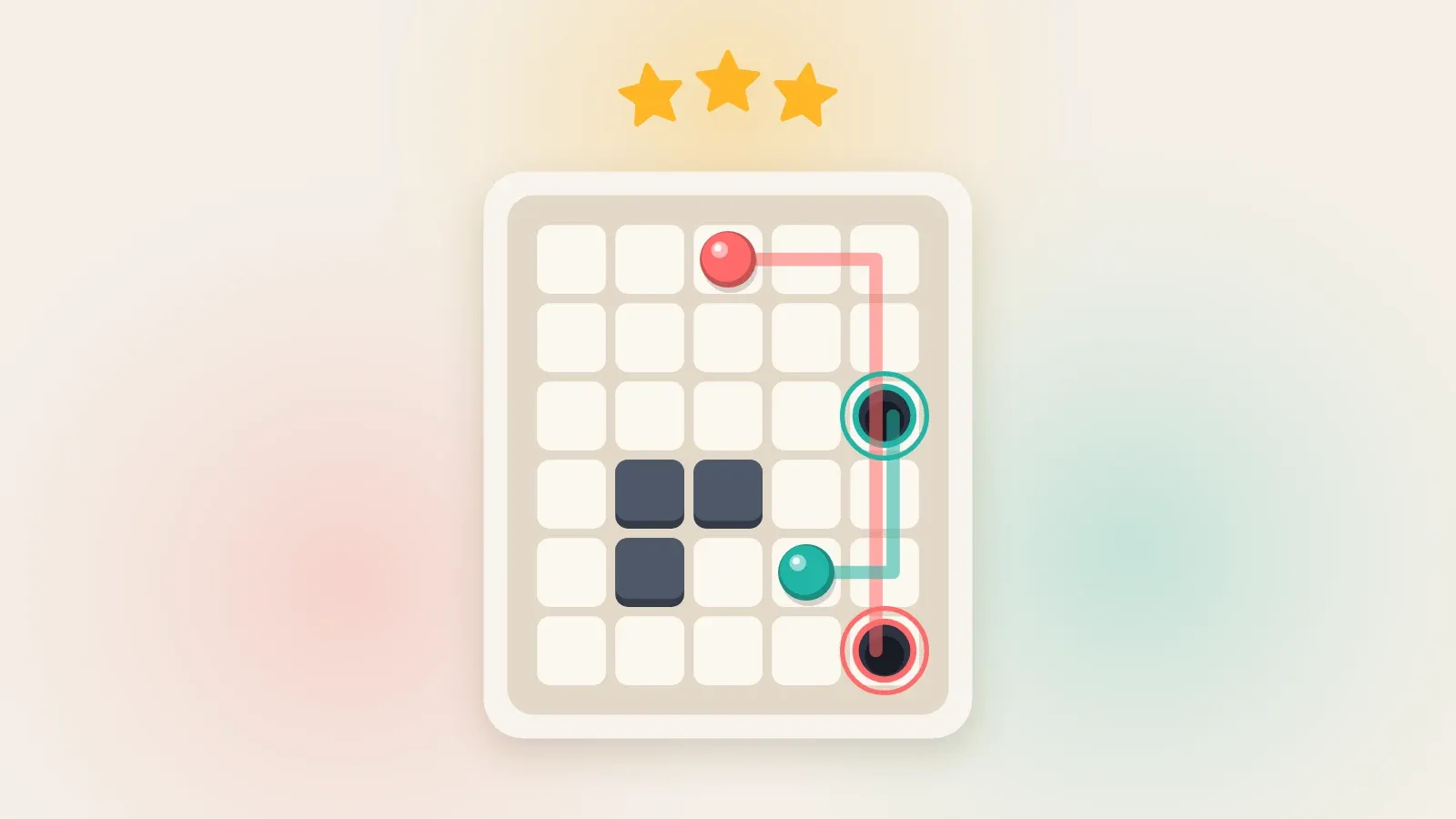
Every level in Plumb has a goal: the fewest tilts that clear the board. Meet it and you earn three stars. This post is about where that number comes from, why the play screen keeps it out of sight, and how to reach it more often.
The goal is a proof, not a guess
Nobody picks the goal by feel. When a level is made, a solver tries every tilt from the start, then every tilt from each board those lead to, one layer at a time, never looking at the same arrangement of marbles twice. The first time it reaches a clear board, it has found a shortest route, and that route’s length is the goal.
So the goal can always be met, because the solver met it, and it can never be beaten, because every shorter sequence was tried first. Every level is solved again whenever the game changes, so a rule change can never quietly break one, and why four directions go so deep has the maths of the search.
Where you see it
The play screen does not show the goal as a number. Next to your move count it shows three small stars, the most this attempt can still earn, and the moment the goal can no longer be met, the third star shrinks back into its outline. I wanted missing the best route to be something you notice from the corner of your eye, not a sum you keep doing in your head.
The number appears once the board is clear. The win sheet says something like “3 moves, goal 3”, and if you went over, it adds a line such as “Solve it in 3 moves for three stars”.
How stars are counted
Call the goal . Two stars allow a leeway on top of it that grows with the goal:
| Your moves | Stars |
|---|---|
| The goal | 3 |
| Up to the goal plus the leeway | 2 |
| More than that | 1 |
So a goal of 3 gives two stars for up to 5 moves, a goal of 8 up to 12, and a goal of 21 up to 32. Two extra moves on a short board make a different solve altogether, while a few extra on a long board can still be a good one.
Every solve earns at least one star, and one star opens the next level. A chapter’s first level also opens once you have solved 14 of the previous chapter’s 20, so one stubborn board never walls off the rest of the game. Your best result on each level is kept, so coming back can only add stars.
The goal only climbs
The goal starts at a single tilt on level 1, and on the longest levels today it is 21. In between it never drops from one level to the next, chapter starts included. How the generator keeps that promise is in every tile earns its place.
One level at its goal
Level 10 has a goal of three, and exactly one route meets it.
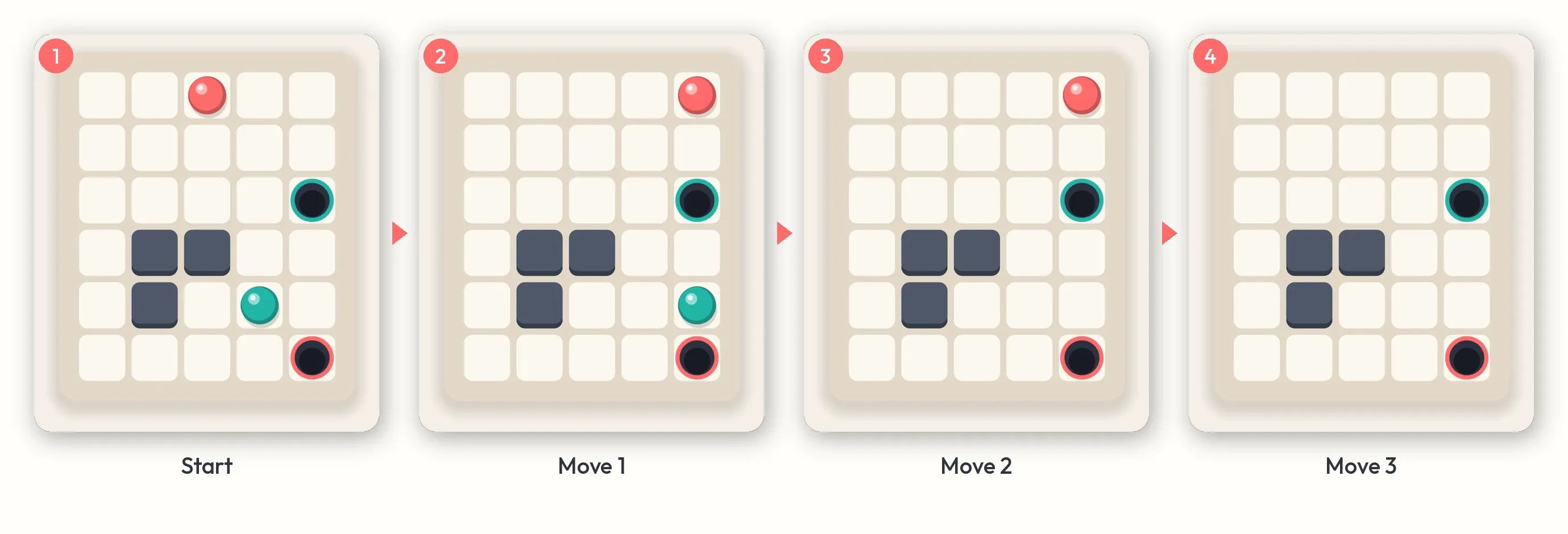
The red marble starts on the top row and the teal one near the bottom, and both holes are on the right edge, the teal hole above the red. Swipe right and both marbles roll to the right edge, which parks each of them in line with its hole. Swipe up and the teal marble rolls into its hole, while the red one, already at the top, stays put. Swipe down and the red marble rolls the full height of the edge, straight over the teal hole, which is just floor to it, and into its own.
The first swipe dropped nothing, and it is still the most important of the three. That shape turns up all through the game: a tilt or two that park marbles on the right lines, then tilts that drop them.
Reaching the goal more often
- Start from the holes. For each hole, ask which wall, edge or marble could stop a marble on a line into it. That is where the marble has to come from.
- Look for tilts that do two jobs, the way level 10’s first swipe parks both marbles at once.
- Replay a level you went over on. Watch on the win sheet replays your solve at speed, which makes the wasted tilt easy to spot, and Again starts over. When you do better, the win sheet says so, with a line like “Up from 1 star.”
- Keep the hint for last. Following it from the very start always meets the goal, so it hands you three stars but takes the puzzle away. Ghost marbles explains how to use it without spoiling a level.