 Plumb
Read the roll before you tilt: habits for new Plumb players
Ways of looking at a Plumb board that make levels click: find the stops, judge a tilt by every marble, distrust the easy drop, and ask what each tile is for.
 , updated , 4 min read

Plumb rewards one habit above all the others: knowing where every marble will stop before you swipe. Players who are good at it have simply stopped being surprised by the board. Everything below is a different angle on that one habit, with real levels to try it on.
Look for stops, not paths
A marble can only end a tilt where something stops it. So after one swipe, each marble can be in at most four places, one for each direction, and on an early board you can find them all in a few seconds.
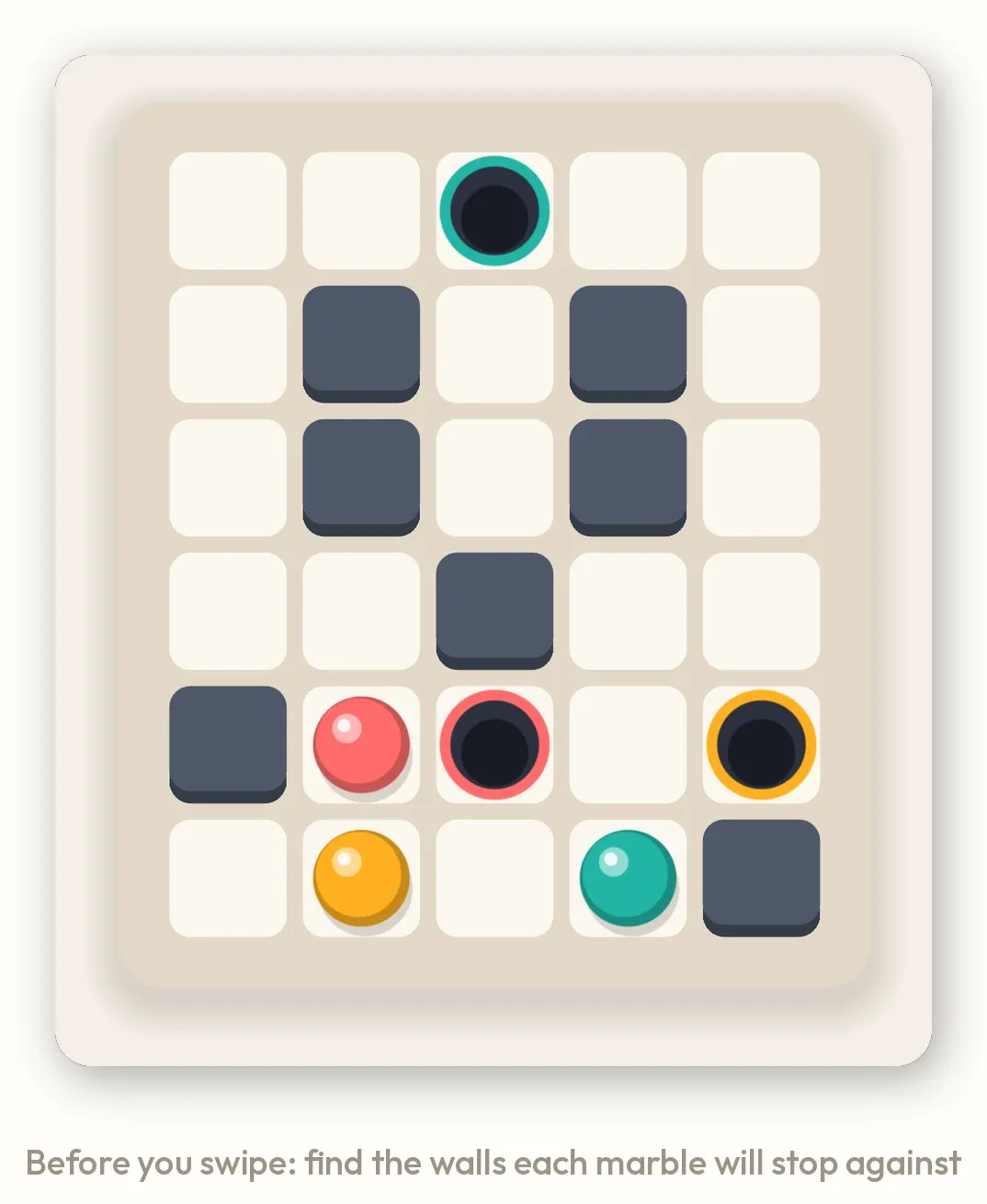
Practise it for a few levels: before each swipe, point at the cell where each marble will come to rest, then swipe and check. When your finger and the board agree every time, the levels start to feel like reading instead of guessing.
Judge a tilt by every marble
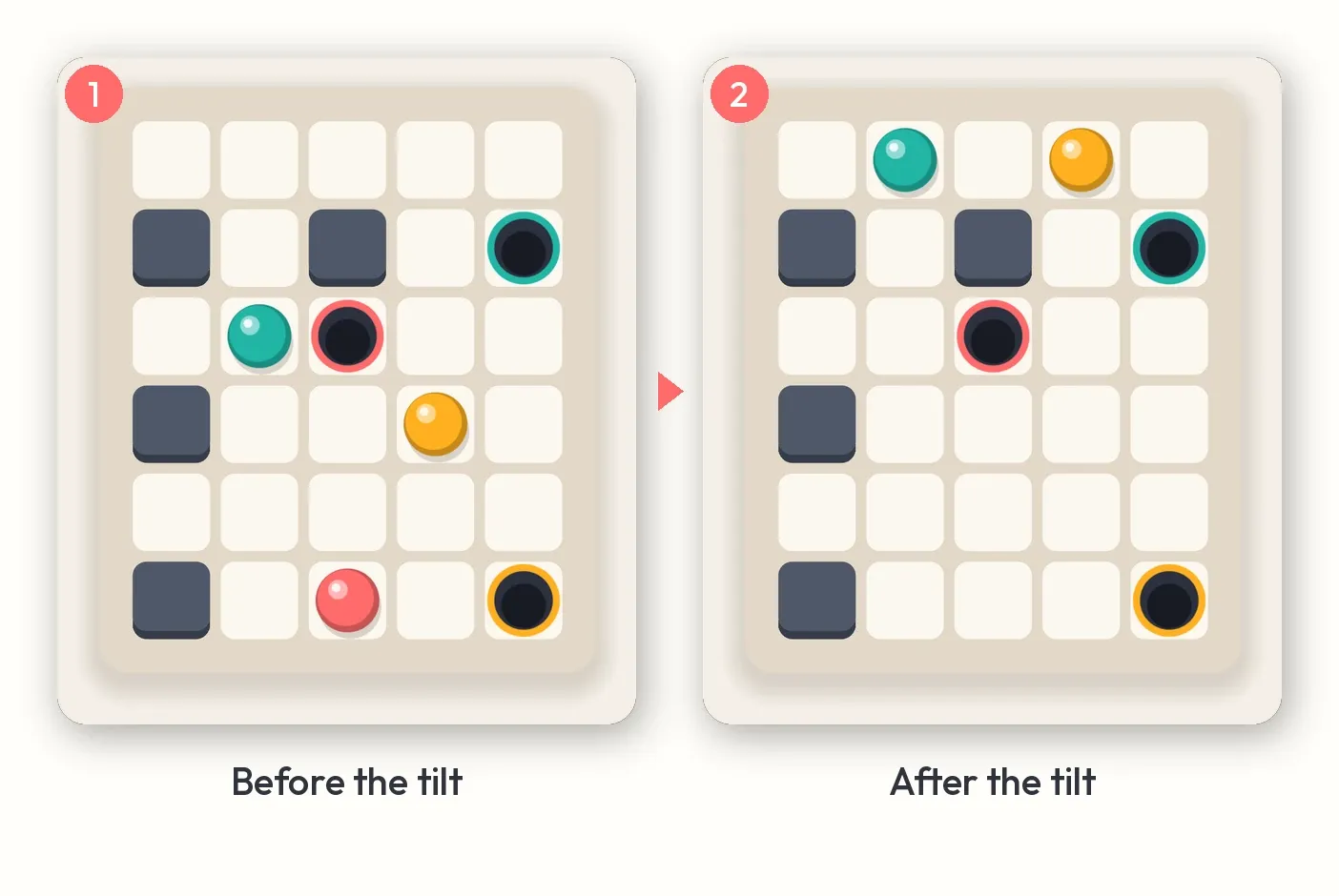
On level 22, a swipe up drops the red marble home and sends the teal and yellow ones to the top edge, away from both their holes. It looks like a bad trade, and it is the first tilt of the only route that meets the goal of four. Down drops the teal and yellow marbles to the bottom row, right rolls the yellow one home and leaves the teal one right under its hole, and up drops the teal one in.
Distance from a hole means very little in Plumb. What matters is whether a marble sits on a line that will lead it home a few tilts from now.
Distrust the easy drop
The swipe that sends a marble home right now is the one to check twice. On level 20, swiping down drops the red marble straight in, but it leaves the teal marble on the top row with walls below it and to its right, and the level then takes six swipes against a goal of four.
The route that meets the goal looks almost backwards. Up moves the red marble one cell into the top left corner. Left sends the teal marble along the top row until it hits the red one, which leaves it above a clear run down. Down drops the red marble home and rolls the teal one down to the row of its own hole, and right rolls it in.
That second swipe is one of the most useful tricks in the game. A marble stops the marble behind it, so you can park one to act as a wall for another, exactly where the board has none. It cuts both ways, since a marble can also block a route you were counting on, so when two marbles share a line, check which one is in front before you tilt along it.
Back and forth is not undo
Swiping left and then right only restores a board if every marble had a clear run both ways, and on a busy board some marble almost always stops somewhere new. If you want the board from one move ago, tap Undo, which puts back exactly that board and the move with it.
When a tile appears, ask what it is for
From chapter 5 on, the generator keeps a level only if its chapter’s tile matters, and it removes any single pad, gate, spring or other tile that the goal does not depend on. So if your plan never touches a tile, it is probably not the shortest plan. Ask what the tile is for: a stop pad gives a marble a place to stop in open floor, and a one-way gate may be there to block a shortcut as much as to open a way. Every tile earns its place explains how the generator checks this.
When you are stuck
Testing a swipe and taking it back costs nothing, and pits, undo and restart has a few ways to explore a board like that. If you are still stuck after that, the bulb draws the best next tilt on the board, and ghost marbles explains how to learn from it rather than just follow it.