Calm by design: why our games never rush you
No timers, no lives, no energy and no ad in the middle of a puzzle. How Plumb, Carillon and Apsis leave you room to think, and where the ads do go.
 , updated , 8 min read
Most free puzzle games on a phone are counting something. A clock runs down, lives run out, or an energy bar asks you to wait or pay. I make the other kind. Plumb, Carillon and Apsis are three different puzzles, and they share one rule: the game waits for you.
This post is about what that rule looks like in each game, how the hints work, and exactly where the ads go. A free game has to pay for itself somehow, and you should know how.
What none of them has
- No timer: nothing moves until you move it, and there is no countdown, par time or bonus for speed.
- No lives or energy: you can play as many levels in a row as you like, because nothing runs out.
- No cost for failing: a level you fail starts again at once, for free, as often as you like.
- No account of ours: your progress is kept on your phone, with a copy in Google Play Games if you use it.
- No connection needed: all three play fully offline.
Stars are the only score, and they measure how well you read a board, never how fast you were. Every level is proven solvable before it ships, so three stars are always within reach.
Room to think, three ways
The same idea runs through all three games: trying something should never cost you the level, and looking should cost nothing at all. Each game gets there in its own way.
Plumb: every tilt can be taken back
In Plumb you tilt the board and every marble rolls at once, until something stops it. Some boards have pits, and a marble that rolls into one is lost. In many games that would cost a life. In Plumb the game stops and offers Undo first, so you take back that one tilt and try another way. Undo works on every move, as many times as you like, and Restart puts the whole board back. Even a swipe made while the marbles are still rolling is kept and played next, so a quick hand never loses a move.
Pits, undo and restart goes into more detail.
Carillon: hold a dot before you tap it
In Carillon you tap a dot, its ring pops every dot it reaches, and each of those pops the dots it reaches in turn. Before you commit, you can hold any dot and see its ring and everything it would set off. Lift your finger on the same dot to tap it, or slide away and nothing happens. You can hold every dot on the field, one after another, and it costs nothing.
Each level also gives you one spare tap on top of the fewest it needs, so there is room for a wrong guess. And a new chain can only start once the last one has finished ringing, so there is never a reason to tap fast.
Apsis: three hearts and no move limit
In Apsis, arrows rest on orbits around a sun, and a tapped arrow flies straight out if nothing is in its way. If something is, it bounces back to where it was and costs a heart. You have three hearts a level, some arrows win a lost heart back as they leave, and there is no move limit to count. Hold an arrow to lift it and see the path it would fly. If your finger caught the wrong arrow on a crowded board, slide onto the right one before you let go, and if you slide off into open space, nothing launches. Out of hearts means Retry, which puts every arrow back, and any stars you already earned on that level stay earned.
Hearts, misses and stars has the whole story.
Hints that teach
All three games have a hint, the bulb in the top corner, and none of them plays the level for you. A hint gives you one move, worked out by the game’s own solver from the board as it is right now, and shows you why it works.
- In Plumb it shows, on the board, where every marble would roll on the best next tilt.
- In Carillon it dims the sky, lights the best next dot and sweeps out its ring, outlining every dot that ring would pop.
- In Apsis it lights an arrow that is free to go and draws its way out, so you can see why it is free, and following it never costs a heart.
Then the move is yours to make.
The first fifteen levels of each game teach it, so their hints are free and unlimited. After that you get three free hints a day, and they come back at midnight. A hint past those asks whether you want to watch a short video for it. If no video can load, for example on a plane, you get the hint anyway.
Where the ads go
The games pay their way with a few ads from Google, and these are the rules it follows, taken straight from the code.
The banner sits at the bottom of the level list, and below the board while you play, once you have solved three levels. It is never over the board. Its space is kept from the first frame, so the board does not jump when the ad loads, and there is a gap above it, so a tap meant for Undo or Restart cannot land on it. It also hides whenever a panel such as Settings is open.
An ad between levels can only come after you tap Next level on a solved board. It never comes before you have solved a dozen levels, or in your first three minutes after opening the app. After that it comes at most once every four levels you solve, and never within four minutes of the last full-screen ad. At a few milestones, that same moment asks for a rating on Google Play instead, with Rate and Not now, and never with an ad as well.
A short video only ever plays when you ask for one. Besides hints, the other place you can ask is when a level runs out. Carillon then offers one more tap, and Apsis one more heart, once per try, and a clear on it earns one star. That extra try costs a short video if you want it, with Retry right beside it. Plumb has no need for one, since Undo is always there.
No ad ever covers the board, interrupts a level, or plays because you failed. Without a connection no ad is requested, and the game plays exactly the same.
The Supporter pack is a one-time purchase in the app that turns the ads off for good and makes every hint free. The app also has a small shop with colour themes, new looks for the pieces, a pack that opens every level, level keys and a tip jar. None of it is needed to play.
Levels open by playing
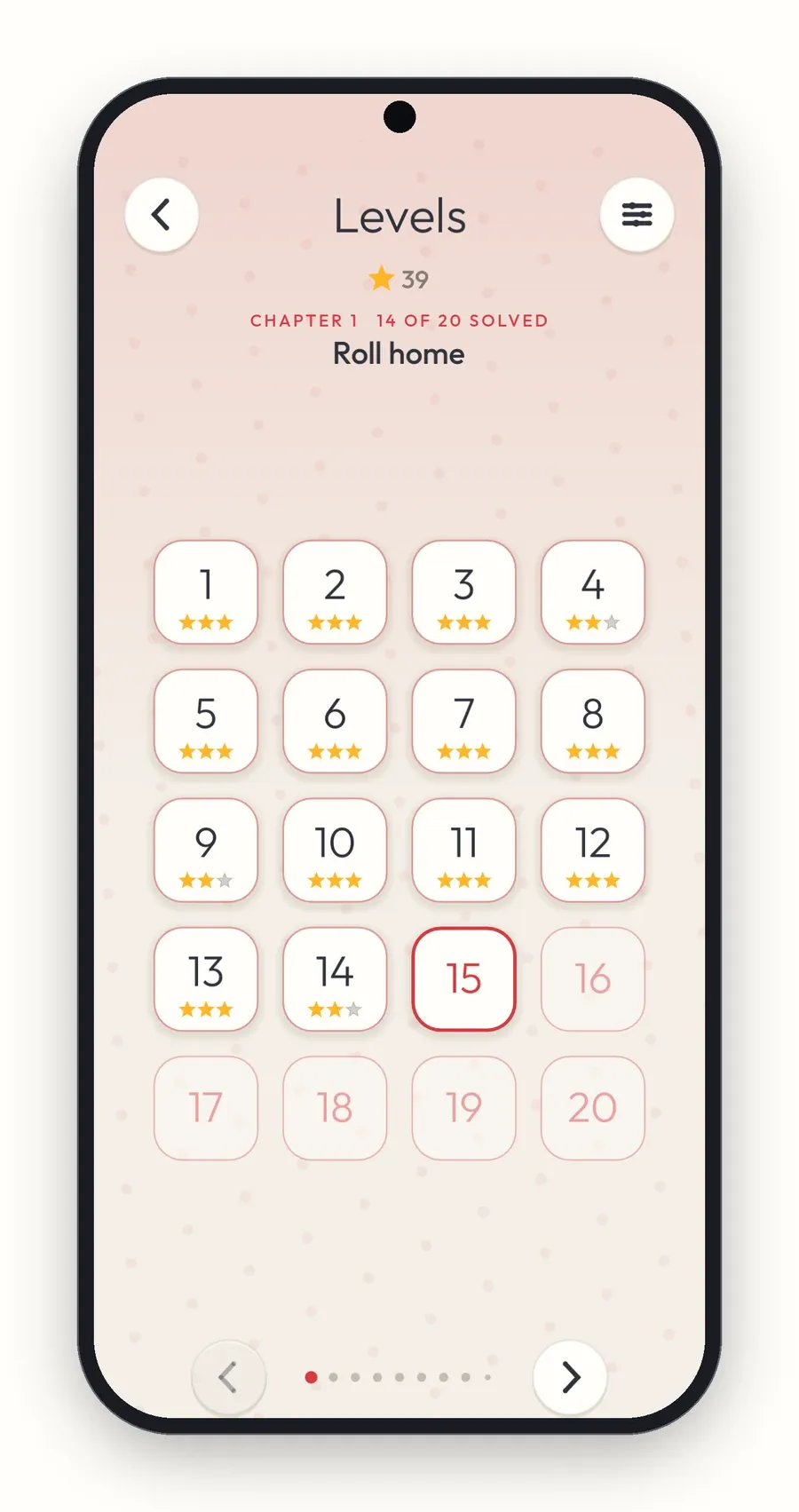
Solve a level and the next one opens. A new chapter opens once you have solved seven in ten levels of the chapter before it, so one stubborn level never walls off the rest of the game. In the Android app you can also open a locked level early with a short video or a key, but every level opens by playing alone.
What leaves your phone
There are no accounts and no crash reporting of their own. Your progress and settings stay on your device, apart from Android’s own backup to your Google account and, if you use Google Play Games, its cloud save of your progress there. The Android apps count how the games are played, with Google Analytics for Firebase: which levels get started and solved, and where people stop. That is how I find the levels that are too hard. They count only where the law needs no consent for it, and never for ads. The ads come from Google AdMob, which does collect some data to show and measure them. Each game’s privacy policy says exactly what: Plumb, Carillon and Apsis. Where the law asks for a choice about ads, Privacy choices in Settings lets you change yours at any time.
Quiet by default
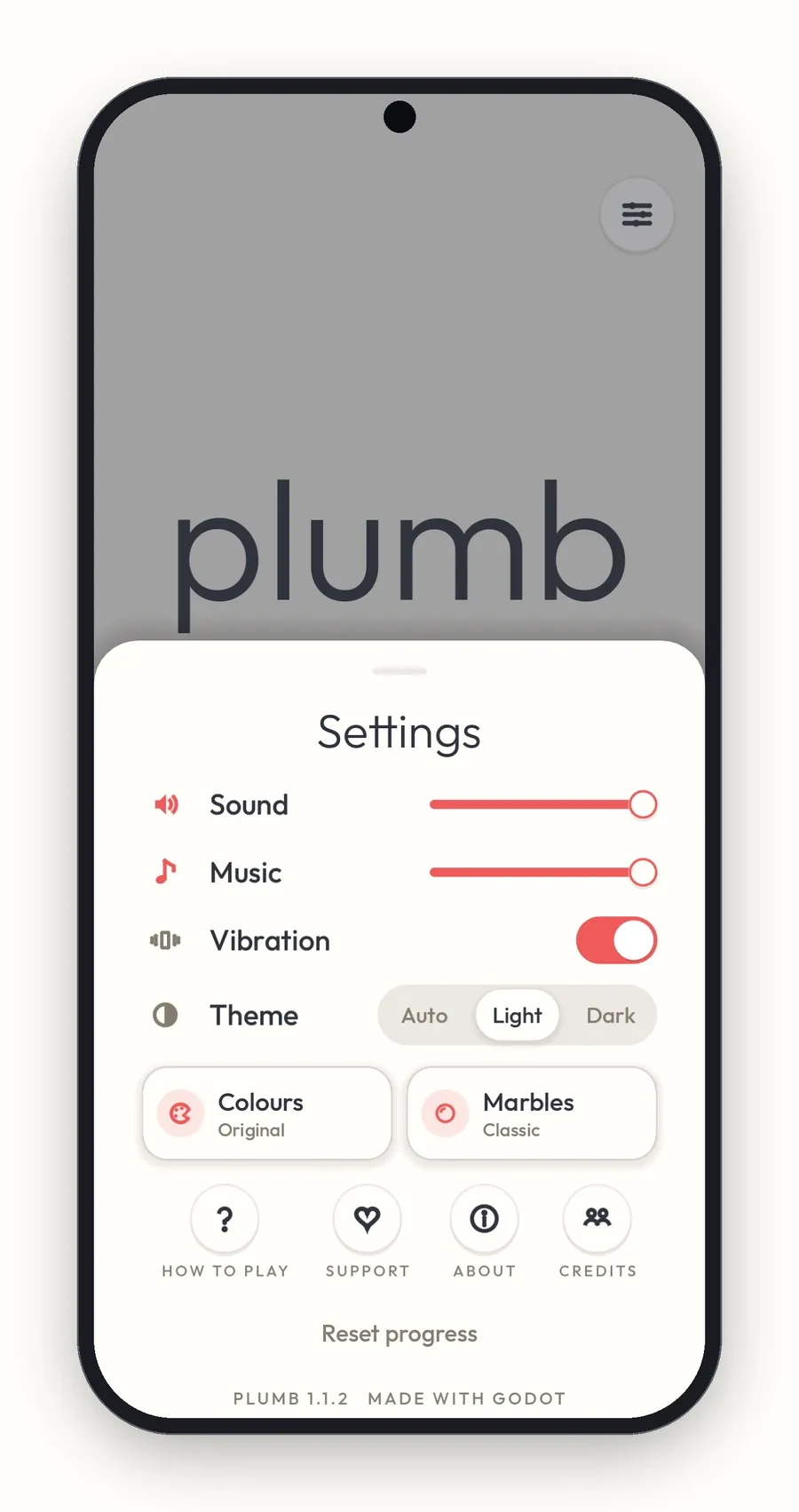
Settings opens from the gear on every screen, even halfway through a level, so you never have to leave a puzzle to turn the sound down. Sound and music each have a slider, and a tap on the icon mutes it. Plumb and Apsis have a soft ambient music loop, and Carillon has none, because its pops are the music. Vibration has its own switch, and the theme can be light, dark, or whatever your phone uses. Reset progress asks you to tap a second time before it erases a single star.
All three games tune their sounds to the same five notes, the C major pentatonic scale, in which any two notes sound good together. Plumb rings a bell when a marble sinks into its hole, each colour on its own note. Carillon plays a note for every pop, so every chain is a little tune. Apsis rings a chime as each arrow leaves, from the lowest note for the first to the highest for the last, whatever order you find. So nothing you do can sound wrong.
Why it matters
A puzzle is a small promise: here is a problem, and all the time you want to think about it. A timer, a lives counter or an ad in the middle of a level breaks that promise, because it makes the game about something other than the puzzle. I would rather make a game you pick up for two minutes and put down feeling a little calmer.
All three are on their pages: Plumb, Carillon and Apsis. If anything in one of them ever feels like it is rushing you, tell me on the support page. I treat that as a bug.